Logo

Log In Sign Up |  An official publication of: American College of Emergency Physicians
Navigation
  • Home
  • Multimedia
    • Podcasts
    • Videos
  • Clinical
    • Airway Managment
    • Case Reports
    • Critical Care
    • Guidelines
    • Imaging & Ultrasound
    • Pain & Palliative Care
    • Pediatrics
    • Resuscitation
    • Trauma & Injury
  • Resource Centers
    • mTBI Resource Center
  • Career
    • Practice Management
      • Benchmarking
      • Reimbursement & Coding
      • Care Team
      • Legal
      • Operations
      • Quality & Safety
    • Awards
    • Certification
    • Compensation
    • Early Career
    • Education
    • Leadership
    • Profiles
    • Retirement
    • Work-Life Balance
  • Columns
    • ACEP4U
    • Airway
    • Benchmarking
    • Brief19
    • By the Numbers
    • Coding Wizard
    • EM Cases
    • End of the Rainbow
    • Equity Equation
    • FACEPs in the Crowd
    • Forensic Facts
    • From the College
    • Images in EM
    • Kids Korner
    • Medicolegal Mind
    • Opinion
      • Break Room
      • New Spin
      • Pro-Con
    • Pearls From EM Literature
    • Policy Rx
    • Practice Changers
    • Problem Solvers
    • Residency Spotlight
    • Resident Voice
    • Skeptics’ Guide to Emergency Medicine
    • Sound Advice
    • Special OPs
    • Toxicology Q&A
    • WorldTravelERs
  • Resources
    • ACEP.org
    • ACEP Knowledge Quiz
    • Issue Archives
    • CME Now
    • Annual Scientific Assembly
      • ACEP14
      • ACEP15
      • ACEP16
      • ACEP17
      • ACEP18
      • ACEP19
    • Annals of Emergency Medicine
    • JACEP Open
    • Emergency Medicine Foundation
  • About
    • Our Mission
    • Medical Editor in Chief
    • Editorial Advisory Board
    • Awards
    • Authors
    • Article Submission
    • Contact Us
    • Advertise
    • Subscribe
    • Privacy Policy
    • Copyright Information

Rhode Island Hospital ED Boosts Efficiency by Adopting Brown University Patient Flow Model

By Shari Welch, MD, FACEP | on June 15, 2016 | 0 Comment
Special OPs
  • Tweet
  • Click to email a link to a friend (Opens in new window) Email
Print-Friendly Version

They then developed a patient-flow model that played to their strengths and their unique demographics. Rhode Island has unusually high emergency medical services utilization relative to the rest of the country. Forty percent of patients arrive at the AEC by ambulance. Imagine 120 ambulances arriving in your department each day! While the national norm is to bed ambulance patients upon arrival, this department did not have the capacity to immediately bed everyone who arrived by ambulance. Many ambulance patients, in fact, did not need a bed, and the leadership opted to save those beds for the sickest arriving patients. The AEC also has two other unique assets: strong nursing and a robust APP presence with a homegrown emergency medicine APP development program. The APPs have an average of nine years of experience and can function autonomously and efficiently.

You Might Also Like
  • Virginia Commonwealth University Improves Patient Flow Through “Vision in Action” Model
  • Intermountain Medical Center in Utah Improves Efficiency, Performance with Vertical Flow Model
  • Patient Flow Improvements to Boost Efficiency in Small Emergency Departments
Explore This Issue
ACEP Now: Vol 35 – No 06 – June 2016
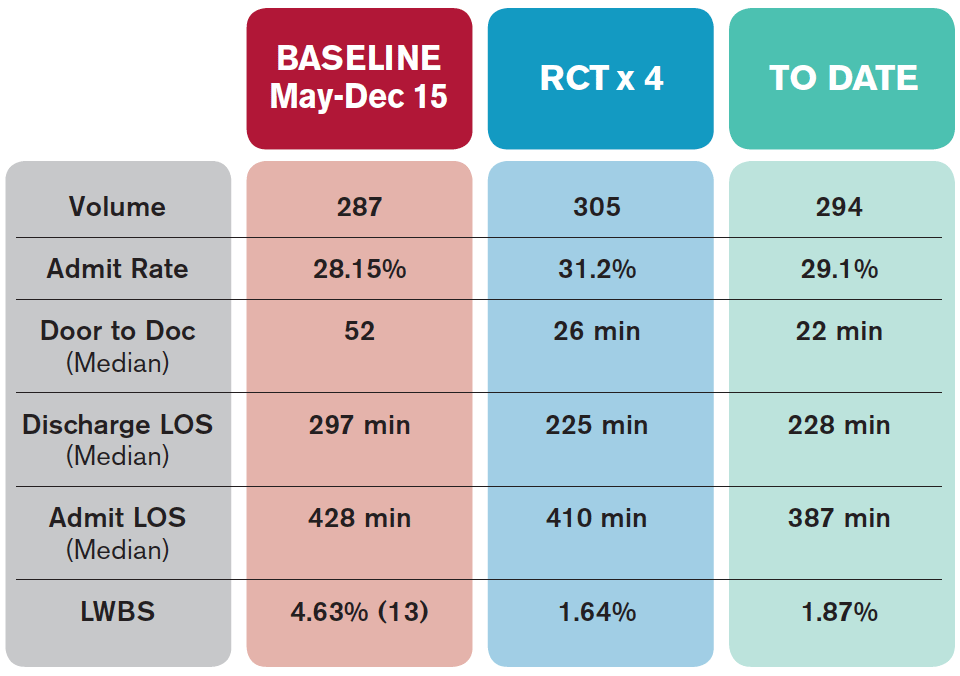
Table 1. Results of the AEC’s patient-flow improvement efforts

(click for larger image) Table 1. Results of the AEC’s patient-flow improvement efforts

The hospital is confident that its nurses know sick when they see it, and so all patients, whether they arrive ambulatory or by ambulance, receive a very rapid nurse assessment taking fewer than three minutes. During this assessment, a chief complaint is obtained, and an Emergency Severity Index (ESI) score is assigned. Vital signs, allergies, and a pain score are recorded. All ESI 1 and 2 patients go to the prime care area, which consists of mirror pods with 16 beds each and a 16-bed critical care area for highly unstable patients, and they are immediately seen by a physician. All patients of low acuity with an ESI of 4 or 5 are sent to a fast-track area, named prompt care, and are seen expeditiously by an APP (see Figure 2).

Half of the nearly 300 patients arriving at the AEC each day have an ESI 3 designation (intermediate acuity). Across the country, we have begun realizing that this is a tricky patient mix and will include some very ill patients with occult medical problems. These ESI 3 patients are typically seen by a physician in triage in fewer than 20 minutes. This physician quickly begins the patient work-up and assigns the patient to an appropriate area within the department. If the physician determines the patient is sicker and needs an acute care bed, the patient can be sent to the prime care area, but most patients are sent for treatment in the lower-acuity focused care area and are treated in lounge chairs. The staff rapidly caught on to this new vertical flow model, which is being adopted and adapted to high-volume departments across the country.

Pages: 1 2 3 | Single Page

Topics: Brown UniversityEmergency DepartmentEmergency MedicineOperationsPatient FlowPractice ManagementQuality & SafetyRhode Island Hospital

Related

  • Florida Emergency Department Adds Medication-Dispensing Kiosk

    November 7, 2025 - 1 Comment
  • Q&A with ACEP President L. Anthony Cirillo

    November 5, 2025 - 0 Comment
  • How Does Emergency Medicine Navigate Consolidation Trends in Health Care?

    October 29, 2025 - 0 Comment

Current Issue

ACEP Now: November 2025

Download PDF

Read More

About the Author

Shari Welch, MD, FACEP

Shari Welch, MD, FACEP, is a practicing emergency physician with Utah Emergency Physicians and a research fellow at the Intermountain Institute for Health Care Delivery Research. She has written numerous articles and three books on ED quality, safety, and efficiency. She is a consultant with Quality Matters Consulting, and her expertise is in ED operations.

View this author's posts »

No Responses to “Rhode Island Hospital ED Boosts Efficiency by Adopting Brown University Patient Flow Model”

Leave a Reply Cancel Reply

Your email address will not be published. Required fields are marked *


*
*


Wiley
  • Home
  • About Us
  • Contact Us
  • Privacy
  • Terms of Use
  • Advertise
  • Cookie Preferences
Copyright © 2025 by John Wiley & Sons, Inc. All rights reserved, including rights for text and data mining and training of artificial technologies or similar technologies. ISSN 2333-2603
