Logo

Log In Sign Up |  An official publication of: American College of Emergency Physicians
Navigation
  • Home
  • Multimedia
    • Podcasts
    • Videos
  • Clinical
    • Airway Managment
    • Case Reports
    • Critical Care
    • Guidelines
    • Imaging & Ultrasound
    • Pain & Palliative Care
    • Pediatrics
    • Resuscitation
    • Trauma & Injury
  • Resource Centers
    • mTBI Resource Center
  • Career
    • Practice Management
      • Benchmarking
      • Reimbursement & Coding
      • Care Team
      • Legal
      • Operations
      • Quality & Safety
    • Awards
    • Certification
    • Compensation
    • Early Career
    • Education
    • Leadership
    • Profiles
    • Retirement
    • Work-Life Balance
  • Columns
    • ACEP4U
    • Airway
    • Benchmarking
    • Brief19
    • By the Numbers
    • Coding Wizard
    • EM Cases
    • End of the Rainbow
    • Equity Equation
    • FACEPs in the Crowd
    • Forensic Facts
    • From the College
    • Images in EM
    • Kids Korner
    • Medicolegal Mind
    • Opinion
      • Break Room
      • New Spin
      • Pro-Con
    • Pearls From EM Literature
    • Policy Rx
    • Practice Changers
    • Problem Solvers
    • Residency Spotlight
    • Resident Voice
    • Skeptics’ Guide to Emergency Medicine
    • Sound Advice
    • Special OPs
    • Toxicology Q&A
    • WorldTravelERs
  • Resources
    • ACEP.org
    • ACEP Knowledge Quiz
    • Issue Archives
    • CME Now
    • Annual Scientific Assembly
      • ACEP14
      • ACEP15
      • ACEP16
      • ACEP17
      • ACEP18
      • ACEP19
    • Annals of Emergency Medicine
    • JACEP Open
    • Emergency Medicine Foundation
  • About
    • Our Mission
    • Medical Editor in Chief
    • Editorial Advisory Board
    • Awards
    • Authors
    • Article Submission
    • Contact Us
    • Advertise
    • Subscribe
    • Privacy Policy
    • Copyright Information

How to Perform Positive Pressure Technique for Nasal Foreign Body Removal

By Justin McNamee, DO and Jordan Jeong, DO | on September 14, 2014 | 0 Comment
Tricks of the Trade
  • Tweet
  • Click to email a link to a friend (Opens in new window) Email
Print-Friendly Version
How to Perform Positive Pressure Technique for Nasal Foreign Body Removal

Equipment Needed (Figure 1)

You Might Also Like
  • Nasal Foreign Body Removal and Other Quick ENT Tricks
  • Noninvasive Positive Pressure Ventilation In the Emergency Department
  • ACEP15: “The Tube Stealer” Advocates in Favor of Non-Invasive Positive Pressure
Explore This Issue
ACEP Now: Vol 33 – No 09 – September 2014
  • Wall suction unit
  • Suction tubing adapter
  • Suction tubing
  • Yeah, that’s it!
  1. Have the patient sit up, lean slightly forward, and tilt the head down.
  2. Ensure wall oxygen is available, and attach one end of the standard suction tubing to the wall oxygen or compressed air. The opposite end of the suction tubing should have the plastic suction tubing adapter piece firmly implanted (see Figure 2).
  3. Place the tubing with the attached adapter into the nostril contralateral to that containing the foreign body (see Figure 3).
  4. Titrate the wall oxygen or medical air to high flow (usually 10–15 L/min) until the foreign body becomes dislodged. Periorbital emphysema or blowing a globe out of its socket reflects a lack of understanding of the term titration.
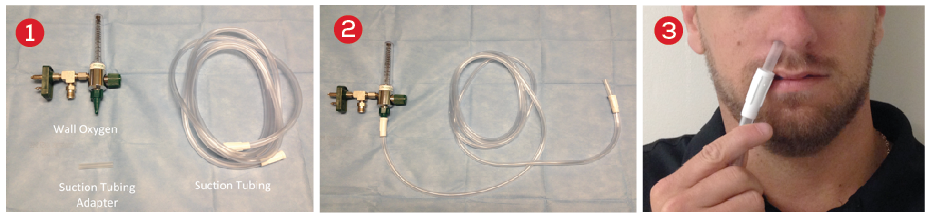
Figure 1. Wall suction unit, a suction tubing adapter, and suction tubing. Figure 2. Assembly for the positive pressure technique.  Figure 3. Place the tubing into the nostril contralateral to the foreign body.

Figure 1. Wall suction unit, a suction tubing adapter, and suction tubing.
Figure 2. Assembly for the positive pressure technique.
Figure 3. Place the tubing into the nostril contralateral to the foreign body.

Patient Selection

This technique may be most applicable for cooperative pediatric patients. However, nasal foreign bodies are not always a problem unique to the pediatric population. Often, adult psychiatric patients will place objects where they do not belong, including the nose.

This technique may be inappropriate for patients who are not amenable to having suction tubing inserted into their nostril. In the case of an uncooperative but otherwise nonviolent pediatric patient, this minimally invasive approach is still of value because it can be performed under procedural sedation or with the use of a papoose.

Caution

Complications from removal of nasal foreign bodies are infrequent, regardless of the approach clinicians choose. Navitsky et al reported no complications with the nasal positive pressure technique using wall oxygen for removal.1 A comprehensive review of nasal foreign body removal by Kiger et al reports no known complications from positive pressure techniques, including the Parent’s Kiss, Big Kiss, nasal positive pressure, or Ambu bag.2,3 As with any foreign body within or near the airway, aspiration is always a risk. In theory, by using positive pressure techniques such as the one described, the risk of aspiration should be lessened. Forcing air from the contralateral side should help expel the foreign body out of the nose as opposed to pushing it posteriorly into the airway. This is one advantage over the traditional methods of extraction such as Foley balloon catheters, Katz extractors, and other forms of mechanical extraction that may result in worsening the situation. Some known complications may include mucosal irritation, swelling, and bleeding.

Pages: 1 2 3 | Single Page

Topics: Airway ManagementCritical CareEmergency MedicinePediatricsProcedures and SkillsTrauma and Injury

Related

  • Why the Nonrebreather Should be Abandoned

    December 3, 2025 - 0 Comment
  • FACEPs in the Crowd: Dr. John Ludlow

    November 5, 2025 - 0 Comment
  • Non-Invasive Positive Pressure Ventilation in the Emergency Department

    October 1, 2025 - 0 Comment

Current Issue

ACEP Now: November 2025

Download PDF

Read More

About the Authors

Justin McNamee, DO

Justin McNamee, DO, is an attending physician at Emergency Medicine Professionals; EMPros, in Ormond Beach, Florida.

View this author's posts »

Jordan Jeong, DO

Jordan Jeong, DO, is an emergency medicine resident at St. Joseph’s Regional Medical Center in Paterson, New Jersey.

View this author's posts »

No Responses to “How to Perform Positive Pressure Technique for Nasal Foreign Body Removal”

Leave a Reply Cancel Reply

Your email address will not be published. Required fields are marked *


*
*


Wiley
  • Home
  • About Us
  • Contact Us
  • Privacy
  • Terms of Use
  • Advertise
  • Cookie Preferences
Copyright © 2025 by John Wiley & Sons, Inc. All rights reserved, including rights for text and data mining and training of artificial technologies or similar technologies. ISSN 2333-2603