
Explore This Issue
ACEP Now: Vol 33 – No 09 – September 2014The Case
A 3-year-old female presents to the emergency department after placing a small bead into her left nostril. The bead became lodged, and the child is unable to move any air out of the left naris. All efforts to remove the foreign body prior to arrival have failed. The child is currently cooperative but apprehensive. Is there a minimally invasive way to safely, quickly, and easily remove or dislodge the foreign body?
Background
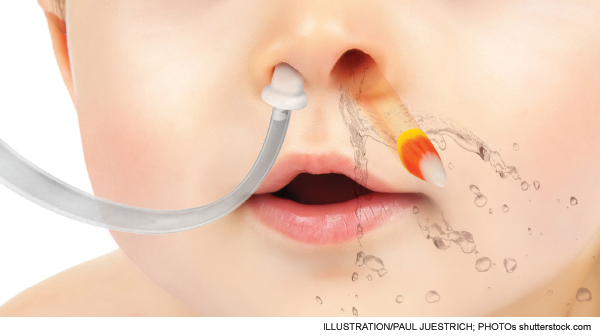
Children often present to the ED with foreign bodies lodged in their nares, with various explanations as to how they got there. On occasion, parents will have given a valiant effort to remove the object prior to arrival in the ED, usually without success. While some of the techniques attempted are more successful than others, there is one such method that may, in fact, straddle the line between anecdotal and evidence based. The Parent’s Kiss is a technique that has been perpetuated by social media and word of mouth as a way for parents to attempt removal before presenting to the ED. With this method, parents or guardians place their mouth over the child’s mouth while at the same time occluding the child’s nonoccluded nostril. They then blow forcefully into the child’s mouth in hopes of dislodging the nasal foreign body.
The question is, does this technique have any merit?
Looking at the evidence, it seems that it might. As it turns out, the use of positive pressure techniques for removal of nasal foreign bodies is not a novel concept. In 2002, Navitsky et al were the first to report the use of high-flow oxygen to remove a nasal foreign body. The technique, referred to as the Beamsley Blaster, is well-described and uses oxygen tubing with a male-male adapter to deliver positive pressure.1 While the technique shown above is similar, it differs slightly in that suction tubing, which usually comes with a prepackaged adapter, is utilized, but the end result is the same.
The Technique
Use wall oxygen or medical air (positive pressure technique) to dislodge a unilateral nasal foreign body with the use of standard suction tubing and a suction adapter.
While there are several ways to attempt removal, using high-flow oxygen or medical air in the contralateral nostril delivered through suction tubing is a safe alternative to more traditional techniques and utilizes equipment easily found in every emergency department. This technique allows for a quick, clean, and painless way to dislodge a nasal foreign body with a high rate of success.
Equipment Needed (Figure 1)
- Wall suction unit
- Suction tubing adapter
- Suction tubing
- Yeah, that’s it!
- Have the patient sit up, lean slightly forward, and tilt the head down.
- Ensure wall oxygen is available, and attach one end of the standard suction tubing to the wall oxygen or compressed air. The opposite end of the suction tubing should have the plastic suction tubing adapter piece firmly implanted (see Figure 2).
- Place the tubing with the attached adapter into the nostril contralateral to that containing the foreign body (see Figure 3).
- Titrate the wall oxygen or medical air to high flow (usually 10–15 L/min) until the foreign body becomes dislodged. Periorbital emphysema or blowing a globe out of its socket reflects a lack of understanding of the term titration.
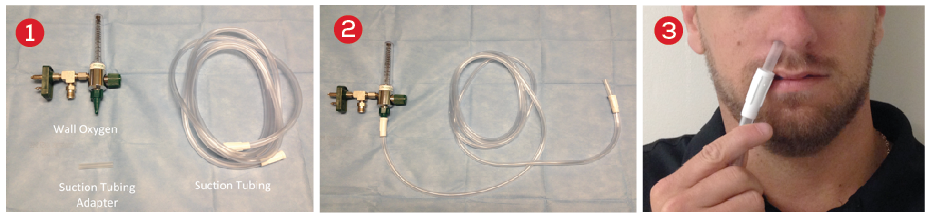
Figure 1. Wall suction unit, a suction tubing adapter, and suction tubing.
Figure 2. Assembly for the positive pressure technique.
Figure 3. Place the tubing into the nostril contralateral to the foreign body.
Patient Selection
This technique may be most applicable for cooperative pediatric patients. However, nasal foreign bodies are not always a problem unique to the pediatric population. Often, adult psychiatric patients will place objects where they do not belong, including the nose.
This technique may be inappropriate for patients who are not amenable to having suction tubing inserted into their nostril. In the case of an uncooperative but otherwise nonviolent pediatric patient, this minimally invasive approach is still of value because it can be performed under procedural sedation or with the use of a papoose.
Caution
Complications from removal of nasal foreign bodies are infrequent, regardless of the approach clinicians choose. Navitsky et al reported no complications with the nasal positive pressure technique using wall oxygen for removal.1 A comprehensive review of nasal foreign body removal by Kiger et al reports no known complications from positive pressure techniques, including the Parent’s Kiss, Big Kiss, nasal positive pressure, or Ambu bag.2,3 As with any foreign body within or near the airway, aspiration is always a risk. In theory, by using positive pressure techniques such as the one described, the risk of aspiration should be lessened. Forcing air from the contralateral side should help expel the foreign body out of the nose as opposed to pushing it posteriorly into the airway. This is one advantage over the traditional methods of extraction such as Foley balloon catheters, Katz extractors, and other forms of mechanical extraction that may result in worsening the situation. Some known complications may include mucosal irritation, swelling, and bleeding.
 Dr. McNamee is chief resident of the emergency medicine residency at St. Joseph’s Regional Medical Center in Paterson, New Jersey.

Dr. Jeong is an emergency medicine resident at St. Joseph’s.
References
- Navitsky R, Beamsley A, McLaughlin S. Nasal positive-pressure technique for nasal foreign body removal in children. Am J Emerg Med. 2002;20:103-4.
- Kiger JR, Brenkert TE, Losek JD. Nasal foreign body removal in children. Pediatr Emerg Care. 2008;24:785-92.
- Alleemudder D, Sonsale A, Ali S. Positive pressure technique for removal of nasal foreign bodies. Int J Pediatr Otorhinolaryngol. 2007;71:1809-11.
Pages: 1 2 3 | Multi-Page





No Responses to “How to Perform Positive Pressure Technique for Nasal Foreign Body Removal”