
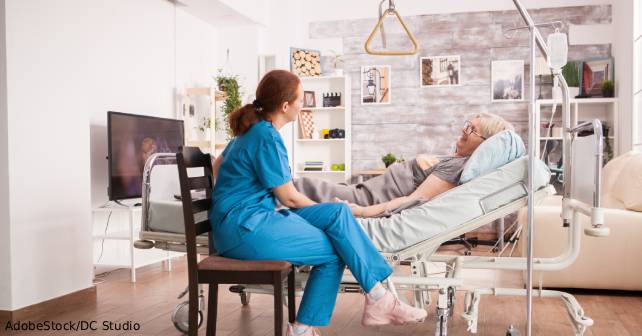
A 68-year-old woman presents to your emergency department (ED) with increasing fatigue, shortness of breath, and swelling in her legs. Your work-up reveals a mild congestive heart failure exacerbation. Although you know what resources the patient needs—a few days of diuresis and monitoring—it is increasingly less clear where this should happen.
Explore This Issue
ACEP Now: August 2025 (Digital)Traditionally, this patient would be an easy admission to medicine or cardiology, or in some places, a short stay in an observation unit. But new options for patients are emerging.
Currently, Congress is considering extending reimbursement mechanisms for a popular response to rising acute care demand—hospital-at-home.1 Hospital-at-home programs seek to replicate inpatient medical admissions in the setting of a patient’s home, offering analogous in-person and virtual services.2
Originally launched decades ago but supercharged by the COVID-19 pandemic, hospital-at-home programs promise higher quality care at lower cost. ED benefits are often cited to justify these programs—including alleviating boarding by expanding hospital capacity.3 However, the ideal role of the ED in these programs has not been established, and the long-term implications for our specialty are unclear.
As hospital-at-home expands, emergency medicine must confront two critical questions: What role should it play, both in terms of shaping and operationalizing hospital-at-home? Can the hospital-at-home model relieve the ED boarding crisis plaguing hospitals nationwide?4 Emergency medicine has always adapted to the realities of the health care system, for better or worse. The emergence of hospital-at-home may require a more profound shift—not just in how we practice, but in how we define the specialty itself.
Emergency Medicine Implications
Successfully scaling hospital-at-home depends on thoughtful integration of the ED into the admission pathway. Although emergency medicine has traditionally focused on triage, diagnosis, stabilization, and short-term decision-making, this landscape is shifting.
Emergency physicians are increasingly expanding their scope beyond the ED, taking on leadership roles in observation units, virtual care settings, and intensive care units. Moreover, as experts in disposition and acute illness management, we are uniquely positioned to identify appropriate candidates for hospital-at-home—patients who would otherwise require hospitalization but are stable enough to recover at home with structured medical support.
Yet, currently, most hospital-at-home programs are led by hospitalists and internal medicine departments, with minimal input from emergency physicians. This risks marginalizing emergency physicians from a pivotal transformation in acute care, to the detriment of hospital-at-home’s long-term success. Integrating emergency physicians will improve the patient selection process and prevent hospital-at-home from becoming an expensive substitute for observation units.
Hospital-at-home may also open new career pathways for emergency physicians. With appropriate training, emergency physicians could play leadership roles in designing and overseeing hospital-at-home programs, as they did in the growth of observation medicine. Emergency medicine is already rapidly evolving to include telehealth monitoring, home triage, and mobile integrated care—roles that may expand in tandem with hospital-at-home. Just as we adapted to the demands of trauma, EMS, and urgent care, we can now help shape and refine the hospital-at-home paradigm.
These opportunities also come with risk. Without ED input, hospital-at-home programs may increase departments’ administrative burden without improving patient outcomes. Worse, they could inadvertently exacerbate inequities. Hospital-at-home eligibility often hinges on subjective criteria, such as the strength of home support, leaving room for implicit clinician bias.5 Emergency medicine must advocate for fair, structured patient selection processes to ensure that inequities are not compounded.
Over-admission presents another challenge. With a seemingly “lower-risk” option available, clinicians may admit patients to hospital-at-home who would otherwise have been discharged home with follow-up. If hospital-at-home becomes a fallback for low-risk discharges rather than a true substitute for hospital-level care, it may forfeit its financial and operational value.
A Boarding Fix?
Perhaps the most tantalizing promise of hospital-at-home is its potential to relieve ED boarding: the dangerous but ubiquitous practice of keeping admitted patients in the ED while awaiting inpatient beds. Policymakers and hospital executives alike point to hospital-at-home as a tool to “open up” beds and improve throughput; indeed, some academic health systems cite this benefit as their primary rationale for investing in hospital-at-home infrastructure.6
In theory, hospital-at-home offers an attractive solution. By admitting stable patients directly from the ED to home care—or transferring ward patients home earlier—it frees physical beds for sicker patients. But the real-world effect is likely to be modest, at least in the short term. Most hospital-at-home programs currently operate at a small scale, admitting only a fraction of patients who would otherwise be hospitalized. Few programs have demonstrated the volume needed to meaningfully affect system-wide occupancy or ED boarding rates.
Furthermore, even if hospital-at-home expands, economic pressures may blunt its benefits. Hospitals abhor “wasted” space; they are incentivized to immediately fill open beds with high-revenue admissions, particularly elective surgical patients. Occupancy may dip temporarily, then rebound once engrained incentive structures take over. This phenomenon has been observed when hospitals physically expand. Moreover, hospitals unable to afford hospital-at-home may be left behind. While well-resourced hospitals gain flexibility and revenue, under-resourced hospitals may face greater strain, further concentrating ED boarding and capacity crises in safety-net institutions.7
A Moment to Lead
Hospital-at-home won’t single-handedly solve ED boarding, but it will inevitably reshape emergency medicine. We are at an inflection point—a chance for emergency physicians to extend our influence beyond hospital walls and into the evolving landscape of acute care. If we approach this moment with cautious optimism and a willingness to lead, emergency medicine can help make high-quality, equitable, and efficient hospital-at-home a reality. If emergency physicians remain passive, we risk being sidelined in the next era of acute care delivery.
With or without us, the home is becoming an extension of the ED. It’s time we identified ourselves as critical stakeholders in this discussion and claimed a seat at the table.
 Dr. Zikry is an emergency physician and health services researcher; he is a scholar in the National Clinical Scholars Program at UCLA. His research interests revolve around incorporating acute, unscheduled care into health systems’ population health strategies, with a particular focus on novel and innovative disposition options such as virtual observation and hospital-at-home. His work has been featured in JAMA, Annals of Emergency Medicine, and Health Affairs.
 Dr. Kilaru is an emergency physician and health services researcher at the University of Pennsylvania. His work focuses on transitions from emergency department care to outpatient services, innovation in delivery and financing of emergency care. His work has been featured in the New England Journal of Medicine, JAMA, JAMA Network Open, Health Affairs, and Annals of Emergency Medicine.
References
- American Hospital Association. Fact Sheet: Extending the Hospital-at-Home Program. https://www.aha.org/fact-sheets/2024-08-06-fact-sheet-extending-hospital-home-program. Published April 2025. Accessed July 15, 2025.
- Levine DM, Ouchi K, Blanchfield B, et al. Hospital-level care at home for acutely ill adults: a randomized controlled trial. Ann Intern Med. 2020;172(2):77-85.
- Edwards E, Thompson A. As ER overcrowding worsens, a program helping to ease the crisis may lose funding. NBC News. https://www.nbcnews.com/health/health-care/er-overcrowding-worsens-program-helping-ease-crisis-may-lose-funding-rcna135966. Published February 7, 2024. Accessed July 15, 2025.
- Kilaru AS, Zikry HE. The role of emergency medicine in hospital-at-home. Ann Emerg Med. 2025:S0196-0644(25)00148-9.
- Clarke DV, Newsam J, Olson DP, et al. Acute hospital care at home: the CMS waiver experience. NEJM Catalyst. https://catalyst.nejm.org/doi/full/10.1056/CAT.21.0338. Published December 7, 2021. Accessed July 15, 2025.
- Advisory Board. How hospitals are tackling ED boarding problems. https://www.advisory.com/daily-briefing/2025/03/31/ed-overflow. Accessed July 15, 2025.
- Zikry HE, Schriger DL, Kilaru AS. Hospital participation in the acute hospital care at home waiver program. JAMA. 2025;333(8):718-720.
Pages: 1 2 3 | Multi-Page


No Responses to “Hospital at Home Is Here: An Opportunity EM Can’t Ignore”