
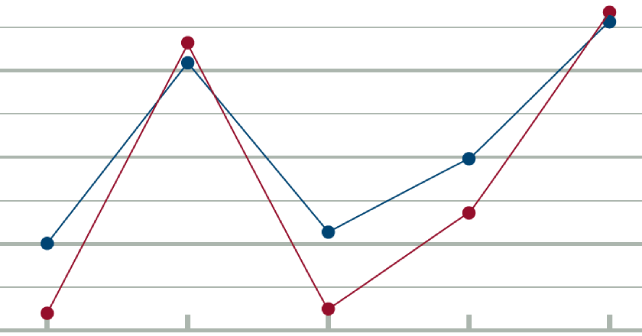
ED surveys done by the EDBA and the CDC report that there were more high acuity visits, senior patients, ambulance arrivals, diagnostic tests, and patients with mental health issues. Injury visits, which continue to decrease, now represent only 26 percent of visits.
Explore This Issue
ACEP Now: Vol 43 – No 12 – December 2024Financial factors are stacked against patients getting service in the ED. Insurance companies have placed more and more financial penalties on patients who come to the ED, and charges by both hospitals and emergency physicians have escalated to produce high bills for these services. Nonetheless, the patients are still coming in higher numbers.
Quit Fighting the Market
A sensible approach would be to quit fighting the market—the many patients, families, and communities that want the ED to serve their acute, unscheduled care needs.
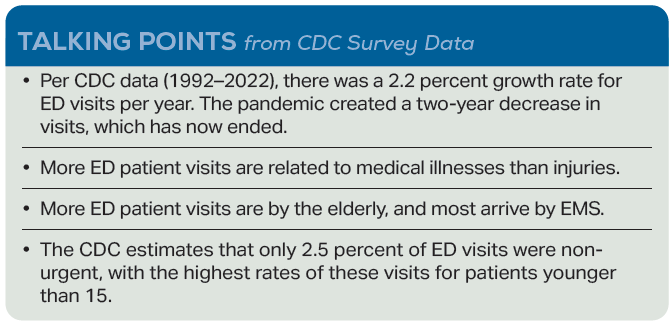
Click to enlarge.
First, let’s work with hospital leaders to improve the efficiency of admitting patients and eliminate the boarding problems for patients admitted to the hospital. Let’s restore timely and patient-friendly patient transfer systems.6 Let’s develop a rational set of charges for care that match acuity and service delivered.
A critical need is for private insurance companies and government payers to follow payment policies that fairly pay emergency physicians. These policies should not be punitive to patients, with “no surprises” to the patient regarding their coverage for emergency services. Finally, service in the ED needs to be high quality and friendly to the 155 million patients and families—and growing—that sought us out in 2022.
 Dr. Augustine is a member of the ACEP Now Editorial Board, clinical professor of emergency medicine at Wright State University in Dayton, Ohio, and vice president of the Emergency Department Benchmarking Alliance.
References
- Centers for Disease Control and Prevention. National Center for Health Statistics. Estimates of Emergency Department Visits in the United States, 2016-2022. Generated August 14, 2024. Accessed November 3, 2024.
- Augustine JJ. Emergency department patient challenges to come. ACEP Now. 2022;41(11):15.
- Coalition to Strengthen America’s Healthcare. 24/7 Access Makes the Difference: After-Hours Access to Emergency Departments Is Critical for Supporting Patients and Communities. Published July 29, 2024. Accessed October 31, 2024.
- Augustine JJ. Latest data reveal the ED’s role as hospital admission gatekeeper. ACEP Now. 2019;38(12):26.
- Augustine JJ. Long emergency department boarding times drive walkaways, revenue losses. ACEP Now. 2016;33(7):16.
- Augustine JJ. Interhospital transfer capabilities still pose major issues. ACEP Now. 2024;43(6):21.
Pages: 1 2 | Single Page

No Responses to “ED Volumes Keep Climbing as Patients Demand Acute, Unscheduled Care”