
“We are excited to let you know that the board approved a major renovation of the emergency department,” the CEO announces at your department meeting. “So your job is to design it correctly.”
Explore This Issue
ACEP Now: Vol 35 – No 12 – December 2016This is a once-in-a-lifetime experience for most emergency physicians. What elements will result in the “best design”?
The Emergency Department Benchmarking Alliance (EDBA), a not-for-profit organization that offers resources to ED leaders, has developed a data resource that will be beneficial for the project. In addition, ACEP recently published a book related to this topic, Emergency Department Design: A Practical Guide to Planning for the Future, 2nd Edition.
The design of the ED physical environment is critical to patient and staff safety as well as to satisfaction. Each department has a unique blend of patient needs, processes, and environments that design characteristics can help to optimize. It is critical for each emergency department to be designed as the front porch and front door to the hospital for the next 30 years, which is a typical lifespan for an emergency department.
The ability to respond to critical patient needs is the primary driver of ED design. The design should provide a safe workspace for staff and be built around the information technology commonly used in most emergency departments.
The trend in the design of emergency departments is to increase the physical footprint of the department and create more patient care spaces. In our report two years ago, the EDBA found that across most ED volume cohorts, the average is about 1,550 visits per patient care space.1 The pediatric-serving emergency departments, which flow patients more quickly, averaged about 1,900 visits per patient care space.
The EDBA data survey now has 10 years of data to report, and the trends are apparent. Emergency departments are being designed with more square footage and more patient care areas. These design principles allow the staff to manage a patient population that is older, is more medically complex, is of higher acuity, and experiences longer lengths of stay. The 10-year trend shows a decrease in the average utilization of patient care space, from about 1,723 visits to about 1,500 visits (see Table 1). Emergency departments serving a higher mix of children and lower overall patient acuity can be served with fewer patient care spaces. The relative square footage has also increased, with average space utilization decreasing in 10 years from 3.9 to about 3 patient visits per square foot.
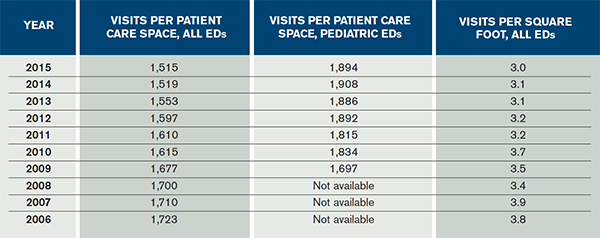
Table 1. EDBA Data Survey Volume Per Space and by Square Footage
We have noted that more boarding increases the need for both ED space and ED care spaces. An increasing number of emergency departments are building patient care areas for vertical patients. Emergency departments are providing care in chairs, recliners, and other upright spaces. It is not yet clear that patients benefit from vertical care.
Frank Zilm, director of the Institute for Health+Wellness Design at the University of Kansas in Lawrence, has suggested that, beyond the appropriate size and number of patient care spaces, the next-generation emergency department has to address the risk to staff and patients from pandemics.
For emergency departments using team triage models, spaces that can serve both for greeting and rapid care (some using recliners due to their flexibility) are a very effective use of square footage. Flow and patient throughput are enhanced by universal patient room design, and patient care rooms must be designed for infection control, noise reduction, and staff efficiency. At the department level, the design must facilitate ambulance reception, toileting availability, and cleanliness, and it must include space designed for the safe processing of mental health patients.
There is a tremendous emphasis on disaster preparedness. Frank Zilm, director of the Institute for Health+Wellness Design at the University of Kansas in Lawrence, has suggested that, beyond the appropriate size and number of patient care spaces, the next-generation emergency department has to address the risk to staff and patients from pandemics. This involves designing for early identification of at-risk patients, the ability to segregate flow through the emergency department, and the ability to create cohort quarantine zones within or adjacent to the emergency department. Another key element in emergency preparedness is the inclusion of a multipurpose utility dirty room (the MUD room) for patient decontamination and early care.
It is wise to plan for a clinical area that is sized around three visits per square foot and about 1,300 to 1,500 visits per care space. The projection of future demand and service requirements for emergency care is a daunting challenge. Designing for flexibility to accommodate new care models is critical.
Reference
- Augustine JJ. Emergency Department Benchmarking Alliance reports on data survey for next-generation ED design. ACEP NOW. 2014;33(8):22.
Pages: 1 2 | Multi-Page




No Responses to “Design Emergency Departments to Boost Patient, Staff Satisfaction”