Logo

Log In Sign Up |  An official publication of: American College of Emergency Physicians
Navigation
  • Home
  • Multimedia
    • Podcasts
    • Videos
  • Clinical
    • Airway Managment
    • Case Reports
    • Critical Care
    • Guidelines
    • Imaging & Ultrasound
    • Pain & Palliative Care
    • Pediatrics
    • Resuscitation
    • Trauma & Injury
  • Resource Centers
    • mTBI Resource Center
  • Career
    • Practice Management
      • Benchmarking
      • Reimbursement & Coding
      • Care Team
      • Legal
      • Operations
      • Quality & Safety
    • Awards
    • Certification
    • Compensation
    • Early Career
    • Education
    • Leadership
    • Profiles
    • Retirement
    • Work-Life Balance
  • Columns
    • ACEP4U
    • Airway
    • Benchmarking
    • Brief19
    • By the Numbers
    • Coding Wizard
    • EM Cases
    • End of the Rainbow
    • Equity Equation
    • FACEPs in the Crowd
    • Forensic Facts
    • From the College
    • Images in EM
    • Kids Korner
    • Medicolegal Mind
    • Opinion
      • Break Room
      • New Spin
      • Pro-Con
    • Pearls From EM Literature
    • Policy Rx
    • Practice Changers
    • Problem Solvers
    • Residency Spotlight
    • Resident Voice
    • Skeptics’ Guide to Emergency Medicine
    • Sound Advice
    • Special OPs
    • Toxicology Q&A
    • WorldTravelERs
  • Resources
    • ACEP.org
    • ACEP Knowledge Quiz
    • Issue Archives
    • CME Now
    • Annual Scientific Assembly
      • ACEP14
      • ACEP15
      • ACEP16
      • ACEP17
      • ACEP18
      • ACEP19
    • Annals of Emergency Medicine
    • JACEP Open
    • Emergency Medicine Foundation
  • About
    • Our Mission
    • Medical Editor in Chief
    • Editorial Advisory Board
    • Awards
    • Authors
    • Article Submission
    • Contact Us
    • Advertise
    • Subscribe
    • Privacy Policy
    • Copyright Information

Antibiotic Therapy for Abscesses Medical Dogma Challenged by Evidence-Based Research, Outcomes

By David A. Talan, MD, FACEP, FAAEM, FIDSA | on November 1, 2016 | 0 Comment
CME CME Now Features
  • Tweet
  • Click to email a link to a friend (Opens in new window) Email
Print-Friendly Version
Antibiotic Therapy for Abscesses Medical Dogma Challenged by Evidence-Based Research, Outcomes
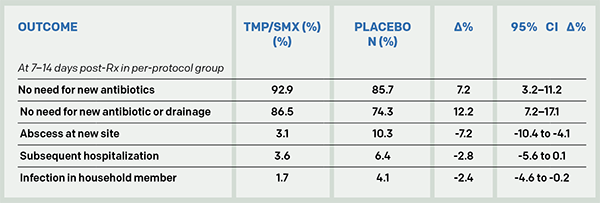
Table 1: Outcome of Patients with a Drained Skin Abscess Randomized to TMP/SMX or Placebo

You Might Also Like
  • Hospitals’ Antibiotic Use Stable Overall from 2006–2012
  • Acute Chest Syndrome in Pediatric Sickle-Cell Disease: Antibiotic Guidelines Matter
  • Acute Chest Syndrome in Pediatric Sickle-Cell Disease: Antibiotic Guidelines Matter
Explore This Issue
ACEP Now: Vol 35 – No 10 – October 2016

(click for larger image)
Table 1: Outcome of Patients with a Drained Skin Abscess Randomized to TMP/SMX or Placebo

So do we now abandon, “Just say ‘no’ to antibiotics for abscesses,” and risk promoting bacterial resistance Armageddon? There’s another perspective to these results. Most patients recover with drainage alone, 85.7 percent not needing a new antibiotic and 74.3 percent not needing either a new antibiotic or more drainage. Further, the placebo group was found to be at no increased risk of subsequent rare invasive infections.

I asked an emergency medicine antibiotic stewardship expert, Larissa May, MD, MSPH, MSHS, at the University of California, Davis. She replied, “I would argue that these results cannot be generalized to truly uncomplicated abscesses as a substantial minority of participants fell into the moderately ill category (diabetes, systemic signs of infection, and abscesses >75 cm2). I am more likely to treat patients who suffer from repeated infections. In addition, even if the study reinforces the current practice of prescribing antibiotics to most patients with uncomplicated abscesses, there is opportunity for decreasing duration of antibiotic use. The authors chose seven to 10 days, which is not necessary.”

Emergency physicians are routinely second-guessed when complications occur, so I asked an infectious diseases expert, Brad Spellberg, MD, at Los Angeles County-University of Southern California Medical Center, who advises the US Food and Drug Administration on antibiotic trials, about his take. He replied, “I cannot understand people’s fixation on not giving antibiotics to people we know have bacterial infections, but they seem to be perfectly at ease blasting people with viral bronchitis, sinusitis, otitis, etc. with pseudomonally active therapy, typically with vanco. … Patients with abscesses need to be treated. … Your data have frankly made it below the standard of care not to do so.”

Brad, we caught the dig about our vosyn abuse. Ouch. We’ll keep working on that.

A seven-day course of TMP/SMX costs about $5 on GoodRx.com. Here’s a back-of-the-napkin cost analysis (see Figure 1).

Figure 1. Back of Dave’s Napkin: Number Needed to Treat (NNT) and Cost/Savings to Prevent One Failed Case

(click for larger image)
Figure 1. Back of Dave’s Napkin: Number Needed to Treat (NNT) and Cost/Savings to Prevent One Failed Case

With an antibiotic that is so cheap, routine use is cost-saving, even with a small outcome benefit considering the savings in avoiding a return visit and especially an extra drainage procedure or hospitalization.

“I cannot understand people’s fixation on not giving antibiotics to people we know have bacterial infections, but they seem to be perfectly at ease blasting people with viral bronchitis, sinusitis, otitis, etc. with pseudomonally active therapy, typically with vanco. … Patients with abscesses need to be treated. … Your data have frankly made it below the standard of care not to do so.” —Brad Spellberg, MD, at Los Angeles County-University of Southern California Medical Center

Jerry Hoffman, MD, perhaps emergency medicine’s toughest literature critic, concluded, “I was quite surprised by the results … and actually wished they’d been different. But this is very good evidence, and certainly the best we have, of a small but real benefit. So it strongly suggests that a few days of antibiotics is worth it.” This new evidence at least opens the door to a discussion with your patient.

Pages: 1 2 3 | Single Page

Topics: AbscessAntibioticEmergency DepartmentEmergency PhysicianOutcomePatient CarePractice ManagementResearch

Related

  • Florida Emergency Department Adds Medication-Dispensing Kiosk

    November 7, 2025 - 1 Comment
  • Q&A with ACEP President L. Anthony Cirillo

    November 5, 2025 - 0 Comment
  • Let Core Values Help Guide Patient Care

    November 5, 2025 - 0 Comment

Current Issue

ACEP Now: November 2025

Download PDF

Read More

No Responses to “Antibiotic Therapy for Abscesses Medical Dogma Challenged by Evidence-Based Research, Outcomes”

Leave a Reply Cancel Reply

Your email address will not be published. Required fields are marked *


*
*


Wiley
  • Home
  • About Us
  • Contact Us
  • Privacy
  • Terms of Use
  • Advertise
  • Cookie Preferences
Copyright © 2025 by John Wiley & Sons, Inc. All rights reserved, including rights for text and data mining and training of artificial technologies or similar technologies. ISSN 2333-2603
