
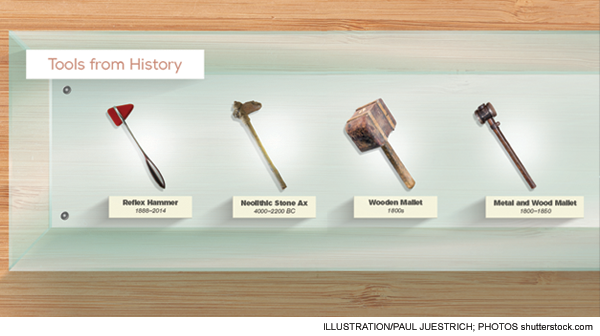
Why a general health check may become obsolete
Explore This Issue
ACEP Now: Vol 33 – No 02 – February 2014As every emergency physician knows, the practical exam required to provide perfect care to patients is very different than that required to effectively bill a chart. The money depends on a well-rehearsed and complex labyrinthine system of paperwork and documentation. Following national guidelines and individual expertise, evidence-based care can be rendered to complex patients; the rate-limiting factor for reimbursement resides in the documentation of an exhaustive history and physical examination. For complex patients, a 10-item physical exam is required for full reimbursement. But does this really add value to the care of the individual patient? In the context of increasingly quality-minded health care reform, is this practice outdated and misaligned with contemporary goals?
There is currently an evolving and growing body of research to suggest that the death of the general physical exam might be afoot. If you forgot your stethoscope, could you make it through your shift? Many could. How often do the physical examination findings we document actually change management? Doesn’t a problem-focused history get us 99 percent of the way in 99 percent of the patients?
A recent meta-analysis by Cochrane Reviews looked at research correlating the comprehensive general physical exam with outcomes.1 General health checks were defined as screening examinations for multiple conditions, not just one particular disease state. (This is effectively what our existing documentation and coding guidelines require of the emergency physician for reimbursement.) A number of general findings are worth noting:
- The general health examination for adults (between 18 and 65 years of age) was not associated with improved overall mortality rates nor improved disease-specific mortality rates.
- General physical examinations did not improve the risk for major health events, such as myocardial infarctions.
- There were little data on whether the general physical examination correlated with utilization of health resources.
The authors concluded that the general physical examination among adults should focus on specific evidence-based goals of preventive medicine, not on broad system reviews and general physical examinations looking for potential disease.
Patients have expectations. They are seeking an intimate relationship with their health care providers and crave the “magical hands” that will find health care problems and restore health, which is in direct conflict with the value of the exam they expect.
Other studies have begun to create a body of knowledge that suggests the physical examination is simply obsolete. Since 1975, the contribution of the physical examination has been called into question. An article in the British Medical Journal found that the physical exam contributed to the final diagnosis in fewer than 10 percent of outpatient visits.2 In 1992, a study in the Western Journal of Medicine using similar methodology found that the general physical exam contributed to the diagnosis in only 12 percent of outpatients.3
A body of research on the emergency-department evaluation of chest pain (accelerated diagnostic protocol, or the ADP and ADAPT studies) has resulted in a number of protocols that do not include physical findings as part of the decision tree.4,5 In 2013, a study in Emergency Medicine Australasia suggested that the vaginal exam added very little to aid in the diagnosis of first-trimester vaginal bleeding.6 In 2005, a paper in the Journal of Trauma found that the digital rectal exam (DRE) adds nothing to the evaluation of trauma patients, a deviation from more than 20 years of ATLS-mandated fingers in rectums.7 It concluded that the DRE be omitted in virtually all trauma patients. In July 2013, an article in Academic Emergency Medicine found that the history and physical examination could not accurately rule out UTI in symptomatic women.8 A simple U/A did, but the physical examination did not.
Experienced clinicians know sick when they see it. Physicians, in particular emergency physicians, get very good at the “blink response” regarding patients’ severity of illness.9,10
Patients have expectations. They are seeking an intimate relationship with their health care providers and crave the “magical hands” that will find health care problems and restore health, which is in direct conflict with the value of the exam they expect. Patients’ expectations often remain unmet.11,12 One of their more common complaints is, “The doctor barely examined me.”
The following is a proposal for a five-step exam that may fulfill the expectations of patients while not wasting physician time on activities that add no value to the diagnostic picture. Remember that 85 percent of communication is nonverbal, and this is never truer than in the examination room. Assuming a more detailed problem-focused physical exam based on the patient’s chief complaint, these five elements may be quickly performed on all patients:
- Tactile temperature check. Place the back of the hand on the patient’s forehead. It is a very intimate and caring gesture that actually has some clinical value. If the patient is diaphoretic, the physician is alerted, and this should change the expectation on the part of the physician in terms of acuity. There is a vital piece of information to be obtained through this maneuver.
- Manual pulse check. Though vital signs are almost uniformly on the patient’s chart, feeling the pulse is another gesture familiar to patients for decades. The nonverbal communication can be married to holding the patient’s hand, conveying care. The quality of the pulse may also provide useful information.
- The “No Listen” lung exam in a patient without pulmonary complaints. The stethoscope often adds little diagnostic value, but it meets an expectation of the patient.
- Belly mash. While the abdominal exam may be much more detailed for a patient with a real abdominal diagnosis, this meets the patient’s expectation and need not slow down the encounter for the physician.
- Quick neuro. Pick any three favorite neurological maneuvers (“follow my finger,” “touch your finger to your nose,” “squeeze my hands” …). The patient attributes all kinds of diagnostic cunning to these maneuvers and expects that you will perform them.
This abbreviated general physical exam ought not take more than two minutes. The take-home message is this: there are increasing data that the traditional physical exam adds little value to the health-care encounter and may need an ideological overhaul. Besides the value of the “blink response” and physicians’ unique gestalt to know sick when they see it, other general examination components are likely irrelevant and obsolete. We must not forget that healing may require that patients’ expectations be met during their encounter with their physician. As a specialty, we must begin to educate patients and payers about what really matters in the emergency physician/patient encounter and work to uncouple the valuable lifesaving work we do from the unnecessary activities now embedded and demanded in our reimbursement model.
References
- Krogsbøll LT, Jørgensen KJ, Grønhøj Larsen C, et al. General health checks in adults for reducing morbidity and mortality from disease: Cochrane systematic review and meta-analysis. BMJ. 2012;345:e7191.
- Hampton JR, Harrison MJ, Mitchell JR, et al. Relative contributions of history-taking, physical examination, and laboratory investigation to diagnosis and management of medical outpatients. Br Med J. 1975;2:486-489.
- Peterson MC, Holbrook JH, Von Hales D, et al. Contributions of the history, physical examination, and laboratory investigation in making medical diagnoses. West J Med. 1992;156:163-165.
- Aldous SJ, Richards MA, Cullen L, et al. A new improved accelerated diagnostic protocol safely identifies low-risk patients with chest pain in the emergency department. Acad Emerg Med. 2012;19:510-516.
- Cullen L, Mueller C, Parsonage WA, et al. Validation of high-sensitivity troponin I in a 2-hour diagnostic strategy to assess 30-day outcomes in emergency department patients with possible acute coronary syndrome. J Am Coll Cardiol. 2013;62:1242-1249.
- Johnstone C. Vaginal examination does not improve diagnostic accuracy in early pregnancy bleeding. Emerg Med Australasia. 2013;25:219-222.
- Esposito TJ, Ingraham A, Luchette FA, et al. Reasons to omit digital rectal exam in trauma patients: no fingers, no rectum, no useful additional information. J Trauma. 2005;59:1314-1319.
- Meister L, Morley EJ, Scheer D, et al. History and physical examination plus laboratory testing for the diagnosis of adult female urinary tract infection. Acad Emerg Med. 2013;20:631-645.
- Rodriguez RM, Wang NE, Pearl RG. Prediction of poor outcome of intensive care unit patients admitted from the emergency department. Crit Care Med. 1997; 25:1801-1806.
- Dent AW, Weiland TJ, Vallender L, et al. Can medical admission and length of stay be accurately predicted by emergency staff, patients or relatives? Aust Health Rev. 2007;31:633-641.
- Kravitz RL, Cope DW, Bhrany V, et al. Internal medicine patients’ expectations for care during office visits. J Gen Intern Med. 1994;9:75-81.
- Bell RA, Kravitx RL, Thom D, et al. Unmet expectations for care and the patient-physician relationship. J Gen Intern Med. 2002;17:817-824.
Pages: 1 2 3 | Multi-Page



One Response to “Does a 10-Item Physical Exam Add Value to Patient Care?”
November 25, 2014
The Land of Protocols - LITFL[…] A recent article in ACEP Now provides a particularly pernicious set of recommendations that explicitly and implicitly would lead to avoidance of much of the physical exam (only 10% yield in diagnoses – ignoring the much lower yields in ACS rule-outs and CT PE studies in low yield patients), deceiving our patients as we knowingly performing useless bedside maneuvers for show, and fabricating medical records for billing purposes. It’s one of the most disturbing articles I’ve read recently. […]