Logo

Log In Sign Up |  An official publication of: American College of Emergency Physicians
Navigation
  • Home
  • Multimedia
    • Podcasts
    • Videos
  • Clinical
    • Airway Managment
    • Case Reports
    • Critical Care
    • Guidelines
    • Imaging & Ultrasound
    • Pain & Palliative Care
    • Pediatrics
    • Resuscitation
    • Trauma & Injury
  • Resource Centers
    • mTBI Resource Center
  • Career
    • Practice Management
      • Benchmarking
      • Reimbursement & Coding
      • Care Team
      • Legal
      • Operations
      • Quality & Safety
    • Awards
    • Certification
    • Compensation
    • Early Career
    • Education
    • Leadership
    • Profiles
    • Retirement
    • Work-Life Balance
  • Columns
    • ACEP4U
    • Airway
    • Benchmarking
    • Brief19
    • By the Numbers
    • Coding Wizard
    • EM Cases
    • End of the Rainbow
    • Equity Equation
    • FACEPs in the Crowd
    • Forensic Facts
    • From the College
    • Images in EM
    • Kids Korner
    • Medicolegal Mind
    • Opinion
      • Break Room
      • New Spin
      • Pro-Con
    • Pearls From EM Literature
    • Policy Rx
    • Practice Changers
    • Problem Solvers
    • Residency Spotlight
    • Resident Voice
    • Skeptics’ Guide to Emergency Medicine
    • Sound Advice
    • Special OPs
    • Toxicology Q&A
    • WorldTravelERs
  • Resources
    • ACEP.org
    • ACEP Knowledge Quiz
    • Issue Archives
    • CME Now
    • Annual Scientific Assembly
      • ACEP14
      • ACEP15
      • ACEP16
      • ACEP17
      • ACEP18
      • ACEP19
    • Annals of Emergency Medicine
    • JACEP Open
    • Emergency Medicine Foundation
  • About
    • Our Mission
    • Medical Editor in Chief
    • Editorial Advisory Board
    • Awards
    • Authors
    • Article Submission
    • Contact Us
    • Advertise
    • Subscribe
    • Privacy Policy
    • Copyright Information

Tablet-Based Ultrasound Tech in Emergency Services Vehicles Can Speed Care in the ED

By Kelly April Tyrrell | on December 29, 2014 | 0 Comment
Uncategorized
  • Tweet
  • Click to email a link to a friend (Opens in new window) Email
Print-Friendly Version
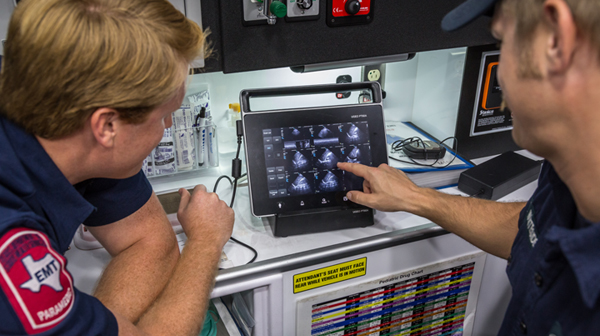
Bedford medics view ultrasound.

Earlier this month, paramedics in the Dallas–Fort Worth (DFW) area responded to a call involving a patient with shortness of breath. While still in the field, the medics performed an ultrasound and found the patient was suffering a spontaneous pneumothorax.

You Might Also Like
  • Coding Wizard: How To Get Paid for Point-of-Care Ultrasound
  • Point-of-Care Pelvic Ultrasound Done by Emergency Physicians Comes Under Fire
  • How to Use Point-of-Care Ultrasound to Identify Shoulder Dislocation

“Because they were able to see that, they were able to dart the chest, and at the hospital, they were able to put a chest tube in earlier,” said Bobby Sewell, chief of the Bedford Fire Department, near the DFW airport.

Six emergency vehicles in the DFW metropolitan area were recently equipped with brand-new Samsung PT60A ultrasounds as part of an ongoing trial to examine how a portable, tablet-based ultrasound system may transform emergency care in the field. If the trial results so far are any indication, big changes are on the horizon.

“This trial was designed for the fact that, when you go out to some of these trauma situations, you would like to make a quick evaluation or assessment of the patient,” said Thad Chodakauskas, senior product manager for Samsung’s Health & Medical Equipment division. “Paramedics can transmit images wirelessly to the emergency department, which can make the decision whether the patient needs to go to the emergency room or directly to the OR.”

While results from the DFW trial have not yet been published, some of its major findings to date were announced in October: wireless transmission of ultrasound images from the field—in some cases within 30 seconds—resulted in faster treatment upon patient arrival at the ED, and DFW-area medics were able to detect heart movement by ultrasound in multiple patients presenting with no pulse and continue treatment, resulting in eventual patient discharge.
Paramedics using a Samsung PT60A ultrasound tablet in the field.

Paramedics using a Samsung PT60A ultrasound tablet in the field.

More than 50 paramedics were trained on the ultrasound and tested by the local partnering trauma center, John Peter Smith Hospital. They successfully transmitted images wirelessly to the hospital and EMS medical director, Roy Yamada, MD. Sewell said physicians can receive the images on smartphones and iPads and that trauma centers can notify the on-duty ED staff while medics are en route.

“We are shortening the hours of response time down to preserve the golden hour,” said Sewell.

The medical team plans to publish full results in the first half of 2015, Chodakauskas said, and is currently working to gather more data, particularly on how the technology—based on Samsung’s Galaxy tablet platform—improves patient outcomes.

It’s a new level of coordination between all parties involved in emergency care, Sewell said. “When 911 is called, we are one system; we all have jobs to do, but there is one patient, and we all do our part,” said Sewell. “The less duplication we have, the more efficient the system can be and the more cost-effective. But the thing is, [tablet-based ultrasound] saves time, and in emergency cases, time is always important.”


Kelly April Tyrrell is a freelance journalist based in Wilmington, Delaware.

Pages: 1 2 | Multi-Page

Topics: Critical CareEmergency Medical ServicesparamedicsSamsungtabletUltrasound

Related

  • Why the Nonrebreather Should be Abandoned

    December 3, 2025 - 0 Comment
  • Non-Invasive Positive Pressure Ventilation in the Emergency Department

    October 1, 2025 - 0 Comment
  • Emergency Department Management of Prehospital Tourniquets

    October 1, 2025 - 0 Comment

Current Issue

ACEP Now: November 2025

Download PDF

Read More

No Responses to “Tablet-Based Ultrasound Tech in Emergency Services Vehicles Can Speed Care in the ED”

Leave a Reply Cancel Reply

Your email address will not be published. Required fields are marked *


*
*


Current Issue

ACEP Now: November 2025

Download PDF

Read More

Polls

Which topic would you like to see ACEP Now tackle?

View Results

Loading ... Loading ...
  • Polls Archive
Wiley
  • Home
  • About Us
  • Contact Us
  • Privacy
  • Terms of Use
  • Advertise
  • Cookie Preferences
Copyright © 2025 by John Wiley & Sons, Inc. All rights reserved, including rights for text and data mining and training of artificial technologies or similar technologies. ISSN 2333-2603