Logo

Log In Sign Up |  An official publication of: American College of Emergency Physicians
Navigation
  • Home
  • Multimedia
    • Podcasts
    • Videos
  • Clinical
    • Airway Managment
    • Case Reports
    • Critical Care
    • Guidelines
    • Imaging & Ultrasound
    • Pain & Palliative Care
    • Pediatrics
    • Resuscitation
    • Trauma & Injury
  • Resource Centers
    • mTBI Resource Center
  • Career
    • Practice Management
      • Benchmarking
      • Reimbursement & Coding
      • Care Team
      • Legal
      • Operations
      • Quality & Safety
    • Awards
    • Certification
    • Compensation
    • Early Career
    • Education
    • Leadership
    • Profiles
    • Retirement
    • Work-Life Balance
  • Columns
    • ACEP4U
    • Airway
    • Benchmarking
    • Brief19
    • By the Numbers
    • Coding Wizard
    • EM Cases
    • End of the Rainbow
    • Equity Equation
    • FACEPs in the Crowd
    • Forensic Facts
    • From the College
    • Images in EM
    • Kids Korner
    • Medicolegal Mind
    • Opinion
      • Break Room
      • New Spin
      • Pro-Con
    • Pearls From EM Literature
    • Policy Rx
    • Practice Changers
    • Problem Solvers
    • Residency Spotlight
    • Resident Voice
    • Skeptics’ Guide to Emergency Medicine
    • Sound Advice
    • Special OPs
    • Toxicology Q&A
    • WorldTravelERs
  • Resources
    • ACEP.org
    • ACEP Knowledge Quiz
    • Issue Archives
    • CME Now
    • Annual Scientific Assembly
      • ACEP14
      • ACEP15
      • ACEP16
      • ACEP17
      • ACEP18
      • ACEP19
    • Annals of Emergency Medicine
    • JACEP Open
    • Emergency Medicine Foundation
  • About
    • Our Mission
    • Medical Editor in Chief
    • Editorial Advisory Board
    • Awards
    • Authors
    • Article Submission
    • Contact Us
    • Advertise
    • Subscribe
    • Privacy Policy
    • Copyright Information

Intermountain Medical Center in Utah Improves Efficiency, Performance with Vertical Flow Model

By Shari Welch, MD, FACEP | on August 9, 2016 | 1 Comment
Special OPs
  • Tweet
  • Click to email a link to a friend (Opens in new window) Email
Print-Friendly Version

Patient flow now looks like this: A highly trained and experienced “greeter nurse” does rapid, abbreviated triage, mostly for the purpose of deciding whether patients are appropriate for the AcceleratED model or traditional bed placement. If criteria are met, patients are streamed to the AcceleratED area and “swarmed” by a team. Patients tell their story once, and the assessment and workup are begun in parallel. Patients may need to be briefly bedded for diagnostics, but most of their ED time is spent in a chair in a large, bright, open waiting room. There are two physicians and a nurse practitioner or physician assistant, five nurses, and three techs working in the AcceleratED area during the busiest hours of the day. During low-volume times, the emergency department operates under a pull-to-full traditional ED model.
You Might Also Like
  • Segmentation Improves Emergency Department Patient Flow at Raritan Bay Medical Center
  • Virginia Commonwealth University Improves Patient Flow Through “Vision in Action” Model
  • Rhode Island Hospital ED Boosts Efficiency by Adopting Brown University Patient Flow Model
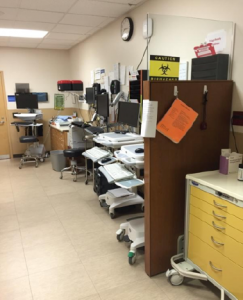
Strategically placed equipment and supplies. (Image courtesy of Adam Balls, MD, and Brian Oliver, MD.)

Strategically placed equipment and supplies. (Image courtesy of Adam Balls, MD, and Brian Oliver, MD.)

The emergency department has four triage rooms, which serve as the AcceleratED space. The team had to bring supplies for point-of-care testing, splints and suturing supplies, and computers to the area to be sure patients could have every step of their care completed out front. The team performed a rapid-cycle testing phase using “A team” physicians who were invested in the success of the initiative and known to be particularly efficient in crafting quick, decisive care plans for patients. They then went live in November. The original implementation plan had been to drop the new process during the holidays, as the emergency department typically sees a 10 percent increase in volume during the week between Christmas and New Year’s. The improvements were so compelling that the leadership at the hospital asked the ED leaders and physicians to continue with the reengineered model.

Dr. Balls is quick to give credit to the administrative leaders at Intermountain Medical Center, who took the leap of faith in providing some quick out-of-budget-cycle funding for small front-end redesigns and enhancements to make the project work. They started in a small, confined workspace, but the results have been remarkable. The project has been so successful that they are supporting space redesigns to allow a more ergonomically friendly space for the team to work in that yields even more gains in efficiency!

The success has been dramatic:

BEFORE AFTER
Door to Doc 27 minutes 19 minutes
LOS 207 minutes 187 minutes
LWBS 2.4% 1.2%

Dr. Oliver and Dr. Balls’ lessons learned from the new flow model:

  • Not all physicians are suited for the physician-in-triage role.
  • An indecisive physician unable to multitask can create a bottleneck at intake.
  • Supplies must be strategically located.
  • Patients appropriate for the AcceleratED model can be through the intake process within 35 minutes.
  • Paperwork and processing must be streamlined.
  • Scribes are a great idea for physicians processing so many patients.
  • ED tech staffing is important in this flow model.
  • Transport techs are important in this flow model.
  • The physician group has to be prepared for many schedule adaptations as the model is improved.
  • These are very busy shifts for physicians, and scheduling must be realistic.

Though this busy emergency department would be the envy of many other departments, the physicians and staff set the bar higher and came out of their comfort zone to engage in wholesale change. The payoff? Mountains of improvement!

Pages: 1 2 3 | Single Page

Topics: Emergency DepartmentEmergency MedicineEmergency PhysicianIntermountain Medical CenterPatient FlowPractice ManagementWorkforce

Related

  • Florida Emergency Department Adds Medication-Dispensing Kiosk

    November 7, 2025 - 1 Comment
  • Q&A with ACEP President L. Anthony Cirillo

    November 5, 2025 - 0 Comment
  • How Does Emergency Medicine Navigate Consolidation Trends in Health Care?

    October 29, 2025 - 0 Comment

Current Issue

ACEP Now: November 2025

Download PDF

Read More

About the Author

Shari Welch, MD, FACEP

Shari Welch, MD, FACEP, is a practicing emergency physician with Utah Emergency Physicians and a research fellow at the Intermountain Institute for Health Care Delivery Research. She has written numerous articles and three books on ED quality, safety, and efficiency. She is a consultant with Quality Matters Consulting, and her expertise is in ED operations.

View this author's posts »

One Response to “Intermountain Medical Center in Utah Improves Efficiency, Performance with Vertical Flow Model”

  1. April 25, 2017

    Anna Fraser Reply

    Hi there,

    Where did you get the Door to Doc, LOS and LWBS statistics from? Do you have a valid source you can pass on to me?

    Regards,
    Anna

Leave a Reply Cancel Reply

Your email address will not be published. Required fields are marked *


*
*


Current Issue

ACEP Now: November 2025

Download PDF

Read More

Polls

Which topic would you like to see ACEP Now tackle?

View Results

Loading ... Loading ...
  • Polls Archive
Wiley
  • Home
  • About Us
  • Contact Us
  • Privacy
  • Terms of Use
  • Advertise
  • Cookie Preferences
Copyright © 2025 by John Wiley & Sons, Inc. All rights reserved, including rights for text and data mining and training of artificial technologies or similar technologies. ISSN 2333-2603
