
Logo

Log In Sign Up |  An official publication of: American College of Emergency Physicians
Navigation
  • Home
  • Multimedia
    • Podcasts
    • Videos
  • Clinical
    • Airway Managment
    • Case Reports
    • Critical Care
    • Guidelines
    • Imaging & Ultrasound
    • Pain & Palliative Care
    • Pediatrics
    • Resuscitation
    • Trauma & Injury
  • Resource Centers
    • mTBI Resource Center
  • Career
    • Practice Management
      • Benchmarking
      • Reimbursement & Coding
      • Care Team
      • Legal
      • Operations
      • Quality & Safety
    • Awards
    • Certification
    • Compensation
    • Early Career
    • Education
    • Leadership
    • Profiles
    • Retirement
    • Work-Life Balance
  • Columns
    • ACEP4U
    • Airway
    • Benchmarking
    • Brief19
    • By the Numbers
    • Coding Wizard
    • EM Cases
    • End of the Rainbow
    • Equity Equation
    • FACEPs in the Crowd
    • Forensic Facts
    • From the College
    • Images in EM
    • Kids Korner
    • Medicolegal Mind
    • Opinion
      • Break Room
      • New Spin
      • Pro-Con
    • Pearls From EM Literature
    • Policy Rx
    • Practice Changers
    • Problem Solvers
    • Residency Spotlight
    • Resident Voice
    • Skeptics’ Guide to Emergency Medicine
    • Sound Advice
    • Special OPs
    • Toxicology Q&A
    • WorldTravelERs
  • Resources
    • ACEP.org
    • ACEP Knowledge Quiz
    • Issue Archives
    • CME Now
    • Annual Scientific Assembly
      • ACEP14
      • ACEP15
      • ACEP16
      • ACEP17
      • ACEP18
      • ACEP19
    • Annals of Emergency Medicine
    • JACEP Open
    • Emergency Medicine Foundation
  • About
    • Our Mission
    • Medical Editor in Chief
    • Editorial Advisory Board
    • Awards
    • Authors
    • Article Submission
    • Contact Us
    • Advertise
    • Subscribe
    • Privacy Policy
    • Copyright Information

What Is—and Isn’t—Guaranteed Under EMTALA Can Be Complex

By Eric Funk, MD | on December 15, 2020 | 0 Comment
Medicolegal Mind
  • Tweet
  • Click to email a link to a friend (Opens in new window) Email
Print-Friendly Version

The Case Continues

After being discharged, the patient had an uneventful night. The next morning, he began to feel worse, and two days after the initial visit, he returned to the emergency department. His exam was now notable for “significant edema” at the left ankle, with bruising up the leg. Extreme tenderness was noted, but there was no crepitus.

You Might Also Like
  • Is “Severe Pain” considered an emergency medical condition under EMTALA?
  • Whose EMTALA Is It, Anyway?
  • EMTALA: The Law That Forever Changed the Practice of EM
Explore This Issue
ACEP Now: Vol 39 – No 12 – December 2020

Vital signs were notable for slight tachycardia at 105 bpm, though his blood pressure, respirations, and pulse remained normal. His CBC and comprehensive metabolic panels were essentially unchanged (see Figure 3).
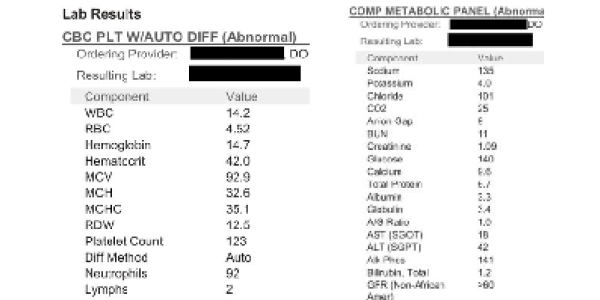
Figure 3

Figure 3

He was diagnosed with cellulitis and admitted to the hospital due to the severity of the swelling, bruising, and pain. The patient had a penicillin allergy listed and was started on vancomycin monotherapy. The emergency physician wrote a long note, including the reasoning shown below:

Consideration for necrotizing fasciitis was done however there is nothing on patient’s exam or history to assess that this is present. Patient’s had leg pain now for a couple of days and this has not been rapidly worsening the patient did state that it got significantly worse today. Pain is not out of proportion. Patient hasn’t had any significant fever and white blood cell count is not significantly elevated.

In the hospital, the patient developed renal failure, and his vitals worsened. A surgeon was consulted, and the patient was taken to the operating room. There was purulent drainage from the leg, and small areas of necrotic muscle were identified.

The patient was ultimately transferred to a larger medical center. He underwent several repeat operations for necrotizing fasciitis, ultimately requiring several skin grafts leading to permanent disability of his left leg.

The Lawsuit

The patient filed a lawsuit against the hospital. The plaintiff’s attorney alleged EMTALA violations, and therefore the lawsuit was filed in federal court. The specific claim was that the medical screening exam violated EMTALA because it did not lead to the correct diagnosis of necrotizing fasciitis.

The judge ultimately dismissed the lawsuit. In his opinion, he noted that “EMTALA is not a medical malpractice statute, and failing to correctly diagnose Plaintiff’s illness does not give rise to [EMTALA] liability.” This concept was reiterated throughout his opinion, and elsewhere he stated, “Defendants cannot incur EMTALA liability for what is merely an incorrect diagnosis.”

The patient proceeded to sue the hospital and all of the doctors involved in the case in state court. That lawsuit was eventually withdrawn without any mention of a settlement.

Pages: 1 2 3 | Single Page

Topics: Case ReportsEMTALAMalpracticeNecrotizing Fasciitis

Related

  • Q&A with ACEP President L. Anthony Cirillo

    November 5, 2025 - 0 Comment
  • How Evidence-Based Medicine Strengthens Your Malpractice Defense

    October 28, 2025 - 0 Comment
  • The Business of Emergency Medicine: Insurance Essentials

    October 9, 2025 - 0 Comment

Current Issue

ACEP Now: November 2025

Download PDF

Read More

No Responses to “What Is—and Isn’t—Guaranteed Under EMTALA Can Be Complex”

Leave a Reply Cancel Reply

Your email address will not be published. Required fields are marked *


*
*


Wiley
  • Home
  • About Us
  • Contact Us
  • Privacy
  • Terms of Use
  • Advertise
  • Cookie Preferences
Copyright © 2025 by John Wiley & Sons, Inc. All rights reserved, including rights for text and data mining and training of artificial technologies or similar technologies. ISSN 2333-2603
