
Currently, almost 6,000 people call poison control centers every day. An additional 4,000 to 9,000 people per day experience a poison exposure but don’t call because they don’t like talking on the phone or waiting in phone queues, feel embarrassed or fear being judged, or don’t want to scare their child who is listening nearby. Others just prefer to look online for health information and won’t call poison control at all.
Explore This Issue
ACEP Now: Vol 38 – No 09 – September 2019Meeting patients where they are, the National Capital Poison Center, in collaboration with other poison centers, has now developed webPOISONCONTROL (see Figure 1). webPOISONCONTROL is a fully automated, algorithm-driven online toxicology tool designed for public users and poison centers. The average time to complete a webPOISONCONTROL case is 2.6 minutes; since human interaction is not required, there is no need to pick up a phone or remain on hold when using the tool.
Online medical information is frequently inaccurate and even unsafe. Among the best ways to combat misinformation is to improve public access to free and accurate information. Case-specific and evidence-based, webPOISONCONTROL is available both online at www.poison.org (click on the orange “help me with a possible poisoning” button) or by downloading a free mobile app (available on the App Store and Google Play).
This tool is not just for the lay user. Many traditional phone-based poison control centers have also begun to use webPOISONCONTROL as an adjunct resource, especially to determine ED triage thresholds and home treatment recommendations. Participating poison centers are provided enhanced accessibility to the program’s algorithms, triage rationales, and calculation functions. Although most webPOISONCONTROL cases are managed in the home setting, emergency physicians should be aware that patients who present to the emergency department may be there based on recommendations given by the program. These patients have done more than just “Googling their symptoms” and should be taken seriously.

Figure 1: webPOISONCONTROL App
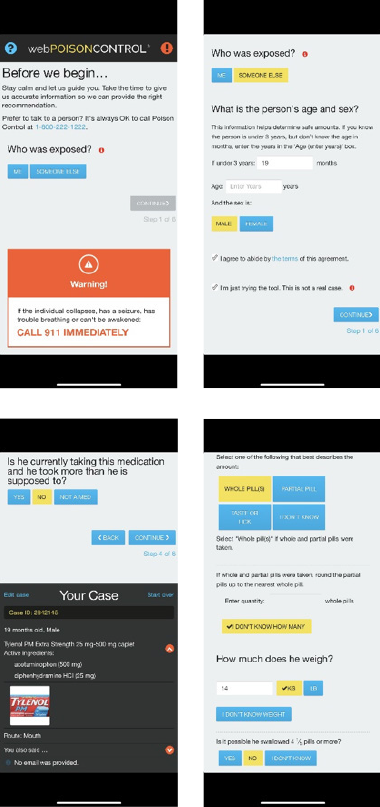
Figure 2: Example Questions
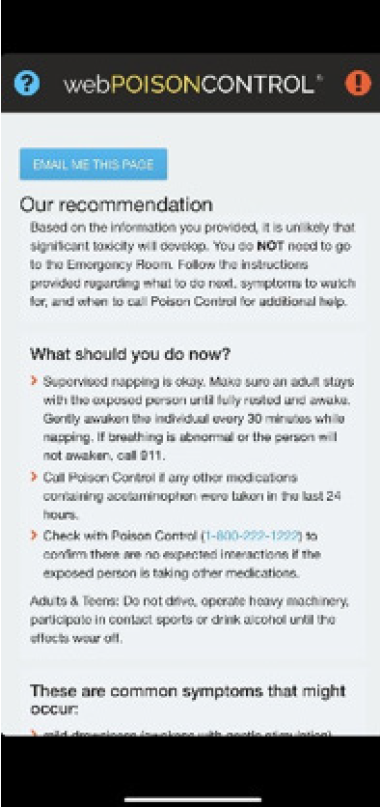
Figure 3: Recommendation
There are currently more than 1,700 unique webPOISONCONTROL human toxicity algorithms ranging from pharmaceutical and over-the-counter medications to household products, bites, stings, and plants. The toxicity algorithms are created by U.S.-based toxicologists and reviewed by an expert panel prior to release.
While webPOISONCONTROL was created with the public user in mind, the platform is also helpful for emergency physicians as it includes toxicity information for rarely encountered substances that may be unfamiliar to many poison center specialists or medical toxicologists. After entering some basic data into the app (including patient age, sex, time of exposure, substance and amount; see Figure 2), webPOISONCONTROL can inform a user about whether toxicity is to be expected after exposure to, for example, a sip of lavender essential oil, ingestion of animal de-wormer tablets, or a catfish sting. Information regarding more commonly encountered toxic exposures (including prescription medications, laundry pods, and vitamins) is also available through webPOISONCONTROL.
The webPOISONCONTROL algorithms also provide information regarding common symptoms, expected durations of symptoms, and home treatment recommendations (see Figure 3). To ensure that the recommendations for each case are accurate, webPOISONCONTROL cases are audited daily by a team of toxicologists, and algorithms are updated when new information becomes available. Analysis of the results of cases managed by webPOISONCONTROL reveals similarities to cases managed by traditional poison centers; the majority of cases are managed in the home setting and without referral to a hospital, and most cases involve children younger than 6 years of age. Most users are in their 20s to 30s, female, and accessed webPOISONCONTROL on a mobile device.1
webPOISONCONTROL was not designed to replace traditional poison control centers; the program is currently limited to the management of single-substance exposures and is therefore unable to provide toxicity recommendations for patients who were exposed to multiple drugs. Additionally, patients who are at the extremes of age, are pregnant, or have underlying serious medical conditions are excluded from the webPOISONCONTROL algorithms. Users who admit to suicidal intent receive an automatic message to call poison control. Based on the information entered into the tool, webPOISONCONTROL may still provide users with a recommendation to call poison control for additional assistance. However, for a large percentage of users, webPOISONCONTROL will simply advise that serious toxicity is not expected and that on-site management is appropriate.
With the increasing use of the internet as a resource for medical advice, it is necessary for medical professionals to identify trustworthy and accurate internet-based medical advice platforms for patients to use. In the emergency medicine setting, patients should be encouraged to download the webPOISONCONTROL app for future use so that they can potentially avoid unnecessary emergency department visits for minor poisoning exposures.
Pages: 1 2 | Single Page



No Responses to “webPOISONCONTROL Is an Automated Online Toxicology Tool for Patients”