
This is Part 2 of our ongoing series on the Internet Of Medical Things (IOMT).
Explore This Issue
ACEP Now: Vol 36 – No 01 – January 2017There are many exciting devices that will help support the practice of medicine. Perhaps even more exciting (and challenging) for the emergency physician will be attempting to stay abreast of the rapidly growing number of devices that patients can purchase directly and will be calling upon us to interpret.

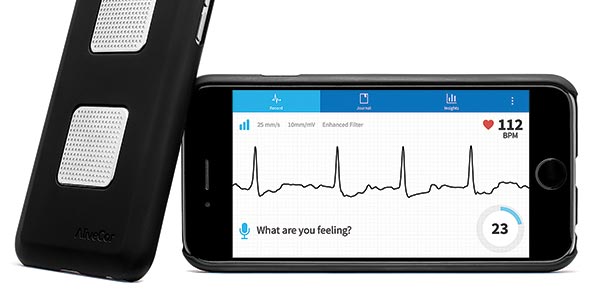
A. AliveCor’s Kardia provides an ECG when the user puts fingers from each hand on the back of the integrated mobile phone case
Most patients have already had the opportunity to explore the first wave of basic personal monitoring with wearables like Fitbit ($99–$150). Although these devices collect basic data about exercise and health, there has been a lot of conversation surrounding the validity and utility of the data. Can you imagine a conversation between a patient and a primary care physician or emergency physician regarding these data? “Doctor, I notice that Grandma’s steps per day have decreased by 50 percent over the past two weeks, which seems to be coinciding with some shortness of breath while exerting herself.” Although these are basic data, they can serve as additional objective pieces of information to support a diagnosis.
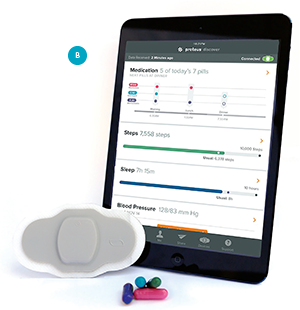
B. Proteus Digital Health’s ingestible sensor sends a recordable signal to a patch that the patient wears on the torso. These data are transmitted to the patient’s mobile device and up to the cloud.
We can expect a large growth in data collection in health care that interfaces with the emergency department. Data will not only come from the home but also be pushed from third parties that are generating and monitoring data for our patients. I remember the first time I received a fax from a cardiac-monitoring device company regarding an event a patient had experienced while walking in a park. It was astounding that this small portable device had recorded an event and transmitted that data to the cloud, where it was interpreted. The patient was called and directed to call 911 to get transported directly to the emergency department. I received the data regarding the dysrhythmia prior to arrival of the patient. Truly astounding.
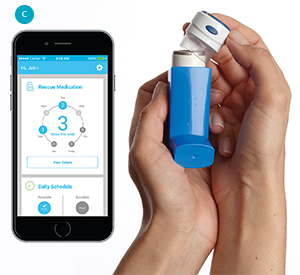
C. Propeller Health’s connected inhaler collects data on frequency of use, time of day, weather, and geographic area to help patients and physicians manage asthma or chronic obstructive pulmonary disease.
Pages: 1 2 3 | Single Page



One Response to “Wearable Health Care Technology, Devices that Emergency Physicians Need to Know About”
September 15, 2017
KevinC-MDYou can buy NIBP, pulse ox, finger stick glucose, pregnancy test*, and dip UA* at Walgreens. The cost to produce (albeit not license) a wearable multilead ECG is within most patient’s discretionary healthcare spending. While we agonize over all the false positives and worried well, good analytics/AI could greatly help in both detecting serious injury or excluding things like unstable angina.
But, it is totally a pipe dream, or bad trip.
The electronic health record systems in use in the vast majority of acute care hospitals are incapable of even the most simple standard-based information exchange. These IoT devices will drive up consumer (what we call patient’s) expectations (“Its in my FitBit”) and create substantial investor/regulator/end-user resentment.
As emergency physician’s we need to stop accepting the antiquated (largely unstudied, if you use a commercial system), and potentially dangerous impediments to safe and efficient patient care.
Technology can be a great boon. What has been shoveled to us, however, is not. Realistic at home data collection (which should include additional low hanging fruit as daily weight and spirometer results) likely can help PCPs and EPs detect and abort early stage disease.
Without decent emergency department information systems (EDIS) and electronic health record system (EHRS), however, we are stuck.
While administrators may be patting themselves on the back (or wringing their hands over the exorbitant sunk costs) for “successfully deploying” what amounts to a crappy documentation(word processing?) and ordering (a lot like emailing tasks with circa 1995 MS Outlook) system, the “proven” benefits fail to manifest (almost all shown using home grown, typically physician directed/engineered), and productivity takes a permanent record.
Want this 21st century in-put? Let’s force the issue and demand a 21st century EDIS!
*Tests, like fecal occult blood and wet preps, we no longer are smart enough to do in the ED (but that is another issue).