
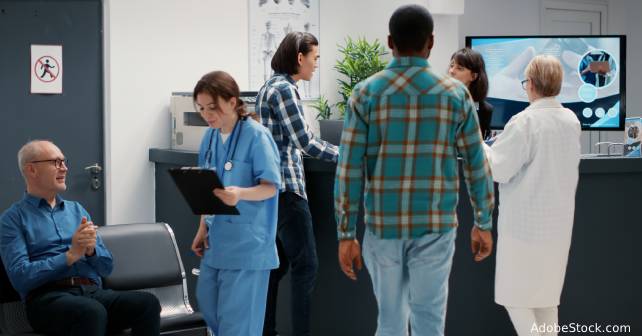
As hospital boarding, increased emergency department (ED) volumes, and complexity of patients have increased, so have wait times. Some physicians now coin themselves “waiting room medicine specialists” as departments schedule a physician in triage or attempt to evaluate patients in whatever spaces might be available. After years of training to fully undress a patient for an exam at ABEM General Hospital, patients may now routinely be treated in street clothes sitting in a hallway chair. Although this practice attempts to deliver care in a more timely and efficient manner, core aspects of care may be lost. A tension between the necessity and the compromises of “waiting room medicine” thus creates an ethical conundrum.
Explore This Issue
ACEP Now: March 02Privacy
Dating back to the Hippocratic oath, privacy is a core tenant of the profession of medicine.1 When space is limited, patients’ medical history is rarely protected from the vision or hearing of other patients and guests in the ED. The sensitivity of the details of an ankle sprain may seem minor. However, the history of a genitourinary complaint or the emotional impact of a miscarriage may be much more intimate. Attempting to obtain pertinent details and exams to allow appropriate and complete treatment may be compromised if care is conducted in the public space of a hallway or waiting room. A patient may not be willing to disclose a sensitive past medical history or events of an injury that they deem embarrassing and that could affect the differential diagnosis of a potentially otherwise benign complaint of pain or cough.
Waiting room medicine attempts to balance the ethical principles of beneficence and nonmaleficence. It is the response of an overwhelmed ED and health system attempting to provide the greatest good with inadequate resources, staffing, and space.2 Focusing on the benefit of providing earlier testing and assessment, even under less-than-ideal conditions, will lead to more timely diagnosis, treatment, and disposition. However, this comes at the risk of potentially incomplete examination, missed details, and lack of privacy and sensitivity. Circumventing a traditional patient evaluation increases the risk for unnecessary testing or cost and risk for human error. There is also the recognized risk that a patient may undergo a partial evaluation and leave prior to full clinician assessment or results of tests initiated in triage. Struggling in the middle, emergency physicians balance what can be done versus doing nothing.
Harm to Physician Patient Relationship
Waiting room medicine is a component of ED crowding, which itself increases the length of stay for patients.3 This affects the physician-patient relationship by prolonging the duration of the ED visit without increasing time spent face to face with a physician. The majority of patients will underestimate their anticipated ED length of stay, and will provide lower satisfaction scores as a result.4 It also places a strain on the physician to provide optimal care for their patients while being constrained by space and time restrictions. Waiting room medicine results in significant strain on the physician-patient relationship and affects the ability for a patient to receive optimal care.
Liability Concerns
Many emergency physicians hesitate to evaluate patients from the ED waiting room because of liability concerns. Once a patient presents to the ED for evaluation, they are covered under EMTALA. The EMTALA law gives every patient the right to a medical screening exam in the ED and treatment until their emergent medical condition is stabilized.5
Does treating a patient in the waiting room establish liability for the patient? The answer is unclear. Perhaps a better way to frame the question is to consider if harm is being done to the patient. It may be that leaving patients unattended in the waiting room for prolonged periods of time may be more harmful than trying to treat with what little room and resources are available.
Solutions
Responses to the challenge of prolonged ED wait times and waiting room crowding center around reimagining the traditional ED workflow to deliver evaluations and treatments to patients asynchronously while they wait. A 2020 scoping review reported 38 interventions to improve patient care.6 Common strategies include employing a nursing-driven standardized triage order sets or utilizing a physician-in-triage. Other interventions have included expanded point-of-care testing, frequent vitals, ED observation units, computerized clinical support systems, and activation of additional services such as scribes, mental health providers, and pharmacists.
These nontraditional care models all center around the reality that the alternative to the ED flexing its workflow is to provide no care to the waiting patients in a gridlock. Although such nontraditional care models may be scrutinized as they represent a deviation from the standard of care, it is a fallacy to reject these interventions, outright. Nontraditional care models may represent the “lesser of two evils” and the best standard of care within the context of crowded circumstances.
Call to Action
The nation’s EDs have continued to bend under the strain of waiting room crowding, principally a result of inpatient boarding in the ED, without any identifiable regulatory, financial, or altruistic motivations making a meaningful impact in this trajectory. For this reason, ACEP called for, and is participating in, a summit on ED boarding with the Centers for Medicare and Medicaid Services to seek pathways forward addressing the root of ED crowding. Although it is the ethical obligation of emergency physicians at the bedside to respond to the individual patient’s needs seeking their best outcome and best interest, the swelling landscape of crowded ED waiting rooms and delayed ED care cannot be resolved at the bedside but at the federal level.
As emergency physicians and EDs develop innovative solutions to address the continual increase in ED crowding and wait times, it is imperative that emergency physicians do not accept this as fate, but continue to advocate for appropriate resources to care for patients. This less-than-ideal situation, however, does not negate the cornerstone of ACEP’s Code of Ethics – to “embrace patient welfare as [our] primary professional responsibility.” Nontraditional care models may be scrutinized as deviating from the typical standard care of patients, but should also be lauded and protected as a commitment to beneficence and nonmaleficence.
 Dr. Clayborne is an emergency physician at the University of Maryland Capital Region Medical Center in Largo, Md.
 Dr. Bissmeyer is an emergency physician at Mercy Health in Cincinnati, Ohio.
 Dr. Kluesner is the associate medical director and associate program director of the Iowa Methodist Medical Center Emergency Medicine Residency Program in Des Moines, Iowa.
 Dr. McGrath is an emergency physician at the Virginia Mason Medical Center in Seattle, Wash.
 Dr. Martinez is a clinical assistant professor of emergency medicine at the University of Oklahoma, School of Community Medicine in Tulsa, Okla.
 Dr. Vearrier is a professor of emergency medicine at the University of Mississippi Medical Center.
References
- Miles, SH. The Hippocratic Oath and the Ethics of Medicine. Oxford; New York: Oxford University Press, 2004.
- Moskop JC, Geiderman JM, Marshall KD, et al. Another look at the persistent moral problem of emergency department crowding. Ann Emerg Med. 2018;74(3):357-364.
- White BA, Bidding PD, Chang Y, et al. boarding inpatients in the emergency department increases discharged patient length of stay. J Emerg Med. 2013;44(1):230-235.
- Parker BT, Marco C. Emergency department length of stay: accuracy of patient estimates. West J Emerg Med. 2014;15(2):170-175.
- Warby R, Leslie SW, Borger J. EMTALA and Patient Transfers. [Updated 2023 Nov 22]. In: StatPearls [Internet]. Treasure Island (FL): StatPearls Publishing; 2025 Jan-. Available from: https://www.ncbi.nlm.nih.gov/books/NBK557812/
- Austin EE, Blakely B, Tufanaru C, et al. Strategies to measure and improve emergency department performance: a scoping review. Scand J Trauma Resusc Emerg Med. 2020;28(1):55.
Pages: 1 2 3 | Multi-Page



2 Responses to “Waiting Room Medicine: The Ethical Conundrum”
March 27, 2025
Dan McGeeIn addition to boarding and hospital overcrowding, I have concerns that hospital administrators are strategically pushing ED waiting room medicine as a means to sidestep nurse to patient staffing ratio rules and agreements and decrease labor costs. This is being done at the cost of quality care and safety.
March 31, 2025
Gail GreenWhen will CMS and hospital admin really address this issues that is many years in the making? Why does it take so long even after deaths have occurred in wait rooms? I was an ED manger/director 13 years ago with the same challenges. Moved to IT as the stress was overwhelming with no end in sight. I advocated for my ED for years on many committees for help to no avail and a lot of pushback. My peers in other facilities had the same experiences. We offered many possible solutions but was rejected over and over. This is old news, I know, but when will they tackle the actual issue? Seems like too much to get a change approved of any sort. I would like all these decision makers to go work an Ed shift for a week or two and perhaps you’ll really get it and go into action. With all that said,…..
I’m thankful for my peers who are still hanging in there….your awesome!