Logo

Log In Sign Up |  An official publication of: American College of Emergency Physicians
Navigation
  • Home
  • Multimedia
    • Podcasts
    • Videos
  • Clinical
    • Airway Managment
    • Case Reports
    • Critical Care
    • Guidelines
    • Imaging & Ultrasound
    • Pain & Palliative Care
    • Pediatrics
    • Resuscitation
    • Trauma & Injury
  • Resource Centers
    • mTBI Resource Center
  • Career
    • Practice Management
      • Benchmarking
      • Reimbursement & Coding
      • Care Team
      • Legal
      • Operations
      • Quality & Safety
    • Awards
    • Certification
    • Compensation
    • Early Career
    • Education
    • Leadership
    • Profiles
    • Retirement
    • Work-Life Balance
  • Columns
    • ACEP4U
    • Airway
    • Benchmarking
    • Brief19
    • By the Numbers
    • Coding Wizard
    • EM Cases
    • End of the Rainbow
    • Equity Equation
    • FACEPs in the Crowd
    • Forensic Facts
    • From the College
    • Images in EM
    • Kids Korner
    • Medicolegal Mind
    • Opinion
      • Break Room
      • New Spin
      • Pro-Con
    • Pearls From EM Literature
    • Policy Rx
    • Practice Changers
    • Problem Solvers
    • Residency Spotlight
    • Resident Voice
    • Skeptics’ Guide to Emergency Medicine
    • Sound Advice
    • Special OPs
    • Toxicology Q&A
    • WorldTravelERs
  • Resources
    • ACEP.org
    • ACEP Knowledge Quiz
    • Issue Archives
    • CME Now
    • Annual Scientific Assembly
      • ACEP14
      • ACEP15
      • ACEP16
      • ACEP17
      • ACEP18
      • ACEP19
    • Annals of Emergency Medicine
    • JACEP Open
    • Emergency Medicine Foundation
  • About
    • Our Mission
    • Medical Editor in Chief
    • Editorial Advisory Board
    • Awards
    • Authors
    • Article Submission
    • Contact Us
    • Advertise
    • Subscribe
    • Privacy Policy
    • Copyright Information

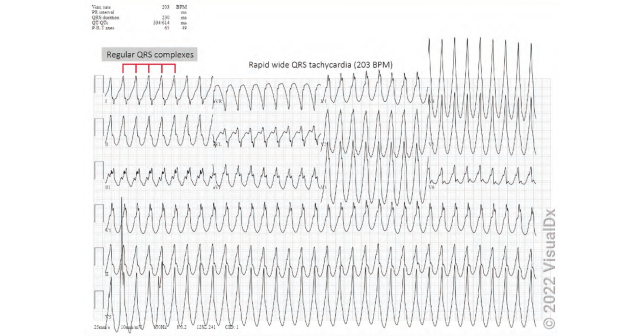
VisualDX Answer: d) Ventricular Tachycardia

By ACEP Now | on July 7, 2023 | 0 Comment
VisualDx
  • Tweet
  • Click to email a link to a friend (Opens in new window) Email
Print-Friendly Version

Answer: The correct answer is ventricular tachycardia (d).

You Might Also Like
  • VisualDX Question: What Does This Electrocardiogram Following Syncope Indicate?
  • Updates in the Management of Refractory Ventricular Tachycardia or Ventricular Fibrillation Arrest
  • Visual Dx Answer: a) Acute Chest Syndrome
Explore This Issue
ACEP Now: Vol 42 – No 07 – July 2023

Ventricular tachycardia (VT) is more common in men and in individuals older than 65 years. The most common risk factors include structural heart disease (i.e., cardiomyopathies), and ion-channel mutations (i.e., catecholaminergic polymorphic VT). Idiopathic VT occurs in a structurally normal heart and is very rare.

Presentation varies from asymptomatic to pulseless cardiac arrest. Common presenting symptoms are weakness, dizziness, palpitations, chest pain, shortness of breath, syncope, sudden collapse, and cardiac arrest.

Treatment varies depending on the presenting symptoms and the patient‘s hemodynamic stability. For pulseless VT, cardiopulmonary resuscitation needs to be started immediately. Other treatments include electrical cardioversion and the use of antiarrhythmic drugs (e.g., amiodarone or lidocaine). Patients with a history of life-threatening or recurrent VT will often undergo radiofrequency catheter ablation and/or placement of a cardioverter defibrillator (implantable or external).

(See the original question here.)

Member Benefit: All ACEP members receive a 20 percent discount on VisualDX.

Reference

  1. Anjeza Cipi MD, et al. Ventricular tachycardia. Visualdx website. Updated 03/29/2023. Accessed June 16, 2023.

Topics: AppsClinicalElectrocardiogramHeart Diseasesyncopeventricular tachycardiaVisualDx

Related

  • Non-Invasive Positive Pressure Ventilation in the Emergency Department

    October 1, 2025 - 0 Comment
  • Emergency Department Management of Prehospital Tourniquets

    October 1, 2025 - 0 Comment
  • ACEP’s October 2025 Poll: How Often Do You Read Your Own X-Rays?

    September 30, 2025 - 0 Comment

Current Issue

ACEP Now: November 2025

Download PDF

Read More

No Responses to “VisualDX Answer: d) Ventricular Tachycardia”

Leave a Reply Cancel Reply

Your email address will not be published. Required fields are marked *


*
*


Wiley
  • Home
  • About Us
  • Contact Us
  • Privacy
  • Terms of Use
  • Advertise
  • Cookie Preferences
Copyright © 2025 by John Wiley & Sons, Inc. All rights reserved, including rights for text and data mining and training of artificial technologies or similar technologies. ISSN 2333-2603
