Logo

Log In Sign Up |  An official publication of: American College of Emergency Physicians
Navigation
  • Home
  • Multimedia
    • Podcasts
    • Videos
  • Clinical
    • Airway Managment
    • Case Reports
    • Critical Care
    • Guidelines
    • Imaging & Ultrasound
    • Pain & Palliative Care
    • Pediatrics
    • Resuscitation
    • Trauma & Injury
  • Resource Centers
    • mTBI Resource Center
  • Career
    • Practice Management
      • Benchmarking
      • Reimbursement & Coding
      • Care Team
      • Legal
      • Operations
      • Quality & Safety
    • Awards
    • Certification
    • Compensation
    • Early Career
    • Education
    • Leadership
    • Profiles
    • Retirement
    • Work-Life Balance
  • Columns
    • ACEP4U
    • Airway
    • Benchmarking
    • Brief19
    • By the Numbers
    • Coding Wizard
    • EM Cases
    • End of the Rainbow
    • Equity Equation
    • FACEPs in the Crowd
    • Forensic Facts
    • From the College
    • Images in EM
    • Kids Korner
    • Medicolegal Mind
    • Opinion
      • Break Room
      • New Spin
      • Pro-Con
    • Pearls From EM Literature
    • Policy Rx
    • Practice Changers
    • Problem Solvers
    • Residency Spotlight
    • Resident Voice
    • Skeptics’ Guide to Emergency Medicine
    • Sound Advice
    • Special OPs
    • Toxicology Q&A
    • WorldTravelERs
  • Resources
    • ACEP.org
    • ACEP Knowledge Quiz
    • Issue Archives
    • CME Now
    • Annual Scientific Assembly
      • ACEP14
      • ACEP15
      • ACEP16
      • ACEP17
      • ACEP18
      • ACEP19
    • Annals of Emergency Medicine
    • JACEP Open
    • Emergency Medicine Foundation
  • About
    • Our Mission
    • Medical Editor in Chief
    • Editorial Advisory Board
    • Awards
    • Authors
    • Article Submission
    • Contact Us
    • Advertise
    • Subscribe
    • Privacy Policy
    • Copyright Information

VisualDX Answer: b) Peritonsillar Abscess

By ACEP Now | on August 15, 2023 | 0 Comment
VisualDx
  • Tweet
  • Click to email a link to a friend (Opens in new window) Email
Print-Friendly Version

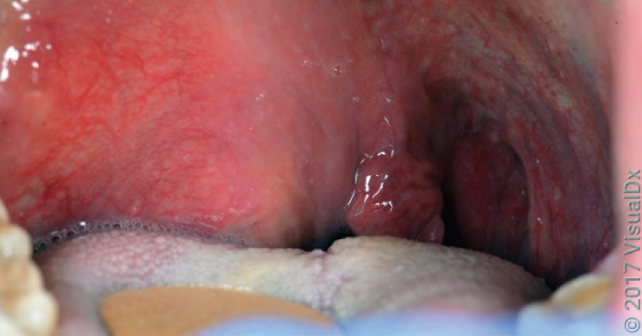
Answer: The correct answer is peritonsillar abscess (b).

You Might Also Like
  • VisualDX Question: Why Is This Man’s Throat Sore?
  • VisualDX Answer: d) Ventricular Tachycardia
  • Ultrasound-guided peritonsillar abscess drainage
Explore This Issue
ACEP Now: Vol 42 – No 08 – August 2023

Peritonsillar abscess, also known as quinsy, is a deep neck space infection characterized by a collection of pus in the peritonsillar space. This infection develops as a suppurative complication of acute tonsillitis or pharyngitis. As with other deep neck space infections, peritonsillar abscesses are frequently polymicrobial in nature and consist of mouth flora. Some important pathogens to consider when choosing empiric antibiotics include Group A Streptococcus, Staphylococcus aureus, Haemophilus, and Fusobacterium. Patients present with a muffled voice, fever, sore throat, and dysphagia. There is deviation of the uvula to the unaffected side. Trismus and otalgia may be present. This infection usually affects young adults, but all ages can be affected. Older adults may have subtle symptoms. Laboratory findings include leukocytosis. Treatment consists of antibiotic therapy and may require surgical drainage. Complications of this infection include airway obstruction or extension of the infection into contiguous spaces in the neck.

(See the original question here.)

Member Benefit: All ACEP members receive a 20 percent discount on VisualDX.

Reference

Mendoza N, Prasad P. Peritonsillar abcess. VisualDx website.Updated January 18, 2021. Accessed July 15, 2023.

Topics: AppsClinicalinfectionperitonsillar abscessquinsyVisualDx

Related

  • Non-Invasive Positive Pressure Ventilation in the Emergency Department

    October 1, 2025 - 0 Comment
  • Emergency Department Management of Prehospital Tourniquets

    October 1, 2025 - 0 Comment
  • ACEP’s October 2025 Poll: How Often Do You Read Your Own X-Rays?

    September 30, 2025 - 0 Comment

Current Issue

ACEP Now: November 2025

Download PDF

Read More

No Responses to “VisualDX Answer: b) Peritonsillar Abscess”

Leave a Reply Cancel Reply

Your email address will not be published. Required fields are marked *


*
*


Wiley
  • Home
  • About Us
  • Contact Us
  • Privacy
  • Terms of Use
  • Advertise
  • Cookie Preferences
Copyright © 2025 by John Wiley & Sons, Inc. All rights reserved, including rights for text and data mining and training of artificial technologies or similar technologies. ISSN 2333-2603
