
Logo

Log In Sign Up |  An official publication of: American College of Emergency Physicians
Navigation
  • Home
  • Multimedia
    • Podcasts
    • Videos
  • Clinical
    • Airway Managment
    • Case Reports
    • Critical Care
    • Guidelines
    • Imaging & Ultrasound
    • Pain & Palliative Care
    • Pediatrics
    • Resuscitation
    • Trauma & Injury
  • Resource Centers
    • mTBI Resource Center
  • Career
    • Practice Management
      • Benchmarking
      • Reimbursement & Coding
      • Care Team
      • Legal
      • Operations
      • Quality & Safety
    • Awards
    • Certification
    • Compensation
    • Early Career
    • Education
    • Leadership
    • Profiles
    • Retirement
    • Work-Life Balance
  • Columns
    • ACEP4U
    • Airway
    • Benchmarking
    • Brief19
    • By the Numbers
    • Coding Wizard
    • EM Cases
    • End of the Rainbow
    • Equity Equation
    • FACEPs in the Crowd
    • Forensic Facts
    • From the College
    • Images in EM
    • Kids Korner
    • Medicolegal Mind
    • Opinion
      • Break Room
      • New Spin
      • Pro-Con
    • Pearls From EM Literature
    • Policy Rx
    • Practice Changers
    • Problem Solvers
    • Residency Spotlight
    • Resident Voice
    • Skeptics’ Guide to Emergency Medicine
    • Sound Advice
    • Special OPs
    • Toxicology Q&A
    • WorldTravelERs
  • Resources
    • ACEP.org
    • ACEP Knowledge Quiz
    • Issue Archives
    • CME Now
    • Annual Scientific Assembly
      • ACEP14
      • ACEP15
      • ACEP16
      • ACEP17
      • ACEP18
      • ACEP19
    • Annals of Emergency Medicine
    • JACEP Open
    • Emergency Medicine Foundation
  • About
    • Our Mission
    • Medical Editor in Chief
    • Editorial Advisory Board
    • Awards
    • Authors
    • Article Submission
    • Contact Us
    • Advertise
    • Subscribe
    • Privacy Policy
    • Copyright Information

Virginia Commonwealth University Improves Patient Flow Through “Vision in Action” Model

By Shari Welch, MD, FACEP | on January 10, 2018 | 2 Comments
Special OPs
  • Tweet
  • Click to email a link to a friend (Opens in new window) Email
Print-Friendly Version
IMAGES: Virginia Commonwealth University

The newly designed flow model also involved the creation of small internal waiting rooms (see Figure 2) to keep patients moving forward, with a goal of never sending them back to the main waiting room.

You Might Also Like
  • Rhode Island Hospital ED Boosts Efficiency by Adopting Brown University Patient Flow Model
  • Segmentation Improves Emergency Department Patient Flow at Raritan Bay Medical Center
  • Intermountain Medical Center in Utah Improves Efficiency, Performance with Vertical Flow Model
Explore This Issue
ACEP Now: Vol 37 – No 01 – January 2018

Finally, a front flow facilitator monitored flow into the department and kept things moving in the front of the department, while a back flow facilitator monitored flow in the major care areas and into the hospital. These highly trained and experienced nurses performed no direct patient care but rather functioned like air traffic controllers, making sure that flow into and out of the department was smooth and efficient.

The Results

The results were astounding. First, the productivity of the minor care areas more than doubled. The variation was proportional to the ESI breakdown of arrivals that 24-hour cycle (see Table 1).

Table 1. Patient Volume Processed Through Each Area

(click for larger image) Table 1. Patient Volume Processed Through Each Area
RCT=rapid cycle test

Then in terms of measured operational performance, the new model really rocked. The VCU emergency department is now posting median wait times to see the physician of fewer than 10 minutes and walkaway rates of less than 1 percent (see Table 2).
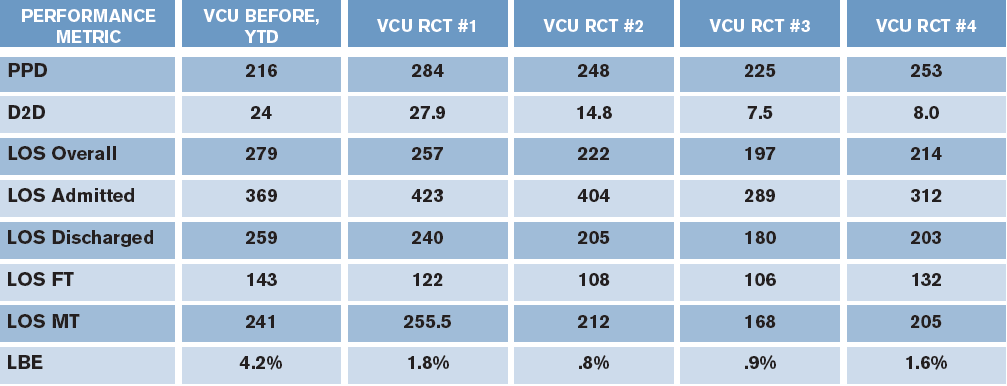
Table 2. Pre- and Postimplementation Performance Metrics

(click for larger image) Table 2. Pre- and Postimplementation Performance Metrics
RCT=rapid cycle test; PPD=patients per day (24-hour period); D2D=door-to-doctor time; LOS=length of stay; FT=fast track; MT=mid track; LBE=left before examination

Most departments of such high volume, with teaching missions and tertiary care delivery, find it hard to achieve this kind of performance. By engaging the physicians and staff early and delegating pieces of this global improvement project to individuals, they moved the entire department forward. The VCU leadership team refused to accept mediocre metrics, and together it put its vision in action!

Pages: 1 2 | Single Page

Topics: EfficiencyEmergency DepartmentEmergency MedicineEmergency PhysiciansPatient CarePatient FlowPractice ManagementWorkforceWorkload

Related

  • Florida Emergency Department Adds Medication-Dispensing Kiosk

    November 7, 2025 - 1 Comment
  • Q&A with ACEP President L. Anthony Cirillo

    November 5, 2025 - 0 Comment
  • Let Core Values Help Guide Patient Care

    November 5, 2025 - 0 Comment

Current Issue

ACEP Now: November 2025

Download PDF

Read More

About the Author

Shari Welch, MD, FACEP

Shari Welch, MD, FACEP, is a practicing emergency physician with Utah Emergency Physicians and a research fellow at the Intermountain Institute for Health Care Delivery Research. She has written numerous articles and three books on ED quality, safety, and efficiency. She is a consultant with Quality Matters Consulting, and her expertise is in ED operations.

View this author's posts »

2 Responses to “Virginia Commonwealth University Improves Patient Flow Through “Vision in Action” Model”

  1. January 22, 2018

    Peter Rizzo Reply

    There is concern of scope creep in this; why can’t the doctor at triage order tests? This established a huge bias at beginning of work up. I’d like to see if a physician at triage could only make decisions on resource management alone. However, I’m sceptical of people “wasting” that doctor as a secondary triage.

  2. March 1, 2018

    Shari Welch Reply

    Hello Peter,

    I think the best results for physician in triage are seen when the physician is resourced to begin work-ups in triage. If all he does is determine the patient’s level of care and zone, sending patients back to the waiting room, you do not gain much in terms of time shaved off the LOS. You are playing to the metric. The only exception would be if the physician determines the stream and the patient is immediately bedded and a SWARM model employed to begin care in the back.

    If you put the patient and physician together in triage for quick streaming and then send the majority back to the waiting room, you will not optimize the pIT model. You will be playing to the metric, but not shortening LOS or decreasing walkaways and patient satisfaction will not change much. That is what VCU saw. They had short D2D but high walkaways, a full waiting room and poor patient flow. When PIT was properly resourced everything changed and improved!

    S

Leave a Reply Cancel Reply

Your email address will not be published. Required fields are marked *


*
*


Wiley
  • Home
  • About Us
  • Contact Us
  • Privacy
  • Terms of Use
  • Advertise
  • Cookie Preferences
Copyright © 2025 by John Wiley & Sons, Inc. All rights reserved, including rights for text and data mining and training of artificial technologies or similar technologies. ISSN 2333-2603
