
Explore This Issue
ACEP Now: Vol 33 – No 08 – August 2014Eighty-seven percent of intubations were performed by emergency physicians. In more than two-thirds of cases, rapid sequence intubation was utilized.
The Skeptics Guide to Emergency Medicine (SGEM) is a knowledge translation project. Its goal is to cut the knowledge translation window down from an average of 10 years to one year. The SGEM uses a validated and reliable tool to turn a skeptical eye on the literature. This information is then disseminated using social media to provide high-quality, clinically relevant, evidence-based information so that you can deliver the best care to your patients.
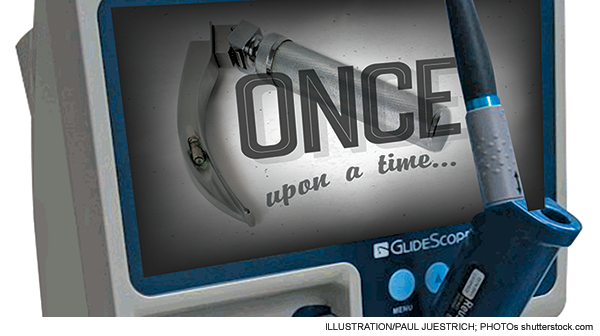
The Case: A 21-year-old male presents collared and boarded from a motor vehicle collision. He is combative, with an obvious head injury, several extremity fractures, and a surgical abdomen. It is clear that he needs to be intubated. You set up your equipment for intubation, and one of the nurses asks you, “Are you going to use DL [direct laryngoscopy] or the GlideScope?”
Question: Which is better for intubation in trauma patients: video or direct laryngoscopy?
Background
Emergency medicine owns the acute airway. A 2011 paper by Walls et al from the National Emergency Airway Registry showed that 87 percent of intubations were performed by emergency physicians. In more than two-thirds of cases, rapid sequence intubation (RSI) was utilized. There have been a number of advances in the last few years. Many of these advances have been in new airway management devices. There are a variety of video laryngoscopy (VL) tools that are displacing traditional DL. For an excellent discussion on the complexities of DL versus VL, check out the 2011 paper by Levitan et al in the Annals of Emergency Medicine. Another good resource is by Levitan and Weingart in the Annals of Emergency Medicine in 2012.
Relevant Article
- Population: Trauma patients at Shock Trauma in Baltimore
- Intervention: Video laryngoscopy (GlideScope)
- Comparison: Direct laryngoscopy
- Outcomes:
- Primary: Mortality
- Secondary: Survival among subgroups, duration of intubation attempt, desaturation during procedure, first-pass success rates
- Authors’ Conclusions: VL and DL are similar for mortality; post-hoc analysis showed possible increased mortality in those with the most severe head injuries who were randomized into the VL group.
Quality Checklist for Randomized Control Trials
- Were these ED patients? Yes, but only the most injured get transferred to Shock Trauma so they may have higher Injury Severity Scores than the average ED
- Were the patients adequately randomized? Yes
- Was the randomization process concealed? Yes
- Were the patients analyzed in the groups to which they were randomized? Yes
- Were patients recruited consecutively? No
- Were patients in both groups similar with respect to prognostic factors? Yes
- Were participants unaware of group allocation? No
- Were groups treated equally except for the intervention? Yes
- Was follow-up complete? Yes
- Were all patient-important outcomes considered? Yes
- Was the treatment effect large enough and precise enough to be clinically significant? No
Key Results
- Primary Outcome: Mortality was the same.
- Secondary Outcomes: VL resulted in a longer time to intubation (56 seconds versus 40 seconds). Post-hoc analysis showed that those with the most severe head injuries had a higher mortality and more frequent desaturations below 80 percent (50 percent in VL versus 24 percent in DL). However, this was not included in the original study design. First-pass success was the same in both groups at 80 percent
Comments
This was a well-done study with one significant weakness. The one weakness is that attending physicians were permitted to not enroll patients if they did not want to take part of this study, even if they were eligible. This could have introduced significant selection bias because the more difficult airways may not have been included due to the attending physicians wanting to use the technique that they were more comfortable with. According to the authors, those excluded did not differ significantly from the enrolled patients.
The treating physicians knew the treatment assignments, but this is not a concern because it is not possible to blind the clinicians given that VL and DL are different procedures that require different equipment.
The strengths include that it was a randomized trial, all patients were followed up for the primary endpoint, and the study used video to record the resuscitation to avoid any bias inherent in a chart review.
The Bottom Line
VL leads to the same outcome as DL in trauma patients. VL takes longer to accomplish and may be associated with higher mortality in patients with severe head injuries. However, this relationship will require more study to confirm.
Case Resolution
You decide to use the GlideScope in this case because you feel that it might be better since the patient is in a cervical collar. Knowing that it may take a little longer to pass the tube, you make sure to properly pre-oxygenate the patient with high-flow oxygen with a non-rebreather mask at 30 to 60 liters per minute and use a nasal cannula set at 15 liters per minute kept on during your intubation attempt. You get an excellent view with the GlideScope and pass the tube on your first attempt.
Thank you to Dr. Steve Carroll from EM Basic for his help on this review.
Remember to be skeptical of anything you learn, even if you learned it from the Skeptics Guide to Emergency Medicine.
References
- Levitan RM, Heitz JW, Sweeney M, Cooper RM. The complexities of tracheal intubation with direct laryngoscopy and alternative intubation devices. Ann Emerg Med. 2011;57:240-247.
- Weingart SD1, Levitan RM. Preoxygenation and prevention of desaturation during emergency airway management. Ann Emerg Med. 2012;59:165-175.e1.
 Dr. Milne is chief of emergency medicine and chief of staff at South Huron Hospital, Ontario, Canada. He is on the Best Evidence in Emergency Medicine faculty and is creator of the knowledge translation project the Skeptics Guide to Emergency Medicine (www.TheSGEM.com).
Pages: 1 2 | Multi-Page




No Responses to “Is Video or Direct Laryngoscopy Better for Intubation in Trauma Patients?”