Logo

Log In Sign Up |  An official publication of: American College of Emergency Physicians
Navigation
  • Home
  • Multimedia
    • Podcasts
    • Videos
  • Clinical
    • Airway Managment
    • Case Reports
    • Critical Care
    • Guidelines
    • Imaging & Ultrasound
    • Pain & Palliative Care
    • Pediatrics
    • Resuscitation
    • Trauma & Injury
  • Resource Centers
    • mTBI Resource Center
  • Career
    • Practice Management
      • Benchmarking
      • Reimbursement & Coding
      • Care Team
      • Legal
      • Operations
      • Quality & Safety
    • Awards
    • Certification
    • Compensation
    • Early Career
    • Education
    • Leadership
    • Profiles
    • Retirement
    • Work-Life Balance
  • Columns
    • ACEP4U
    • Airway
    • Benchmarking
    • Brief19
    • By the Numbers
    • Coding Wizard
    • EM Cases
    • End of the Rainbow
    • Equity Equation
    • FACEPs in the Crowd
    • Forensic Facts
    • From the College
    • Images in EM
    • Kids Korner
    • Medicolegal Mind
    • Opinion
      • Break Room
      • New Spin
      • Pro-Con
    • Pearls From EM Literature
    • Policy Rx
    • Practice Changers
    • Problem Solvers
    • Residency Spotlight
    • Resident Voice
    • Skeptics’ Guide to Emergency Medicine
    • Sound Advice
    • Special OPs
    • Toxicology Q&A
    • WorldTravelERs
  • Resources
    • ACEP.org
    • ACEP Knowledge Quiz
    • Issue Archives
    • CME Now
    • Annual Scientific Assembly
      • ACEP14
      • ACEP15
      • ACEP16
      • ACEP17
      • ACEP18
      • ACEP19
    • Annals of Emergency Medicine
    • JACEP Open
    • Emergency Medicine Foundation
  • About
    • Our Mission
    • Medical Editor in Chief
    • Editorial Advisory Board
    • Awards
    • Authors
    • Article Submission
    • Contact Us
    • Advertise
    • Subscribe
    • Privacy Policy
    • Copyright Information

Traumatic Coronary Artery Dissection Diagnosis Tips

By Anton Helman, MD, CCFP(EM), FCFP | on November 7, 2024 | 1 Comment
EM Cases
  • Tweet
  • Click to email a link to a friend (Opens in new window) Email
Print-Friendly Version

While many of us are familiar with spontaneous coronary artery dissection (SCAD) as a common cause of myocardial ischemia in young people, traumatic coronary artery dissection (TCAD) is a rare, potentially life-threatening diagnosis that is challenging to diagnose and often missed in the emergency department (ED), as the clinical features overlap with more common diagnoses that result from blunt chest trauma.1 It is important to pick up this diagnosis early, as emergency treatment with percutaneous coronary intervention (PCI) to restore blood from to the heart can be lifesaving. In this ACEP Now column, I hope to elucidate some of the key clinical clues of TCAD to maximize your chances of picking it up in your blunt chest trauma patients.

You Might Also Like
  • The Many Faces of Spontaneous Cervical Artery Dissection
  • Headache and Neck Pain – When to Suspect Cervical Artery Dissection
  • Similar Outcomes of Cervical-Artery Dissection With Antiplatelet, Anticoagulation Therapy
Explore This Issue
ACEP Now: Vol 43 – No 11 – November 2024

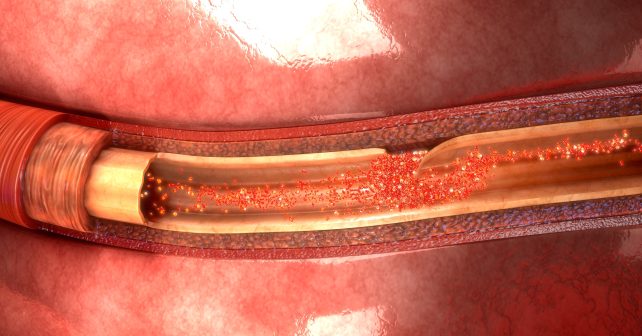
TCAD occurs as a result of rapid deceleration, which increases shear forces on the endothelium of the coronary artery. The stress of the traumatic event causes an acute increase in blood pressure. The combination of shear forces on the coronary artery endothelium and sudden increase in blood pressure results in TCAD. The dissection of the coronary artery that occurs in TCAD may lead to thrombus and/or vasospasm resulting in myocardial infarction and all of its potential complications, including death. Aortic dissection as a result of blunt trauma is often immediately fatal, and if patients do survive to be transported to the ED, it can be difficult to diagnose. By contrast, traumatic aortic dissection does not cause cardiac ischemia like TCAD typically does.

There are several reasons TCAD is often missed in the ED besides it being a rare entity with an incidence of only 0.1 percent.2 First, TCAD may result from a relatively low energy mechanism such as a seemingly innocuous blow to the chest in sport. Second, it is predominately diagnosed in young people; 82 percent of patients with acute myocardial infarction after chest trauma are under 45 years of age.3 Another reason TCAD is easily missed in the ED is that the most common cause of TCAD is a motor vehicle crash caused by deceleration and traction or direct impact, and concurrent traumatic injuries in these cases often overshadow the diagnosis.4 Patients may present with altered mental status, rendering them unable to convey symptoms of cardiac ischemia. Generalized chest pain has a broad differential diagnosis in the polytrauma patient. Other cardiac injuries are often considered first, such as cardiac contusion, dysrhythmias, and cardiac tamponade. Finally, symptoms of TCAD may not present for several hours, days, or weeks after the inciting traumatic event, as the rate of expansion of the false lumen may vary considerably.5

Pages: 1 2 3 | Single Page

Topics: Arterial DissectionClinicalTrauma & Injury

Related

  • Non-Invasive Positive Pressure Ventilation in the Emergency Department

    October 1, 2025 - 0 Comment
  • Emergency Department Management of Prehospital Tourniquets

    October 1, 2025 - 0 Comment
  • ACEP’s October 2025 Poll: How Often Do You Read Your Own X-Rays?

    September 30, 2025 - 0 Comment

Current Issue

ACEP Now: November 2025

Download PDF

Read More

One Response to “Traumatic Coronary Artery Dissection Diagnosis Tips”

  1. November 23, 2024

    Brian Levy Reply

    another great short to the point article, Anton Thanks.

Leave a Reply Cancel Reply

Your email address will not be published. Required fields are marked *


*
*


Wiley
  • Home
  • About Us
  • Contact Us
  • Privacy
  • Terms of Use
  • Advertise
  • Cookie Preferences
Copyright © 2025 by John Wiley & Sons, Inc. All rights reserved, including rights for text and data mining and training of artificial technologies or similar technologies. ISSN 2333-2603