
See question
Answer: Both!
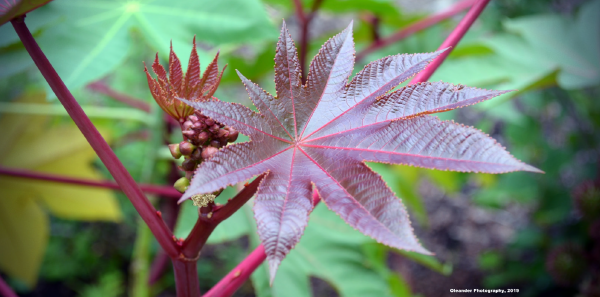
The castor plant is a beautiful, large semi-woody shrub that can grow to 40-feet tall in the right environment. The star-shaped leaves can grow more than 2.5 feet across. Each lobed leaf has serrated edges and prominent central veins that vary in color from green to red to white. Many species have glossy green leaves; others can be purplish, dark red, or maroon. The stems are often a striking red color.
Explore This Issue
ACEP Now: Vol 38 – No 03 – March 2019The female flower develops a bundle of seed capsules, each about the size of a large walnut, which are covered with soft flexible spines after pollination. They have notable colors of coral pink or red that fade to brown with maturity.
To protect and defend themselves from herbivores, some plants develop innate immune systems. These defense mechanisms include lectins and proteins that act to make the threatening animals ill after ingestion, resulting in future plant avoidance.
Properties
The castor plant has been recognized for thousands of years as having properties that can be used for health benefit but may also be harmful. The two major components are castor oil and ricin.
Ricin: The Poison
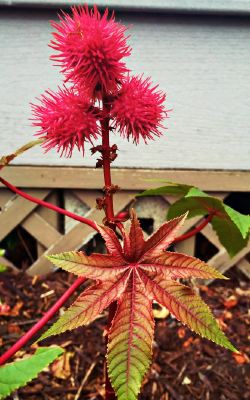
Castor Bean Plant
Ricinus Communis
Ricin is a poison found naturally in castor beans. A nonmalicious exposure might occur if a castor bean is chewed and swallowed. Mastication releases ricin and causes injury.
Ricin is a natural product that is created from waste material when processing castor beans. It is a heat-labile powder, dissolvable in water or weak acid.
Ricin is a toxalbumin (protein toxin) that is composed of two chains, A and B (the “killer” and the “key”). As a group, they are referred to as ribosome-inactivating proteins (RIPs).
The B chain (key) is a lectin that binds to cell membrane surface glycoproteins and glycolipids, which causes endocytosis and allows ricin to access the cell. Once inside, the A chain (killer) irreversibly inactivates RNA, stopping protein synthesis, leading to cell death.
Ricin is estimated to be 6,000 times more poisonous than cyanide and 12,000 times more poisonous than rattlesnake venom.
One milligram of ricin can kill an adult. The symptoms of human poisoning begin within a few hours of ingestion.
Exposure Route
After ingestion, nonspecific symptoms—including nausea, vomiting, diarrhea, and abdominal pain—develop after approximately 12 hours. Ultimately, this progresses to hypotension, liver failure, renal dysfunction, and may progress to death due to multiple organ failure or cardiovascular collapse. After inhalation, symptoms develop within eight hours and include cough, dyspnea, arthralgias, and fever, which may progress to respiratory distress and death, without other organ system manifestations.
Castor Oil
Castor oil, historically known as Oleum Palmae Christi, comes from the seeds of the Ricinus communis plant and has been used therapeutically for centuries. No ricin is thought to remain in the oil and it would be inactivated during extraction due to heating of the oil.
Castor oil is metabolized to ricinoleic acid, which is absorbed in the intestine. This acts as a strong laxative that has been used medicinally dating back to ancient cultures. Castor oil can also induce labor but has a poor safety profile and thus is not used clinically.
Treatment
There is no antidote and no specific treatment for ricin poisoning. The treatment is supportive for the organs affected.
Interesting Facts
The name Ricinus is a Latin word for tick because the seed of the plant has markings and a bump at the end that resemble certain ticks.
This plant is commonly regarded as one of the most poisonous in the world.
Four seeds can kill an average-sized adult, while ingestion of lesser amounts has resulted in gastrointestinal symptoms and convulsions.
Ricin is suspected to have been the poisonous agent used to assassinate Georgi Markov, a Bulgarian journalist who spoke out against the Bulgarian government, in 1978. He was stabbed with the point of an umbrella while waiting at a bus stop in London. His autopsy revealed a perforated metallic pellet embedded in his leg that presumably contained ricin.
It is advisable to keep children away from the castor bean plant or necklaces made with its seeds.
Ricin has been used experimentally in medicine to kill cancer cells.
Dr. Hack (Oleander Photography) is an emergency physician and medical toxicologist who enjoys taking photographs of beautiful toxic, medicinal, and benign flowers that he stumbles upon or grows in his garden. Contact him at ToxInRI@gmail.com.
Pages: 1 2 | Multi-Page




4 Responses to “Toxicology Q&A Answer: Castor Beans Can Kill, and the Oil Is Iffy, Too”
March 24, 2019
Arno Vosk, M.D.Nice, informative article. Where does the castor plant grow?
August 29, 2020
Conny Huthsteiner, MDI grows in southern climates, grows wild here in Los Angeles, if it starts somewhere.
December 19, 2021
EdwinThank you doctor for the information. However, does application of castor oil on a Kaposi’s Sacoma leg help in treating KS?
April 7, 2019
Steven Marcus, MDThe literature showing that ingestion of any amount of castor beans causing death is all old and “iffy” at best. It certainly can cause vomiting and diarrhea, and 70 years ago, without adequate methods for hydration, there were deaths reported.
There are hundreds, if not thousands, of exposures to the bean by various routes, each year, and to my knowledge, no deaths.
Death from ricin has been reported anecdotally, as the result of injection of the substance. The murder of Bulgarian dissident Georgi Markov by the KGB is always used as an example. There have been other attempts at weaponizing ricin, but to my knowledge, and my attempt to search the literature, I have never been able to find any reliable reports.
Let us continue to consider the plant and seeds as potential poisons, not as confirmed ones, except in a few rare situations.