
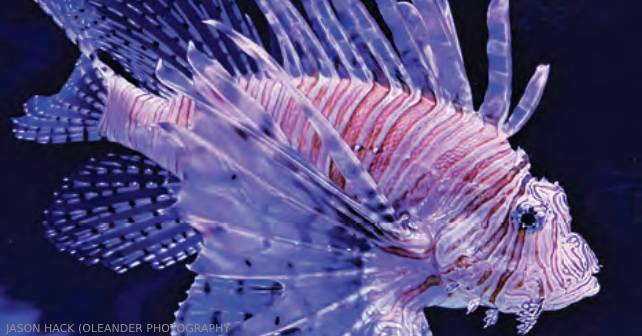
Lionfish (Pterois species) are members of the family Scorpaenidae, which includes lionfish (Pterois), scorpionfish (Scorpaena), and stonefish (Synanceia). They also are commonly called butterfly cod, firefish, peacock lionfish, and turkeyfish in some places.
Explore This Issue
ACEP Now: Vol 43 – No 08 – August 2024They deliver one of the most painful stings a human can receive from a marine creature. People are most commonly stung in the hand while snorkeling, diving, spearfishing, cooking them, or feeding them in aquaria.1
They are venomous, voracious piscivores that prey on small reef fish and crustaceans up to their own body size, and they naturally inhabit the Indo-Pacific oceans, living near corals, sea grass, or hard-bottomed areas. In 1985, they were spotted in Dania Beach, Fla., and have spread invasively with the sea currents up the East Coast of the United States (spotted in North Carolina in 2000) and into the Caribbean.2 The Pterois miles and volitans invasion exemplifies a bioinvasive species that was inadvertently introduced through anthropogenic corridors, such as trade, ballast water dumping, and unwanted pet disposal, into non-native areas where they have profound effects.
Lionfish are “perfect storm” invaders: Females can lay two million eggs a year; they grow faster than other species in the area; they have a very broad generalist diet and more tolerance for fasting than their competition; they are adaptable to many living environments, tolerating varying salinities and temperatures, for example; they have few to no natural predators in new areas that can bypass their anatomic defenses; and they have parasite resistance.3 These attributes allow them to kill or displace native species, causing profound changes and damage in these novel regional coastal ecosystems.4 Lionfish are one of the most ecologically harmful marine fish invasions to date.
Lionfish Anatomy
The dramatic striped fins of the lionfish hide a painful surprise for anyone who unwisely tries to pet or grab one of them. The red lionfish has 18 venomous spines (13 dorsal spines, two pelvic spines, and three anal spines). When threatened, the fish turns its back to the threat and assumes a defensive head down posture, frilling the dorsal spines. The pectoral (lateral chest) spines are not venomous.5
Spine Anatomy
In nature, spines are multifunctional biological materials that assist organisms in gripping, injecting, damaging, and defending. In lionfish, each spine consists of a rigid core spike that has three longitudinal grooves—in cross section, it’s tri-lobed and looks like a three-leaf clover—that contain embedded venom-producing glands wrapped in a “sheath” of tissue, presumably so the venom isn’t washed away. Unlike the keratin spines found in porcupines, hedgehogs, and echidnas, these central, needle-sharp, hard spikes are made of hydroxyapatite and collagen.5,6 When a spine punctures soft tissue, the pointy tip of the rigid core depresses, piercing the thin tissue sheath and jabbing the venom-filled grooves into the flesh.7 Depending on velocity of contact, this action can fracture the spike and leave foreign body fragments of the spine within the tissue.5,8 Interestingly, the break forms a new point that can be used for future defense.
Symptoms of Envenomation
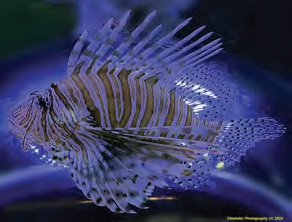
People are most commonly stung in the
hand by the lionfish.
Local effects: Local effects of lionfish envenomation include severe localized pain, swelling, and potential tissue necrosis. Dermal wounds are classified into:
- Grade I: local erythema, pallor, or cyanosis
- Grade II: vesicles at the sting site
- Grade III: local necrosis
Sensory alterations, such as anesthesia, paresthesia, or hypesthesia, can occur and may persist for weeks.8
Systemic Effects
Systemic effects are infrequent but can include nausea, diaphoresis, dyspnea, weakness, hypotension, and chills. More severe systemic reactions like delirium, seizures, limb paralysis, blood pressure changes, respiratory distress, dysrhythmia, myocardial ischemia, and syncope are rare.9
Pain
Extreme pain is a universal symptom of lionfish stings; it’s described as one of the most painful stings a person can receive from a marine creature.10
A survey study of more than 500 lionfish sting victims revealed that the immediate and intense pain caused by the sting extends radially from the wound, reaching its full potency after about one to two hours, and can continue for 24 hours or even weeks. This excruciating pain is described by many victims as a continuous burning, tingling, and numbness.1
Mechanism of Action
The pain-producing (algogenic) mechanisms of the lionfish venom are interesting. While bradykinin (found in the venom of the Hymenoptera order of insects) and capsaicin receptors (found in the venom of several tarantulas) do not contribute to the pain caused by the lionfish venom, it does contain hyaluronidases, acetylcholine (which causes swelling and inflammation), and other heat-labile peptides that have a specific excitatory effect in the central and peripheral nervous system and act almost exclusively on small-diameter nonpeptidergic nociceptors while nearby large-diameter neurons are unaffected.10 This nociceptor specificity likely developed evolutionarily as a defense mechanism to deter predators, not as a means to immobilize prey.11
Treatment for Lionfish Envenomation
Atkinson and colleagues performed a literature review on traditional treatments of marine envenomations, including vinegar, fig juice, boiled cactus, heated stones, hot urine, hot water, and ice.12 They concluded that the only effective pain treatment for fish spine injuries is to immerse the affected area in hot water.
Although not standardized, the most commonly suggested method is hot water (42-45 °C) immersion (hot but not scalding shower) for 30- 90 minutes or until the pain resolves.13 The heat is thought to either denature the venom, lessen the discomfort by causing a modulation of pain receptors, or both.
Additional pain management interventions include analgesic pain medicine, infiltration of the area with lidocaine, or regional blocks.
Other local wound care includes irrigation, debridement of necrotic tissue, X-ray if there is suspected retained foreign body, and tetanus immunization if needed.
Antibiotics are broadly recommended for wounds that appear infected; prophylactic antibiotic administration is contested except with deep punctures, wounds contaminated with material, or those with significant tissue insult.
Antibiotic selection must cover a multitude of saltwater bacteria, including Vibrio. If chosen, prophylactic antibiotics would be ciprofloxacin or trimethoprim-sulfamethoxazole.
Parenteral antibiotics include cefotaxime, ceftazidime, chloramphenicol, gentamicin, or tobramycin.
Fulminant infections should be treated with imipenem/cilastatin until cultures return.14
No antivenom is currently available for lionfish venom.
Soft tissue wounds left by lionfish may take weeks or longer to heal.
Other Uses
Once the venomous spines are carefully removed, these fish are reportedly delicious. I saw a cookbook for lionfish that includes lionfish eggs Benedict and lionfish croquettes.
 Dr. Hack is chief of the division of medical toxicology and vice chair for research at East Carolina University in Greenville, N.C.
References
- Mouchbahani-Constance S, Choinière M, Sharif-Naeini R. (2023). Understanding the pain experience of lionfish envenomation. Pain Rep. 2023;8(5):e1090.
- Johnston MW, Purkis SJ. Spatial analysis of the invasion of lionfish in the western Atlantic and Caribbean. Mar Pollut Bull. 2011;62(6):1218-1226.
- Côté IM, Smith NS. The lionfish Pterois sp. invasion: Has the worst-case scenario come to pass? J Fish Biol. 2018;92(3):660-689.
- Savva I, Chartosia N, Antoniou C, et al. They are here to stay: the biology and ecology of lionfish (Pterois miles) in the Mediterranean Sea. J Fish Biol. 2020;97:148-162.
- Galloway KA, Porter ME. Predator–prey interactions examined using lionfish spine puncture performance. Integr Org Biol. 2021;3(1):obaa049.
- Galloway KA, Porter ME. Mechanical properties of the venomous spines of Pterois volitans and morphology among lionfish species. J Exp Biol. 2019;222(6):jeb197905.
- Resiere D, Cerland L, De Haro L, et al. Envenomation by the invasive Pterois volitans species (lionfish) in the French West Indies—a two-year prospective study in Martinique. Clin Toxicol (Phila). 2016;54:313-318.
- Vetrano SJ, Lebowitz JB, Marcus S. Lionfish envenomation. J Emerg Med. 2002;23(4):379-382.
- Kizer KW, McKinney HE, Auerbach PS. Scorpaenidae envenomation. A five-year poison center experience. JAMA. 1985;253(6):807-810.
- Mouchbahani-Constance S, Lesperance LS, Petitjean H, et al. Lionfish venom elicits pain predominantly through the activation of nonpeptidergic nociceptors. Pain. 2018;159(11):2255-2266.
- Chuang PS, Shaio JC. Toxin gene determination and evolution in scorpaenoid fish. Toxicon. 2014;88:21–33.
- Atkinson PRT, Boyle A, Hartin D, et al. Is hot water immersion an effective treatment for marine envenomation? Emerg Med J. 2006;23(7):503-508.
- Perkins RA, Morgan SS. Poisoning, envenomation, and trauma from marine creatures. Am Fam Physician. 2004;69(4):885-890.
- Auerbach PS. Marine envenomations. N Engl J Med. 1991;325(7):486-493.
Click here to see the original question.
Pages: 1 2 3 4 | Multi-Page



No Responses to “Toxicology Answer: the Lionfish, a Dangerous, Non-Native Invader”