Logo

Log In Sign Up |  An official publication of: American College of Emergency Physicians
Navigation
  • Home
  • Multimedia
    • Podcasts
    • Videos
  • Clinical
    • Airway Managment
    • Case Reports
    • Critical Care
    • Guidelines
    • Imaging & Ultrasound
    • Pain & Palliative Care
    • Pediatrics
    • Resuscitation
    • Trauma & Injury
  • Resource Centers
    • mTBI Resource Center
  • Career
    • Practice Management
      • Benchmarking
      • Reimbursement & Coding
      • Care Team
      • Legal
      • Operations
      • Quality & Safety
    • Awards
    • Certification
    • Compensation
    • Early Career
    • Education
    • Leadership
    • Profiles
    • Retirement
    • Work-Life Balance
  • Columns
    • ACEP4U
    • Airway
    • Benchmarking
    • Brief19
    • By the Numbers
    • Coding Wizard
    • EM Cases
    • End of the Rainbow
    • Equity Equation
    • FACEPs in the Crowd
    • Forensic Facts
    • From the College
    • Images in EM
    • Kids Korner
    • Medicolegal Mind
    • Opinion
      • Break Room
      • New Spin
      • Pro-Con
    • Pearls From EM Literature
    • Policy Rx
    • Practice Changers
    • Problem Solvers
    • Residency Spotlight
    • Resident Voice
    • Skeptics’ Guide to Emergency Medicine
    • Sound Advice
    • Special OPs
    • Toxicology Q&A
    • WorldTravelERs
  • Resources
    • ACEP.org
    • ACEP Knowledge Quiz
    • Issue Archives
    • CME Now
    • Annual Scientific Assembly
      • ACEP14
      • ACEP15
      • ACEP16
      • ACEP17
      • ACEP18
      • ACEP19
    • Annals of Emergency Medicine
    • JACEP Open
    • Emergency Medicine Foundation
  • About
    • Our Mission
    • Medical Editor in Chief
    • Editorial Advisory Board
    • Awards
    • Authors
    • Article Submission
    • Contact Us
    • Advertise
    • Subscribe
    • Privacy Policy
    • Copyright Information

Tips and Tricks for Performing Cricothyrotomy

By Richard M. Levitan, MD, FACEP | on February 6, 2014 | 6 Comments
Features
  • Tweet
  • Click to email a link to a friend (Opens in new window) Email
Print-Friendly Version

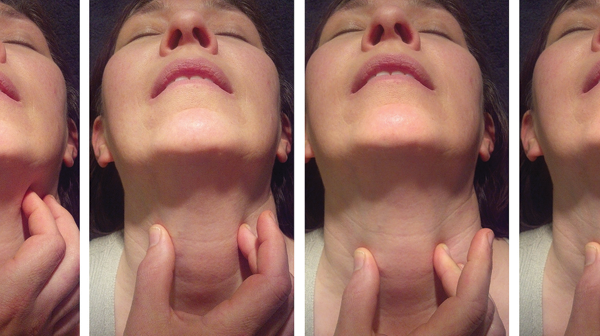
I initiate the laryngeal handshake with my dominant right hand (see Figure 5). Ergonomically, I prefer to stand on the patient’s right side (at the thorax) so that when holding the scalpel, I can rest my cutting hand on the sternum. (We will address sternal stabilization in part two of this series.)

You Might Also Like
  • How to Make the Incision, Insert the Tube in Cricothyrotomy
  • 10 Tips for Safety in Airway Management
  • Tips to Improve Airway Management
Explore This Issue
ACEP Now: Vol 33 – No 02 – February 2014

I started gently up high with the hyoid, using the thumb and index finger, under the angle of the mandible. Staying lateral to midline, slide down to the broad, firm, thyroid lamina. At this point, use the index finger to come to midline and palpate the thyroid prominence in men. Lower down is the inferior cornu of the thyroid, bilaterally overlapping the cricoid cartilage. This is the bottom of the rhomboid, below which are the softer tracheal rings. Using the firm lamina of the thyroid as a guide (and especially if the thyroid prominence is not felt) the index finger is brought midline to the cricothyroid membrane at the inferior aspect of the lamina. In men, the thyroid cartilage is always more prominent than the cricoid, but in women they often have equal prominence.

After performing the laryngeal handshake with the dominant hand, switch to the non-dominant hand and grab the same landmarks. Use the non-dominant hand to stabilize the larynx (on the thyroid lamina) with the index finger over the cricothyroid. The dominant hand holds the scalpel and is stabilized on the sternum. Sternal stabilization is needed to make a controlled incision. We address this in part two of this series.
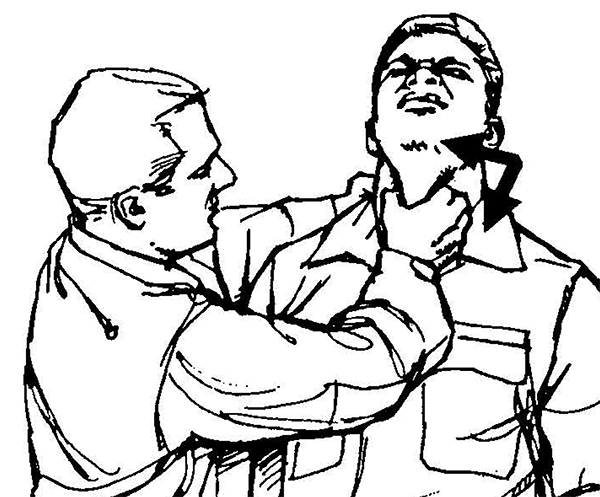
Figure 4. An image from the US Army Field Manual of Close Quarters Combat showing the trachea choke; the laryngeal handshake is a gentle version of this five-finger palpation of the larynx, using a side-to-side motion to confirm palpation of the thyroid lamina.

Figure 4.
An image from the US Army Field Manual of Close Quarters Combat showing the trachea choke; the laryngeal handshake is a gentle version of this five-finger palpation of the larynx, using a side-to-side motion to confirm palpation of the thyroid lamina.

Figure 5. The laryngeal handshake, starting on right side with dominant hand (top), then switching to the nondominant hand on larynx, with the dominant hand getting ready to make the incision (bottom).

Figure 5.
The laryngeal handshake, starting on right side with dominant hand (top), then switching to the nondominant hand on larynx, with the dominant hand getting ready to make the incision (bottom).

Pages: 1 2 3 | Single Page

Topics: Airway ManagementEmergency MedicineEmergency PhysicianPractice ManagementPractice TrendsProcedures and SkillsTrauma and Injury

Related

  • Why the Nonrebreather Should be Abandoned

    December 3, 2025 - 0 Comment
  • Florida Emergency Department Adds Medication-Dispensing Kiosk

    November 7, 2025 - 1 Comment
  • Q&A with ACEP President L. Anthony Cirillo

    November 5, 2025 - 0 Comment

Current Issue

ACEP Now: November 2025

Download PDF

Read More

About the Author

Richard M. Levitan, MD, FACEP

Richard M. Levitan, MD, FACEP, is an adjunct professor of emergency medicine at Dartmouth’s Geisel School of Medicine in Hanover, N.H., and a visiting professor of emergency medicine at the University of Maryland in Baltimore. He works clinically at a critical care access hospital in rural New Hampshire and teaches cadaveric and fiber-optic airway courses.

View this author's posts »

6 Responses to “Tips and Tricks for Performing Cricothyrotomy”

  1. February 10, 2015

    Approaching the Awake Intubation - MarylandCCProject.org Reply

    […] “safely” in the risky zone.  Welcome her to the resuscitation room with a gentle laryngeal handshake and be prepared to perform a surgical airway.   Obviously, I have as much interest in performing […]

  2. March 4, 2015

    Approaching the Awake Intubation | Vinnie's ICU Reply

    […] think we’re “safely” in the risky zone.  Welcome her to the resuscitation room with a gentle laryngeal handshake and be prepared to perform a surgical airway.   Obviously, I have as much interest in performing […]

  3. June 10, 2015

    Approaching the Awake Intubation | University of Maryland Reply

    […] “safely” in the risky zone.  Welcome her to the resuscitation room with a gentle laryngeal handshake and be prepared to perform a surgical airway.   Obviously, I have as much interest in performing […]

  4. August 25, 2015

    Surgical airway training: technical and nontechnical skills and trainers | airwayNautics Reply

    […] that unanticipated difficult airways occur, always having a plan for failure and identifying the surgically inevitable airway early will help the team perform a surgical airway when it is required before too […]

  5. September 10, 2015

    Obesity Emergency Management | EM Cases : Emergency Medicine Cases Reply

    […] in obesity emergency management, Dr. Levitan recommends first identifying the midline using the laryngeal handshake technique or ‘rocking the rhomboid‘ and cutting a large vertical skin incision rather than first […]

  6. May 4, 2018

    emDOCs.net – Emergency Medicine EducationEM Cases: Obesity Emergency Management - emDOCs.net - Emergency Medicine Education Reply

    […] in obesity emergency management, Dr. Levitan recommends first identifying the midline using the laryngeal handshake technique or ‘rocking the rhomboid‘ and cutting a large vertical skin incision rather than first […]

Leave a Reply Cancel Reply

Your email address will not be published. Required fields are marked *


*
*


Wiley
  • Home
  • About Us
  • Contact Us
  • Privacy
  • Terms of Use
  • Advertise
  • Cookie Preferences
Copyright © 2025 by John Wiley & Sons, Inc. All rights reserved, including rights for text and data mining and training of artificial technologies or similar technologies. ISSN 2333-2603
