
Once the operator has crossed the decision point, a surgical airway is inevitable; patient outcome hinges on speed. To ensure success, one must be able to reliably identify landmarks and have a methodical, step-by-step approach.
Explore This Issue
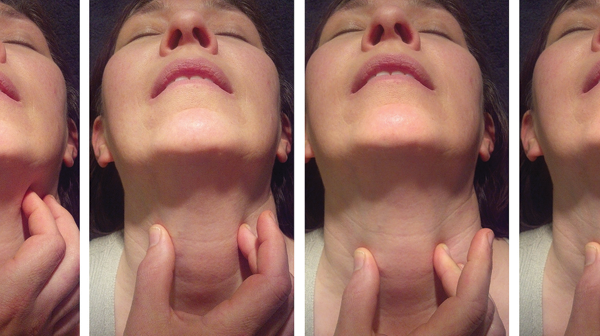
ACEP Now: Vol 33 – No 02 – February 2014Instead of using the tip of the index finger to feel for landmarks, palpate the laryngeal framework using the whole hand with what I call the “laryngeal handshake.”
The Technique
The traditional method of finding the cricothyroid membrane relies on palpation of the thyroid prominence (Adam’s apple) and the gap between the lower thyroid cartilage and the cricoid ring. This works well in thin males but not when there is significant neck fat and musculature. In women, the thyroid lamina is smaller and has a shallower angle; there is no thyroid prominence (see Figure 1).
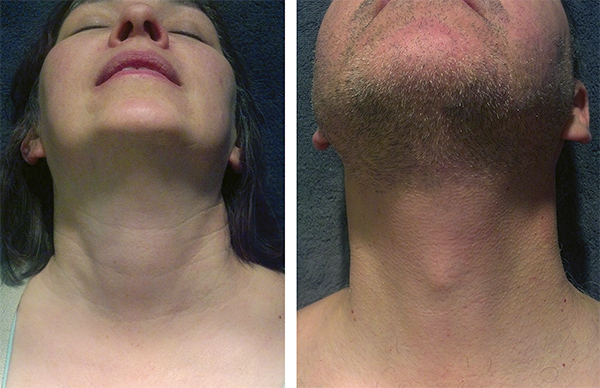
Figure 1. Female versus male external anatomy: The thyroid prominence is evident in the male, whereas the thyroid and cricoid have equal prominence in a female.
Female versus male external anatomy: The thyroid prominence is evident in the male, whereas the thyroid and cricoid have equal prominence in a female. [/caption]Instead of using the tip of the index finger to feel for landmarks, palpate the laryngeal framework using the whole hand with what I call the “laryngeal handshake”(see Figure 2).
The hyoid, thyroid, and cricoid form a rhomboid structure and move as a unit from side to side (see Figure 3).
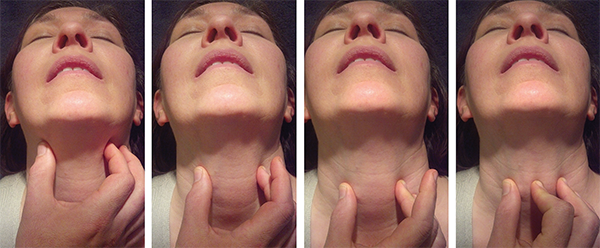
Figure 2.
The “laryngeal handshake,” from left to right: 1) hyoid, 2) thyroid, 3) cricoid, and 4) palpation of cricothyroid membrane.
Instead of feeling for the thyroid prominence, palpate the broad thyroid lamina. When the front of the neck does not give certainty of location, I have found that palpating the firm lamina of the thyroid and moving the whole laryngeal framework from side to side will consistently confirm the landmarks.

Figure 3.
CT imaging of the larynx in a coronal projection showing the epiglottis; the piriform recesses lateral to the epiglottis; the hyoid (bright dots); thyroid lamina; and, lowest and most medial, the cricoid. The vocal cords are at the inferior aspect of the thyroid cartilage. Note the rhomboid shape from the hyoid to the thyroid and cricoid and that the lower thyroid encircles the cricoid.
It does not take a lot of force to appreciate landmarks or rock the larynx side to side. Palpation of the laryngeal framework has been taught as a close combat technique (when used with maximum force) to perform a “tracheal choke” (see Figure 4).
Pages: 1 2 3 | Single Page




6 Responses to “Tips and Tricks for Performing Cricothyrotomy”
February 10, 2015
Approaching the Awake Intubation - MarylandCCProject.org[…] “safely” in the risky zone. Welcome her to the resuscitation room with a gentle laryngeal handshake and be prepared to perform a surgical airway. Obviously, I have as much interest in performing […]
March 4, 2015
Approaching the Awake Intubation | Vinnie's ICU[…] think we’re “safely” in the risky zone. Welcome her to the resuscitation room with a gentle laryngeal handshake and be prepared to perform a surgical airway. Obviously, I have as much interest in performing […]
June 10, 2015
Approaching the Awake Intubation | University of Maryland[…] “safely” in the risky zone. Welcome her to the resuscitation room with a gentle laryngeal handshake and be prepared to perform a surgical airway. Obviously, I have as much interest in performing […]
August 25, 2015
Surgical airway training: technical and nontechnical skills and trainers | airwayNautics[…] that unanticipated difficult airways occur, always having a plan for failure and identifying the surgically inevitable airway early will help the team perform a surgical airway when it is required before too […]
September 10, 2015
Obesity Emergency Management | EM Cases : Emergency Medicine Cases[…] in obesity emergency management, Dr. Levitan recommends first identifying the midline using the laryngeal handshake technique or ‘rocking the rhomboid‘ and cutting a large vertical skin incision rather than first […]
May 4, 2018
emDOCs.net – Emergency Medicine EducationEM Cases: Obesity Emergency Management - emDOCs.net - Emergency Medicine Education[…] in obesity emergency management, Dr. Levitan recommends first identifying the midline using the laryngeal handshake technique or ‘rocking the rhomboid‘ and cutting a large vertical skin incision rather than first […]