Logo

Log In Sign Up |  An official publication of: American College of Emergency Physicians
Navigation
  • Home
  • Multimedia
    • Podcasts
    • Videos
  • Clinical
    • Airway Managment
    • Case Reports
    • Critical Care
    • Guidelines
    • Imaging & Ultrasound
    • Pain & Palliative Care
    • Pediatrics
    • Resuscitation
    • Trauma & Injury
  • Resource Centers
    • mTBI Resource Center
  • Career
    • Practice Management
      • Benchmarking
      • Reimbursement & Coding
      • Care Team
      • Legal
      • Operations
      • Quality & Safety
    • Awards
    • Certification
    • Compensation
    • Early Career
    • Education
    • Leadership
    • Profiles
    • Retirement
    • Work-Life Balance
  • Columns
    • ACEP4U
    • Airway
    • Benchmarking
    • Brief19
    • By the Numbers
    • Coding Wizard
    • EM Cases
    • End of the Rainbow
    • Equity Equation
    • FACEPs in the Crowd
    • Forensic Facts
    • From the College
    • Images in EM
    • Kids Korner
    • Medicolegal Mind
    • Opinion
      • Break Room
      • New Spin
      • Pro-Con
    • Pearls From EM Literature
    • Policy Rx
    • Practice Changers
    • Problem Solvers
    • Residency Spotlight
    • Resident Voice
    • Skeptics’ Guide to Emergency Medicine
    • Sound Advice
    • Special OPs
    • Toxicology Q&A
    • WorldTravelERs
  • Resources
    • ACEP.org
    • ACEP Knowledge Quiz
    • Issue Archives
    • CME Now
    • Annual Scientific Assembly
      • ACEP14
      • ACEP15
      • ACEP16
      • ACEP17
      • ACEP18
      • ACEP19
    • Annals of Emergency Medicine
    • JACEP Open
    • Emergency Medicine Foundation
  • About
    • Our Mission
    • Medical Editor in Chief
    • Editorial Advisory Board
    • Awards
    • Authors
    • Article Submission
    • Contact Us
    • Advertise
    • Subscribe
    • Privacy Policy
    • Copyright Information

Tips for Handling the Bougie Airway Management Device

By Richard M. Levitan, MD, FACEP | on September 14, 2014 | 2 Comments
Airway
  • Tweet
  • Click to email a link to a friend (Opens in new window) Email
Print-Friendly Version

In an epiglottis-only view, always perform bimanual laryngoscopy (either with direct or video laryngoscopy) to try to visualize the interarytenoid notch, then direct the bougie tip over it to ensure you’re entering the trachea and not the esophagus. In the true epiglottis-only situation, make sure you keep the distal tip up (and feel the rings) as it can easily rotate under the epiglottis and miss the larynx.

You Might Also Like
  • 10 Tips for Safety in Airway Management
  • Tips to Improve Airway Management
  • Managing Stress In Crisis Critical to Performing Emergency Airway Management Techniques
Explore This Issue
ACEP Now: Vol 33 – No 09 – September 2014

The bougie has historically been held with a pencil grip. I find this not an easy way to keep it from rolling over; I want to track which way the distal tip is pointing. Some versions of the bougie place their depth markings (usually every 10 cm) on the same side as the direction of the Coudé tip, but this is not universal.
Tips for Handling the Bougie Airway Management Device

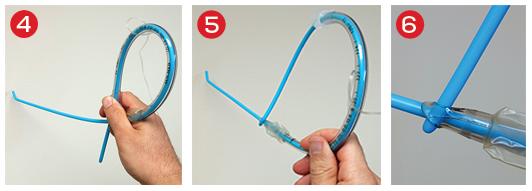
Figure 4. The Kiwi grip: A one-handed means of inserting the tube and bougie together, and prevent sliding of the devices on each other. After the bougie tip is inserted, the operator drops the laryngoscope and uses his or her left hand to counterclockwise rotate the tube down the bougie into the trachea.
Figure 5. The Kiwi-D grip, Jim Ducanto’s method of inserting the bougie tip into the Murphy eye of the tube as a one handed means of tube-bougie insertion.
Figure 6. Close up of the Kiwi-D grip showing tip of bougie in Murphy eye.

I think the best way to grip the bougie is what I call the “Shaka” grip (see Figure 3). “Shaka” is the Hawaiian hand gesture with the middle fingers folded over that means “hang loose.” Gripping the device this way, the user has fine control and knows the direction of the distal tip, and the insertion end is the proper length, all of which helps avoid rolling over.

If you work in a setting where you do not have anyone to help with tube placement over the bougie (while you keep the direct or video laryngoscope retracting the tongue), you can use a one-handed bougie/tube grip. I first found out about this from Paul Baker, senior lecturer in the department of anaesthesiology at The University of Auckland in New Zealand and director at Airway Simulation Limited, but I have been since informed he learned of it from an Italian physician. I named it the “Kiwi” grip a few years ago (see Figure 4). With this grip, you place the bougie/tube with your right hand, and after entering the trachea with the exposed distal tip of the device, you drop your laryngoscope, hold the top of the bougie with your left hand, and roll the tube down the bougie into the trachea with your right hand. Jim Ducanto, an anesthesiologist from Milwaukee who has an incredible passion for education and imaging, devised the Kiwi-D grip (tucking the tip of the bougie into the Murphy eye, see Figures 5 and 6).

Pages: 1 2 3 4 | Single Page

Topics: Airway ManagementBougieCritical CareEmergency MedicineEmergency PhysicianPractice TrendsProcedures and Skills

Related

  • Why the Nonrebreather Should be Abandoned

    December 3, 2025 - 0 Comment
  • Non-Invasive Positive Pressure Ventilation in the Emergency Department

    October 1, 2025 - 0 Comment
  • Emergency Department Management of Prehospital Tourniquets

    October 1, 2025 - 0 Comment

Current Issue

ACEP Now: November 2025

Download PDF

Read More

About the Author

Richard M. Levitan, MD, FACEP

Richard M. Levitan, MD, FACEP, is an adjunct professor of emergency medicine at Dartmouth’s Geisel School of Medicine in Hanover, N.H., and a visiting professor of emergency medicine at the University of Maryland in Baltimore. He works clinically at a critical care access hospital in rural New Hampshire and teaches cadaveric and fiber-optic airway courses.

View this author's posts »

2 Responses to “Tips for Handling the Bougie Airway Management Device”

  1. September 25, 2014

    visual aid: bougie handling tips | DAILYEM Reply

    […] in ACEP Now, with some handy tips for gripping the bougie so it feeds with the Coude tip up.  Click through for the article, but if you have 30 seconds, check out the visual aids […]

  2. February 22, 2024

    Girijanandan D Menon Reply

    Used BIliary dilatation catheter used by endoscopist, as a substitute for bougie, to easily intubate a high anterior larynx in four cases.

Leave a Reply Cancel Reply

Your email address will not be published. Required fields are marked *


*
*


Wiley
  • Home
  • About Us
  • Contact Us
  • Privacy
  • Terms of Use
  • Advertise
  • Cookie Preferences
Copyright © 2025 by John Wiley & Sons, Inc. All rights reserved, including rights for text and data mining and training of artificial technologies or similar technologies. ISSN 2333-2603
