Logo

Log In Sign Up |  An official publication of: American College of Emergency Physicians
Navigation
  • Home
  • Multimedia
    • Podcasts
    • Videos
  • Clinical
    • Airway Managment
    • Case Reports
    • Critical Care
    • Guidelines
    • Imaging & Ultrasound
    • Pain & Palliative Care
    • Pediatrics
    • Resuscitation
    • Trauma & Injury
  • Resource Centers
    • mTBI Resource Center
  • Career
    • Practice Management
      • Benchmarking
      • Reimbursement & Coding
      • Care Team
      • Legal
      • Operations
      • Quality & Safety
    • Awards
    • Certification
    • Compensation
    • Early Career
    • Education
    • Leadership
    • Profiles
    • Retirement
    • Work-Life Balance
  • Columns
    • ACEP4U
    • Airway
    • Benchmarking
    • Brief19
    • By the Numbers
    • Coding Wizard
    • EM Cases
    • End of the Rainbow
    • Equity Equation
    • FACEPs in the Crowd
    • Forensic Facts
    • From the College
    • Images in EM
    • Kids Korner
    • Medicolegal Mind
    • Opinion
      • Break Room
      • New Spin
      • Pro-Con
    • Pearls From EM Literature
    • Policy Rx
    • Practice Changers
    • Problem Solvers
    • Residency Spotlight
    • Resident Voice
    • Skeptics’ Guide to Emergency Medicine
    • Sound Advice
    • Special OPs
    • Toxicology Q&A
    • WorldTravelERs
  • Resources
    • ACEP.org
    • ACEP Knowledge Quiz
    • Issue Archives
    • CME Now
    • Annual Scientific Assembly
      • ACEP14
      • ACEP15
      • ACEP16
      • ACEP17
      • ACEP18
      • ACEP19
    • Annals of Emergency Medicine
    • JACEP Open
    • Emergency Medicine Foundation
  • About
    • Our Mission
    • Medical Editor in Chief
    • Editorial Advisory Board
    • Awards
    • Authors
    • Article Submission
    • Contact Us
    • Advertise
    • Subscribe
    • Privacy Policy
    • Copyright Information

Tips for Handling the Bougie Airway Management Device

By Richard M. Levitan, MD, FACEP | on September 14, 2014 | 2 Comments
Airway
  • Tweet
  • Click to email a link to a friend (Opens in new window) Email
Print-Friendly Version

While the Europeans are steadfastly married to their bougies, Americans pioneered the use of stylets to aid in shaping and inserting tracheal tubes. Tracheal tubes have an inherent arcuate shape as a consequence of the way they are formed. This arcuate shape, with a wide side-to-side dimension, is not ideal for insertion into the narrowing confines of the upper airway, which Sir Macintosh appreciated. Minor rotation of the tube causes major lateral movement of the distal tip, and combined with blocking of the view, this a contributing factor in tube misplacement during direct laryngoscopy. A styletted tube, however, can be shaped into a long narrow axis shape, with a bend angle that respects the dimensions of the trachea (straight to cuff and 35 degrees, see Figure 2). When placed into this shape, I find that the distal tip of such a tube can be placed from below the line of sight, and tube insertion does not need to obscure the cords. I have carried a bougie in my airway tool kit for more than 15 years, and I have never deployed it in anger; I became obsessed with stylet shaping. A styletted tube can also be inserted faster (tube placed, stylet withdrawn) compared to a bougie intubation, which is generally a three-step process of bougie insertion, tube railroading, and bougie withdrawal.

You Might Also Like
  • 10 Tips for Safety in Airway Management
  • Tips to Improve Airway Management
  • Managing Stress In Crisis Critical to Performing Emergency Airway Management Techniques
Explore This Issue
ACEP Now: Vol 33 – No 09 – September 2014

Despite my enthusiasm for a straight-to-cuff stylet, I think a bougie should be part of every airway kit. It can be useful in situations of poor laryngeal exposure, for placement into a trach, or in an emergent cric. The single-use versions are inexpensive. Some users complain it is hard to store because of its long length, about 60 cm. I address that issue by folding it in half. Bending the bougie and using a rubber band to keep it in this bent-over shape allows it to fit in intubation trays, draws, and jump bags. More important, when it is pulled out, this bent shape allows good control and preserves the long axis narrow dimension of the distal tip as it is inserted. Although the Pocket bougie is easy to carry, straightening may be needed depending on its intended use (especially for direct laryngoscopy).
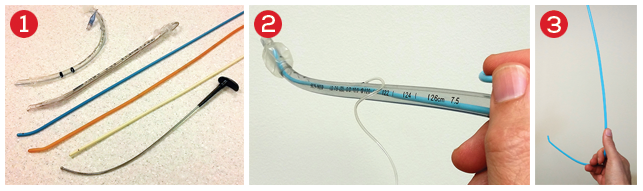
Figure 1. Bougies and tube introducers: Tracheal tubes have an inherent arcuate shape (top). A malleable stylet can optimally shape a tube to be straight-to-cuff (35 degree bend, second from top). Bougies have long narrow axes with an upturned distal tip (Frova, blue color, allows for insufflation) and Smiths-Portex original design (resin covered fiberglass, beige). Cook Critical Care tracheal tube exchange catheter (straight shape, hollow bore for insufflation, second from bottom). The GlideRite stylet is used with a hyperangulated video blade to get the tube around the tongue, but has too wide a side-to-side dimension to insert into the trachea (bottom). Figure 2. Straight-to-cuff styletted tube. Note the narrow long-axis view. There is a 35-degree bend at the proximal cuff. The stylet stops at the distal cuff, leaving the last few centimeters of the tube pliable. Figure 3. The Shake grip: By folding the bougie in half and gripping the bougie this way, it is easy to determine the direction of the distal tip, prevent tube rotation, and achieve fine control of the device.

Figure 1. Bougies and tube introducers: Tracheal tubes have an inherent arcuate shape (top). A malleable stylet can optimally shape a tube to be straight-to-cuff (35 degree bend, second from top). Bougies have long narrow axes with an upturned distal tip (Frova, blue color, allows for insufflation) and Smiths-Portex original design (resin covered fiberglass, beige). Cook Critical Care tracheal tube exchange catheter (straight shape, hollow bore for insufflation, second from bottom). The GlideRite stylet is used with a hyperangulated video blade to get the tube around the tongue, but has too wide a side-to-side dimension to insert into the trachea (bottom).
Figure 2. Straight-to-cuff styletted tube. Note the narrow long-axis view. There is a 35-degree bend at the proximal cuff. The stylet stops at the distal cuff, leaving the last few centimeters of the tube pliable.
Figure 3. The Shake grip: By folding the bougie in half and gripping the bougie this way, it is easy to determine the direction of the distal tip, prevent tube rotation, and achieve fine control of the device.

Pages: 1 2 3 4 | Single Page

Topics: Airway ManagementBougieCritical CareEmergency MedicineEmergency PhysicianPractice TrendsProcedures and Skills

Related

  • Why the Nonrebreather Should be Abandoned

    December 3, 2025 - 0 Comment
  • Non-Invasive Positive Pressure Ventilation in the Emergency Department

    October 1, 2025 - 0 Comment
  • Emergency Department Management of Prehospital Tourniquets

    October 1, 2025 - 0 Comment

Current Issue

ACEP Now: November 2025

Download PDF

Read More

About the Author

Richard M. Levitan, MD, FACEP

Richard M. Levitan, MD, FACEP, is an adjunct professor of emergency medicine at Dartmouth’s Geisel School of Medicine in Hanover, N.H., and a visiting professor of emergency medicine at the University of Maryland in Baltimore. He works clinically at a critical care access hospital in rural New Hampshire and teaches cadaveric and fiber-optic airway courses.

View this author's posts »

2 Responses to “Tips for Handling the Bougie Airway Management Device”

  1. September 25, 2014

    visual aid: bougie handling tips | DAILYEM Reply

    […] in ACEP Now, with some handy tips for gripping the bougie so it feeds with the Coude tip up.  Click through for the article, but if you have 30 seconds, check out the visual aids […]

  2. February 22, 2024

    Girijanandan D Menon Reply

    Used BIliary dilatation catheter used by endoscopist, as a substitute for bougie, to easily intubate a high anterior larynx in four cases.

Leave a Reply Cancel Reply

Your email address will not be published. Required fields are marked *


*
*


Wiley
  • Home
  • About Us
  • Contact Us
  • Privacy
  • Terms of Use
  • Advertise
  • Cookie Preferences
Copyright © 2025 by John Wiley & Sons, Inc. All rights reserved, including rights for text and data mining and training of artificial technologies or similar technologies. ISSN 2333-2603
