Logo

Log In Sign Up |  An official publication of: American College of Emergency Physicians
Navigation
  • Home
  • Multimedia
    • Podcasts
    • Videos
  • Clinical
    • Airway Managment
    • Case Reports
    • Critical Care
    • Guidelines
    • Imaging & Ultrasound
    • Pain & Palliative Care
    • Pediatrics
    • Resuscitation
    • Trauma & Injury
  • Resource Centers
    • mTBI Resource Center
  • Career
    • Practice Management
      • Benchmarking
      • Reimbursement & Coding
      • Care Team
      • Legal
      • Operations
      • Quality & Safety
    • Awards
    • Certification
    • Compensation
    • Early Career
    • Education
    • Leadership
    • Profiles
    • Retirement
    • Work-Life Balance
  • Columns
    • ACEP4U
    • Airway
    • Benchmarking
    • Brief19
    • By the Numbers
    • Coding Wizard
    • EM Cases
    • End of the Rainbow
    • Equity Equation
    • FACEPs in the Crowd
    • Forensic Facts
    • From the College
    • Images in EM
    • Kids Korner
    • Medicolegal Mind
    • Opinion
      • Break Room
      • New Spin
      • Pro-Con
    • Pearls From EM Literature
    • Policy Rx
    • Practice Changers
    • Problem Solvers
    • Residency Spotlight
    • Resident Voice
    • Skeptics’ Guide to Emergency Medicine
    • Sound Advice
    • Special OPs
    • Toxicology Q&A
    • WorldTravelERs
  • Resources
    • ACEP.org
    • ACEP Knowledge Quiz
    • Issue Archives
    • CME Now
    • Annual Scientific Assembly
      • ACEP14
      • ACEP15
      • ACEP16
      • ACEP17
      • ACEP18
      • ACEP19
    • Annals of Emergency Medicine
    • JACEP Open
    • Emergency Medicine Foundation
  • About
    • Our Mission
    • Medical Editor in Chief
    • Editorial Advisory Board
    • Awards
    • Authors
    • Article Submission
    • Contact Us
    • Advertise
    • Subscribe
    • Privacy Policy
    • Copyright Information

Tips for Using a Hyperangulated Video Laryngoscope
By Richard M. Levitan, MD, FACEP | on December 15, 2015 | 2 Comments
Airway
  • Tweet
  • Click to email a link to a friend (Opens in new window) Email
Print-Friendly Version
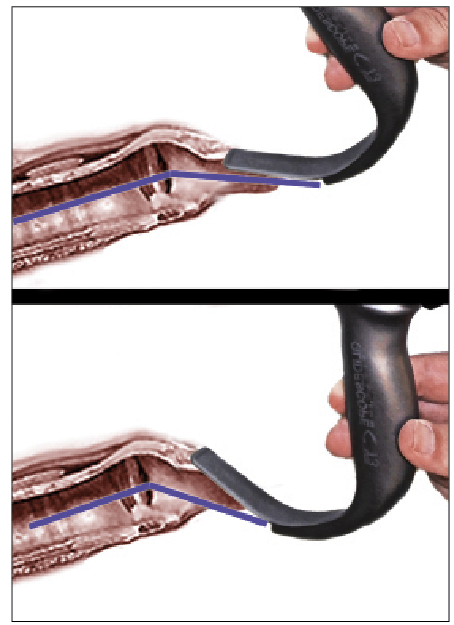
Figure 2 (Right). Schematic representation of the angle of approach. The top image shows ideal placement of a hyperangulated blade—in this case, a GlideScope Titanium blade—compared to overinsertion (bottom image). Note that the approach angle is more acute and that there is less room for tube delivery between the blade and the larynx.

You Might Also Like
  • Tips for Handling the Bougie Airway Management Device
  • Four Techniques for Handling the Omega-Shaped Epiglottis
  • Keep Video Laryngoscope Clear with IV Tubing, Saline, and Some Ingenuity
Explore This Issue
ACEP Now: Vol 34 – No 12 – December 2015

Figure 2 (Right). Schematic representation of the angle of approach. The top image shows ideal placement of a hyperangulated blade—in this case, a GlideScope Titanium blade—compared to overinsertion (bottom image). Note that the approach angle is more acute and that there is less room for tube delivery between the blade and the larynx.

The second piece of the puzzle with a hyperangulated video blade is getting the tube to drop into the trachea. One cannot merely advance the stylet, as the curvature used to get around the tongue creates a side-to-side dimension that exceeds the diameter of the human trachea. The trachea is only 15–20 mm in males and 14–16 mm in females. Additionally, if the hyperangulated stylet is simply rotated upward through the cords, the direction the tube and stylet points is upward, while the trachea has a downward inclination. Finally, there are the tracheal rings, which can prevent tube advancement when using a standard asymmetric left-beveled tracheal tube.

Verathon offers the GlideRite stylet to help with tube insertion. It is a rigid stylet with a 70-degree angle and a nifty proximal end, allowing the thumb to pop the stylet up (see Figure 3). A GlideRite stylet exceeds 2 inches in side-to-side dimension; this exceeds the dimensions of the human trachea. Accordingly, it is a tube delivery device (around the tongue and into the larynx), not a tracheal introducer. By partially removing the stylet after insertion through the cords, the tracheal tube can be advanced downward into the trachea. This maneuver, however, doesn’t address issues with the inclination of the trachea and the corrugation of the tracheal rings.

Figure 3. GlideRite stylet has an approximate 70-degree angulation and a side-to-side long-axis dimension exceeding 2 inches (far larger than the diameter of the human trachea).

Figure 3. GlideRite stylet has an approximate 70-degree angulation and a side-to-side long-axis dimension exceeding 2 inches (far larger than the diameter of the human trachea).

Figure 4. Right-turn overhand technique for hyperangulated stylet insertion into the trachea. By turning the stylet and tube 90 degrees, the tube angles downward, aligning with the inclination of the trachea. Note that the tube can be advanced in small increments off the stylet using the right hand only as long as an overhand grip is used at the top of the tube and stylet.

Figure 4. Right-turn overhand technique for hyperangulated stylet insertion into the trachea. By turning the stylet and tube 90 degrees, the tube angles downward, aligning with the inclination of the trachea. Note that the tube can be advanced in small increments off the stylet using the right hand only as long as an overhand grip is used at the top of the tube and stylet.

Figure 5. Turning the tube right improves interaction with trachea rings (corrugation and inclination) with a left-bevel tube. Whenever inserting trachea tubes with a left-bevel tube, if resistance is felt beneath the vocal cords, a gentle rightward turn will solve the problem in most instances.

Figure 5. Turning the tube right improves interaction with trachea rings (corrugation and inclination) with a left-bevel tube. Whenever inserting trachea tubes with a left-bevel tube, if resistance is felt beneath the vocal cords, a gentle rightward turn will solve the problem in most instances.

Pages: 1 2 3 | Single Page

Topics: Airway ManagementCritical CareEmergency DepartmentEmergency PhysicianImaging and UltrasoundKovacs' SignLaryngoscopePractice ManagementProcedures and Skills

Related

  • Why the Nonrebreather Should be Abandoned

    December 3, 2025 - 0 Comment
  • Florida Emergency Department Adds Medication-Dispensing Kiosk

    November 7, 2025 - 1 Comment
  • Q&A with ACEP President L. Anthony Cirillo

    November 5, 2025 - 0 Comment

Current Issue

ACEP Now: November 2025

Download PDF

Read More

About the Author

Richard M. Levitan, MD, FACEP

Richard M. Levitan, MD, FACEP, is an adjunct professor of emergency medicine at Dartmouth’s Geisel School of Medicine in Hanover, N.H., and a visiting professor of emergency medicine at the University of Maryland in Baltimore. He works clinically at a critical care access hospital in rural New Hampshire and teaches cadaveric and fiber-optic airway courses.

View this author's posts »

2 Responses to “Tips for Using a Hyperangulated Video Laryngoscope”

  1. January 10, 2016

    Heston LaMar, MD Reply

    The proper use of the proximal end of the GlideRite stylet in terms of the “thumb pop” & also using it to steer the distal end of the tube is something that I think very few are taught or know (unless they have gone to a good recent airway course). Depth & angle are also key as you point out (which is why I hardly ever use a 4 blade on our GlideScope).

  2. January 10, 2016

    ML Cleveland Reply

    Can you include a link to a video representation of using the overhand technique with the 90° rotation?

Leave a Reply Cancel Reply

Your email address will not be published. Required fields are marked *


*
*


Wiley
  • Home
  • About Us
  • Contact Us
  • Privacy
  • Terms of Use
  • Advertise
  • Cookie Preferences
Copyright © 2025 by John Wiley & Sons, Inc. All rights reserved, including rights for text and data mining and training of artificial technologies or similar technologies. ISSN 2333-2603
