Logo

Log In Sign Up |  An official publication of: American College of Emergency Physicians
Navigation
  • Home
  • Multimedia
    • Podcasts
    • Videos
  • Clinical
    • Airway Managment
    • Case Reports
    • Critical Care
    • Guidelines
    • Imaging & Ultrasound
    • Pain & Palliative Care
    • Pediatrics
    • Resuscitation
    • Trauma & Injury
  • Resource Centers
    • mTBI Resource Center
  • Career
    • Practice Management
      • Benchmarking
      • Reimbursement & Coding
      • Care Team
      • Legal
      • Operations
      • Quality & Safety
    • Awards
    • Certification
    • Compensation
    • Early Career
    • Education
    • Leadership
    • Profiles
    • Retirement
    • Work-Life Balance
  • Columns
    • ACEP4U
    • Airway
    • Benchmarking
    • Brief19
    • By the Numbers
    • Coding Wizard
    • EM Cases
    • End of the Rainbow
    • Equity Equation
    • FACEPs in the Crowd
    • Forensic Facts
    • From the College
    • Images in EM
    • Kids Korner
    • Medicolegal Mind
    • Opinion
      • Break Room
      • New Spin
      • Pro-Con
    • Pearls From EM Literature
    • Policy Rx
    • Practice Changers
    • Problem Solvers
    • Residency Spotlight
    • Resident Voice
    • Skeptics’ Guide to Emergency Medicine
    • Sound Advice
    • Special OPs
    • Toxicology Q&A
    • WorldTravelERs
  • Resources
    • ACEP.org
    • ACEP Knowledge Quiz
    • Issue Archives
    • CME Now
    • Annual Scientific Assembly
      • ACEP14
      • ACEP15
      • ACEP16
      • ACEP17
      • ACEP18
      • ACEP19
    • Annals of Emergency Medicine
    • JACEP Open
    • Emergency Medicine Foundation
  • About
    • Our Mission
    • Medical Editor in Chief
    • Editorial Advisory Board
    • Awards
    • Authors
    • Article Submission
    • Contact Us
    • Advertise
    • Subscribe
    • Privacy Policy
    • Copyright Information

Tips for Quickly Diagnosing Compartment Syndrome

By Brit Long, MD, FACEP; and Alex Koyfman, MD | on October 21, 2019 | 3 Comments
Features
  • Tweet
  • Click to email a link to a friend (Opens in new window) Email
Print-Friendly Version

Diagnosis

Is your bedside exam reliable? While we are taught about the classic findings of pain with passive stretch, a tense/firm compartment, swelling, focal motor/sensory changes, and decreased pulses, these are not always present and have poor sensitivity.3-5,14,19 Digital palpation has a sensitivity under 50 percent for detection of compartment syndrome affecting the hand and under 25 percent for the leg.22,23 Paralysis and absent pulses are rare, and palpating a tense or firm compartment is not reliable. Swelling of the affected area may be present in only half of patients.3,14,19 Table 2 demonstrates the sensitivity and specificity of exam findings.19

You Might Also Like
  • Case Report Provides Tips for Diagnosing the Rare Tolosa-Hunt Syndrome
  • Tips for Diagnosing Occult Fractures in the Emergency Department
  • Tips for Managing Complex Regional Pain Syndrome
Explore This Issue
ACEP Now: Vol 38 – No 10 – October 2019

As you can see from Table 2, many classic findings are highly specific but poorly sensitive.
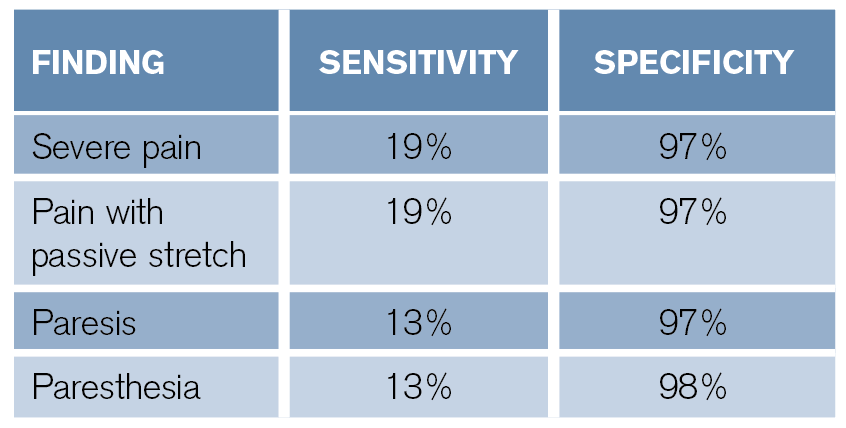
Table 2: Diagnostic Accuracy of Exam Findings19

Table 2: Diagnostic Accuracy of Exam Findings19

What happens if you combine signs and symptoms? A combination of pain with passive stretch, pain at rest, and paresthesias has a sensitivity of 93 percent for diagnosis, and the addition of paresis increases sensitivity to 98 percent.19 However, do not rely on the absence of any classic isolated findings. Other items that complicate diagnosis based on history and exam include clinician inexperience, sedation, polytrauma, and intoxication.8,19,24,25
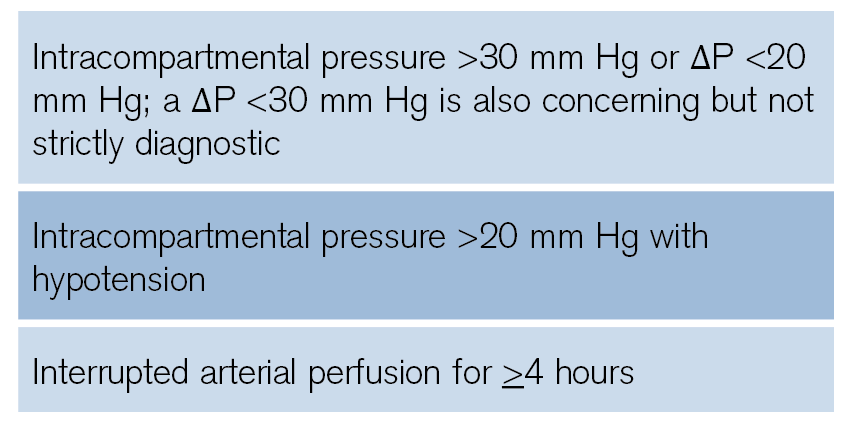
Table 3: Clinical Signs Suggestive of Compartment Syndrome

Table 3: Clinical Signs Suggestive of Compartment Syndrome

What about other tools? Abnormal pulse oximetry may indicate compartment syndrome.3,18,19 However, you cannot use this to exclude the condition. Rhabdomyolysis is present in up to 40 percent of patients with compartment syndrome, so be sure to check creatine kinase levels, renal function, and electrolytes.26-28

The most reliable bedside data can be obtained by measuring intracompartmental pressure. Options include a solid-state transducer intracompartmental catheter (STC) device (eg, a Stryker monitor) or other needle manometer/arterial line setups.4-6,19 The Stryker monitor has a diagnostic sensitivity around 95 percent, with specificity greater than 98 percent.29-31 Make sure to place the catheter within 5 cm of the fracture/injury level. However, the catheter tip should be outside the actual site of the fracture. Also ensure the pressure transducer and catheter tip are at the same height.24,32-35
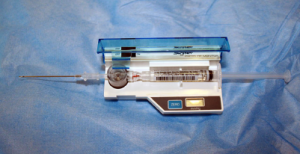
Figure 1: Stryker intracompartmental pressure monitoring device. To measure the pressure in a particular compartment, set the device to zero, insert the needle into the compartment and perpendicular to the skin, inject 0.3 mL sterile saline, and read the pressure displayed on the screen.
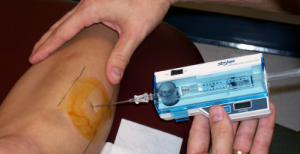
Figure 1: Stryker intracompartmental pressure monitoring device. To measure the pressure in a particular compartment, set the device to zero, insert the needle into the compartment and perpendicular to the skin, inject 0.3 mL sterile saline, and read the pressure displayed on the screen.

Figure 2: Stryker intracompartmental pressure monitoring device being inserted into the lower leg.

Figure 2: Stryker intracompartmental pressure monitoring device being inserted into the lower leg.

Pages: 1 2 3 4 | Single Page

Topics: Compartment SyndromeCritical CareinfectionStryker monitor

Related

  • Why the Nonrebreather Should be Abandoned

    December 3, 2025 - 0 Comment
  • Non-Invasive Positive Pressure Ventilation in the Emergency Department

    October 1, 2025 - 0 Comment
  • Emergency Department Management of Prehospital Tourniquets

    October 1, 2025 - 0 Comment

Current Issue

ACEP Now: November 2025

Download PDF

Read More

3 Responses to “Tips for Quickly Diagnosing Compartment Syndrome”

  1. November 19, 2019

    Emil Pajek MD Reply

    Cannot find the CME that is listed in the article.
    ALSO the article in the magazine has DIFFERENT Title than here …cannot find the CME /article or reference.
    I had to call the ACEP

  2. February 4, 2020

    David Glass Reply

    Same. I can’t find the CME link / test.

  3. March 20, 2021

    J Wells Reply

    I think you mean AP is diastolic pressure minus compartment pressure

Leave a Reply Cancel Reply

Your email address will not be published. Required fields are marked *


*
*


Wiley
  • Home
  • About Us
  • Contact Us
  • Privacy
  • Terms of Use
  • Advertise
  • Cookie Preferences
Copyright © 2025 by John Wiley & Sons, Inc. All rights reserved, including rights for text and data mining and training of artificial technologies or similar technologies. ISSN 2333-2603