
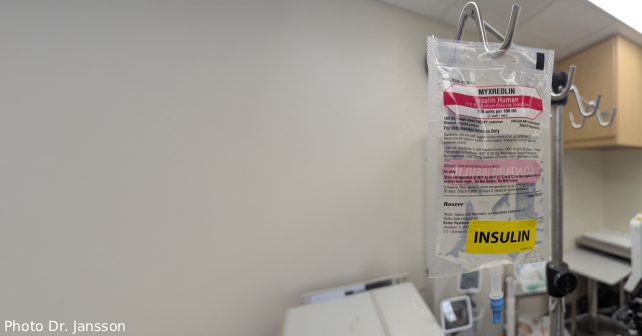
I can think of few conditions easier to diagnose and disposition as diabetic ketoacidosis (DKA): A single venous blood gas from triage will clinch both the diagnosis as well as an acceptance to the intensive care unit (ICU) from even the most curmudgeonly intensivist. In this month’s Critical Care Time, I’ll try to lay out a few high-yield pearls in the management of DKA learned from my time upstairs managing these patients beyond the first few hours.
Explore This Issue
ACEP Now: March 2026Fluids
Often, you’ll suspect the DKA diagnosis even before the confirmatory metabolic panel is back. It can feel like it takes an eternity for the results as the lab double- and triple-checks the abnormal values while you impatiently wait to initiate your insulin drip. During this limbo, however, you can make significant headway in the resuscitation with intravenous (IV) fluids. Virtually all of these patients are significantly hypovolemic from multiple sources. The nausea, vomiting, and abdominal pain associated with the ketosis result in decreased oral intake while the osmotic load of the glucosuria further dehydrates the patient via polyuria. One British society guideline estimates that a 70 kg adult may have as much as a 7 L fluid deficit! 1
As such, I will typically start with a bolus of 2-3 liters while waiting for the labs to come back. By dilution alone, the fluids will start to improve the hyperglycemia, often by several hundred mg/dL, even before starting insulin, and may decrease the cortisol that worsens insulin resistance.2 So, what fluid to use? Although the aforementioned curmudgeonly intensivist may drone on and on about the concomitant chloride loss and metabolic alkalosis from the vomiting, most of us who manage the patient in the emergency department (ED) won’t even have the metabolic panel back, so keep it simple: Lactated Ringer’s (LR) for everyone. LR leads to faster resolution of DKA with shorter hospital length of stay.3–5 Large volumes of normal saline, on the other hand, can cause a hyperchloremic metabolic acidosis that, in addition to causing renal arteriolar vasoconstriction and oliguria, can produce its own anion-gap acidosis that frustratingly prevents you from “closing the gap.”1 Take home message: For most patients in DKA, start with at least 2-3 L of LR while you are waiting for the labs to come back.
For most patients in DKA, start with at least 2-3 L of LR while you are waiting for the labs to come back.
Electrolytes
Waiting for the potassium before starting insulin has been drilled into our heads during residency, although the initial serum potassium in my experience is rarely low. Many patients will have an acute kidney injury impairing potassium excretion plus acidemia shifting potassium out of the cells.6,7 If the serum potassium is low, however, this is a frustrating situation, because we can’t fix the DKA until we fix the potassium. Most of these patients will be unable to tolerate oral potassium because of abdominal pain and nausea, and so the only option is IV repletion. The classic teaching, embodied in many hospital policies, is that the “safe rate” of IV repletion through a peripheral IV is 10 mEq/hr, although I have not been able to find much evidence to support that maximal correction rate, and at least one guideline supports repletion of up to 40 mEq/hr.8 To avoid the phlebitis that occurs with IV potassium administration, you can use two peripheral lines, each at 10 mEq/hr.9 Higher rates of correction will generally require a central line and telemetry monitoring. Almost all patients with DKA will require significant potassium repletion, with an estimated total body deficit of several hundred mEq of potassium.10
Many of these patients will also have some degree of hypomagnesemia. Although hypomagnesemia is not a contraindication to insulin administration, magnesium is a required renal cofactor for potassium reabsorption, and so potassium repletion may be more difficult in the presence of hypomagnesemia.11 Consider giving a few grams of IV magnesium up front to help your (inevitable) potassium repletion. Due to decreased oral intake and urinary losses, hypophosphatemia is common,12 so consider repletion, particularly because phosphorus is necessary for the respiratory muscles that are helping your patient compensate for their metabolic acidosis.12 Finally, I will often administer a dose of IV thiamine, both for presumed malnutrition, as well as to help resolve any co-existing lactic acidosis.
Insulin
Guidelines recommend an insulin infusion of 0.1 units/kg/hr. Some institutions have published protocols that vary the rate of the insulin based on the serum glucose, but I think that the complexity outweighs the benefits of implementation in most EDs. Keep it simple. Consensus guidelines allow for an optional bolus of regular insulin at the initiation of therapy, but this initial bolus is of dubious benefit. Instead, I prefer to give an initial dose of subcutaneous long-acting (basal) insulin, typically glargine, when starting the insulin infusion.
Early basal insulin leads to faster DKA resolution and shorter length of stay.13,14 It can also prevent rebound hyperglycemia without any increase in hypoglycemia.15,16 For a patient with a stable home regimen, you can give their home dose, and for all others a weight-based dose (0.15-0.25 units/kg) is a reasonable place to start.
One Bag or Two?
In virtually all cases of DKA, the hyperglycemia will resolve before the ketosis. As such, you will need to give supplemental glucose to allow continued insulin administration to clear the ketosis. Most centers will accomplish this by switching the maintenance fluids to include dextrose once the serum glucose is below ~250 mg/dL (the so-called “one-bag” method, since only one bag of IV fluids is used at a time). The “two-bag” method, which uses an administration of both dextrose- and non-dextrose-containing fluids for glucose levels between 150 and 250 mg/dL (see Table 1), has been shown to speed the resolution of DKA and shorten the duration of insulin infusion, with lower rates of hypoglycemia.17,18
Table 1. The Two-Bag Method for Fluids in Diabetic Ketoacidosis
| Fluid Administered | ||
|---|---|---|
| Serum Glucose | 0.45% Saline + 20 mEq KCl | D10-0.45% Saline + 20 mEq KCl |
| >250 mg/dL | 250 mL/hr | 0 mL/hr |
| 150-250 mg/dL | 125 mL/hr | 125 mL/hr |
| < 150 mg/dL | 0 mL/hr | 250 mL/hr |
Adapted from Haas, et al. J Intensive Care Med 2023;38(7).
Disposition
As I wrote at the beginning of this article, most of these patients will get a routine acceptance from the ICU. However, they tend to not be “critically ill” for long and may often languish in the ICU for days after resolution of the DKA, awaiting a floor bed and occupying valuable critical care space. When the hospital is at capacity, I will commonly discharge patients with DKA directly from the ICU. An ED-ICU or a well-resourced ED observation unit can sometimes safely care for many of these patients while thoughtfully conserving inpatient ICU beds.19
 Paul S. Jansson, MD, MS, is the medical director of the emergency critical care center (EC3), director of operations for the division of critical care, and an assistant professor of emergency medicine and internal medicine at the University of Michigan.
References
- Dhatariya KK, Joint British Diabetes Societies for Inpatient Care. The management of diabetic ketoacidosis in adults-An updated guideline from the Joint British Diabetes Society for Inpatient Care. Diabet Med. 2022;39(6):e14788.
- Umpierrez GE, Davis GM, ElSayed NA, Fadini GP, Galindo RJ, Hirsch IB, et al. Hyperglycemic Crises in Adults With Diabetes: A Consensus Report. Diabetes Care. 2024;47(8):1257–1275.
- Catahay JA, Polintan ET, Casimiro M, Notarte KI, Velasco JV, Ver AT, et al. Balanced electrolyte solutions versus isotonic saline in adult patients with diabetic ketoacidosis: A systematic review and meta-analysis. Heart Lung. 2022;54:74–79.
- Alghamdi NA, Major P, Chaudhuri D, Tsui J, Brown B, Self WH, et al. Saline Compared to Balanced Crystalloid in Patients With Diabetic Ketoacidosis: A Systematic Review and Meta-Analysis of Randomized Controlled Trials. Crit Care Explor. 2022;4(1):e0613.
- Self WH, Evans CS, Jenkins CA, Brown RM, Casey JD, Collins SP, et al. Clinical Effects of Balanced Crystalloids versus Saline in Adults With Diabetic Ketoacidosis: A Subgroup Analysis of Cluster Randomized Clinical Trials. JAMA Netw Open. 2020;3(11):e2024596.
- Arora S, Cheng D, Wyler B, Menchine M. Prevalence of hypokalemia in ED patients with diabetic ketoacidosis. Am J Emerg Med. 2012;30(3):481–484.
- Murthy K, Harrington JT, Siegel RD. Profound hypokalemia in diabetic ketoacidosis: a therapeutic challenge. Endocr Pract. 2005;11(5):331–334.
- Goguen J, Gilbert J. Hyperglycemic Emergencies in Adults. Can J Diabetes. 2013;37(SUPPL.1).
- Lin M. Post-It Pearls. Emergency Medicine News. 2022;44(11):18.
- Kitabchi AE, Umpierrez GE, Murphy MB, Barrett EJ, Kreisberg RA, Malone JI, et al. Management of hyperglycemic crises in patients with diabetes. Diabetes Care. 2001;24(1):131–153.
- Rude RK. Physiology of magnesium metabolism and the important role of magnesium in potassium deficiency. Am J Cardiol. 1989;63(14):31G-34G.
- Ditzel J, Lervang H-H. Disturbance of inorganic phosphate metabolism in diabetes mellitus: clinical manifestations of phosphorus-depletion syndrome during recovery from diabetic ketoacidosis. Diabetes Metab Syndr Obes. 2010;3:319–324.
- Mohamed A, Ploetz J, Hamarshi MS. Evaluation of Early Administration of Insulin Glargine in the Acute Management of Diabetic Ketoacidosis. Curr Diabetes Rev. 2021;17(8):e030221191986.
- Thammakosol K, Sriphrapradang C. Effectiveness and safety of early insulin glargine administration in combination with continuous intravenous insulin infusion in the management of diabetic ketoacidosis: A randomized controlled trial. Diabetes Obes Metab. 2023;25(3):815–822.
- Cardoso L, Vicente N, Rodrigues D, Gomes L, Carrilho F. Controversies in the management of hyperglycaemic emergencies in adults with diabetes. Metabolism. 2017;68:43–54.
- Hsia E, Seggelke S, Gibbs J, Hawkins RM, Cohlmia E, Rasouli N, et al. Subcutaneous administration of glargine to diabetic patients receiving insulin infusion prevents rebound hyperglycemia. J Clin Endocrinol Metab. 2012;97(9):3132–3137.
- Haas NL, Sell J, Cranford JA, Korley FK, Bassin BS. The Two-Bag Method for Management of Adult Diabetic Ketoacidosis-Experience With 634 Patients. J Intensive Care Med. 2023;38(7):668–674.
- Srikrishnaraj A, Souter AR, Woods N, Van Aarsen K, Iansavitchene A, Haas NL, et al. Two-bag Versus One-bag Method for Adult and Pediatric Diabetic Ketoacidosis Management. Ann Emerg Med. 2025 Sep 6; epub: doi: 10.1016/j.annemergmed.2025.07.032.
- Haas NL, Whitmore SP, Cranford JA, Tsuchida RE, Nicholson A, Boyd C, et al. An Emergency Department-Based Intensive Care Unit is Associated with Decreased Hospital and Intensive Care Unit Utilization for Diabetic Ketoacidosis.



No Responses to “Tips and Tricks for Managing Patients with Diabetic Ketoacidosis in the Emergency Department”