
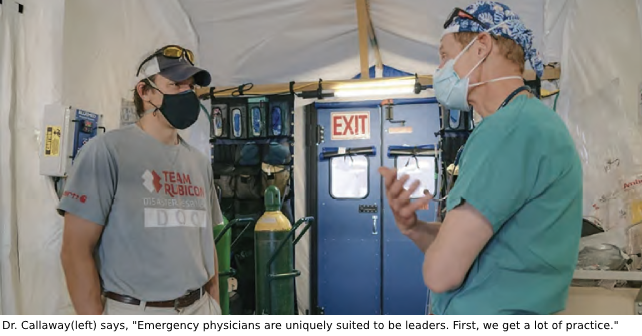
Physician leadership is a priority for ACEP President Aisha T. Terry, MD, MPH, FACEP. She’s approaching the issue from all sides. As she builds a programmatic approach within ACEP to identify and cultivate leaders, she is strengthening the “pipeline” and creating opportunities for newer physicians to thrive. In this spotlight. Dr. Terry interviews Team Rubicon International Chief Medical Officer David Callaway, MD, MPA, FACEP.
Explore This Issue
ACEP Now: Vol 43 – No 07 – July 2024The Leadership Spotlight highlights examples of emergency physicians using their foundation in emergency medicine to lead, teach, and inspire the next generation. Whether inside the hospital or beyond, the foundation laid by deep experience in the specialty is versatile, unique, and invaluable.
Dr. Terry: One of my priorities for the specialty going forward is to be more intentional about recruiting emergency physicians and leaders, ensuring diversity and bold new ways of thinking along the way. What are your thoughts on emergency physician recruitment and empowerment through leadership?
Dr. Callaway: Emergency physicians are uniquely suited to be leaders. First, we get a lot of practice. On a daily basis, we are placed in situations where we must direct multidisciplinary teams to care for patients, often in high stress situations. Quickly understanding people’s strengths, weaknesses, and needs becomes second nature to most of us.
Second, we are action oriented. And this piece is important for ACEP—our members are passionate, committed, and want to get stuff done. Nothing builds resilience like action and progress. Finally, we are on the front lines of nearly every major issue facing our country. So naturally people become vested in trying to find solutions—to homelessness, firearm violence, climate change, human trafficking. ACEP can harness this passion for great things.
Dr. Terry: You have an incredible range of experience. Are there common threads you see woven through your clinical work in Charlotte, N.C., whether it’s service with the U.S. Marshals, disaster response with Team Rubicon, counterterrorism operations, or your role leading efforts to combat climate change?
Dr. Callaway: I truly believe that being an emergency physician is one of the greatest jobs in the world, and with it comes an even greater responsibility. I’ve always been driven toward opportunities to use health care to build bridges and create stability in unstable areas. Whether it’s clinical and operational, such as directing COVID response for a large health system, or it’s civic minded, like our efforts to ensure safety in voting through an initiative called Healthy Democracy for All. Or when its advocacy informed by science, on topics like climate change and health equity. It all comes back to skills and passions I developed through emergency medicine.
Look, my wife euphemistically says I have a “healthy distaste for the status quo.” That is shorthand for being a pain in the butt. But I find crisis response is the ultimate time for innovation—the barriers are down. I’m an optimist; I think that whatever we are doing, we can do it better.
Dr. Terry: Climate change is interesting because there are a fair amount of people who struggle to see it as a physician’s priority. Let’s talk about some of these big challenges.
Dr. Callaway: I see two existential threats to humanity—artificial intelligence and climate change. We don’t have a full grasp on how either will impact humanity. But we know they are both complex systems that likely have irreversible tipping points.
Let’s talk about climate change. The World Health Organization calls climate change the top public health threat of the 21st century and the World Economic Forum identifies it as contributing to five of the Top 10 socioeconomic threats of the next decade.
Climate change is real. It is here. And it is impacting our patients, our communities, and the foundations of health and health care across the globe. Canadian wildfires triggering increased ED visits for COPD in Milwaukee, patients displaced from worsening hurricanes in my state of North Carolina, and extreme heat exacerbating housing instability because of increased utility bills. This all lands in our waiting rooms and ambulance bays.
Problems like climate change—or AI or firearm violence—are complex systems challenges that are high stakes and often have accelerating decision timelines. These are exactly the kind of challenges that emergency physicians are trained to address.
Dr. Terry: Can you dig into that a bit? What are your thoughts on an emergency medicine informed approach to leadership and problem solving?
Dr. Callaway: I think we are a pretty diverse group of decision makers, so I hesitate to speak for our entire profession. One framework is John Boyd’s “OODA loop” for decision making—Observe, Orient, Decide, and Act. The OODA loop relies on knowledge, experience, and judgement to push you toward decision and action. It is not a single loop. With each decision, you must reorient and move through the process again. But the key is action. And this is where emergency physicians excel. To lead, one must be able to make hard decisions. Leaders get stuff done. This is what we do every day.
Often, other experts don’t have the urgency to act that emergency medicine instills. They succumb to “analysis paralysis” or are crippled by perceptions of risk. I think we have a unique advantage—we understand risk, we always make decisions with limited and sometimes inaccurate information, we trust our teams to act, and we recognize that an unexpected outcome does not de facto equal failure. Most people don’t necessarily think that way.
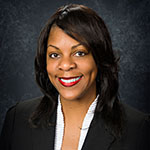 Dr. Terry is president of the American College of Emergency Physicians.
Pages: 1 2 3 | Multi-Page



No Responses to “This Emergency Physician Leads Next Generation Through Service”