Logo

Log In Sign Up |  An official publication of: American College of Emergency Physicians
Navigation
  • Home
  • Multimedia
    • Podcasts
    • Videos
  • Clinical
    • Airway Managment
    • Case Reports
    • Critical Care
    • Guidelines
    • Imaging & Ultrasound
    • Pain & Palliative Care
    • Pediatrics
    • Resuscitation
    • Trauma & Injury
  • Resource Centers
    • mTBI Resource Center
  • Career
    • Practice Management
      • Benchmarking
      • Reimbursement & Coding
      • Care Team
      • Legal
      • Operations
      • Quality & Safety
    • Awards
    • Certification
    • Compensation
    • Early Career
    • Education
    • Leadership
    • Profiles
    • Retirement
    • Work-Life Balance
  • Columns
    • ACEP4U
    • Airway
    • Benchmarking
    • Brief19
    • By the Numbers
    • Coding Wizard
    • EM Cases
    • End of the Rainbow
    • Equity Equation
    • FACEPs in the Crowd
    • Forensic Facts
    • From the College
    • Images in EM
    • Kids Korner
    • Medicolegal Mind
    • Opinion
      • Break Room
      • New Spin
      • Pro-Con
    • Pearls From EM Literature
    • Policy Rx
    • Practice Changers
    • Problem Solvers
    • Residency Spotlight
    • Resident Voice
    • Skeptics’ Guide to Emergency Medicine
    • Sound Advice
    • Special OPs
    • Toxicology Q&A
    • WorldTravelERs
  • Resources
    • ACEP.org
    • ACEP Knowledge Quiz
    • Issue Archives
    • CME Now
    • Annual Scientific Assembly
      • ACEP14
      • ACEP15
      • ACEP16
      • ACEP17
      • ACEP18
      • ACEP19
    • Annals of Emergency Medicine
    • JACEP Open
    • Emergency Medicine Foundation
  • About
    • Our Mission
    • Medical Editor in Chief
    • Editorial Advisory Board
    • Awards
    • Authors
    • Article Submission
    • Contact Us
    • Advertise
    • Subscribe
    • Privacy Policy
    • Copyright Information

Strategies To Help Your ED Adapt to Variable Volumes and Patient Needs

By Shari Welch, MD, FACEP | on October 25, 2021 | 0 Comment
Special OPs
  • Tweet
  • Click to email a link to a friend (Opens in new window) Email
Print-Friendly Version
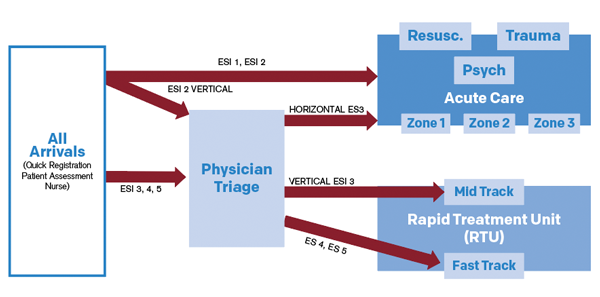
Figure 1: Tennity ED Flow Model

On-Call Strategies

While most emergency physicians were attracted to the specialty because of the carefully delineated work hours, we may start needing an on-call arrangement. This will likely be a result of surges and the new extremes of volume variation. This may contribute to the need for on-call backup. Hospital leadership should articulate triggers for both calling in and sending home physicians and APPs. Real-time data should inform these triggers, which will be location specific. A few examples of triggers are listed below:

You Might Also Like
  • Where Will Emergency Department Volumes Go Post-Pandemic?
  • Pennsylvania ED Re-Engineers Patient Flow to Reduce Boarding Burden
  • 2015 Emergency Department Survey Shows Spike in Volume, Structural Changes, Patient Boarding Concerns
Explore This Issue
ACEP Now: Vol 40 – No 10 – October 2021
  • Calling in a physician or nurse
    1. More than six people waiting in the waiting room
    2. More than 30-minute waits to see the clinician
    3. A sick clinician
  • Sending a physician or nurse home
    1. Fewer than two arrivals per hour for a zone
    2. No nurse or tech to support the clinician
    3. Zone closure

The most progressive emergency departments are learning to build flex into their operations. Ideally, emergency departments should have these flex options mapped out beforehand and standardized to avoid confusion. In the emergency department, we are known for being very creative (anyone remember using a Foley catheter for a posterior nosebleed?), but inventing operations on the spot will be less successful than deliberately gathering your team together to brainstorm how to create more flexibility to manage the inevitable variability in your emergency department. Map out these plans, educate staff, and achieve buy-in in advance. By flexing your geography and your shifts and by planning for contingencies with on-call strategies, your emergency department will be able to bend without breaking as the situation around it changes.

References

  1. Pedder H, Jones T, Rejon CS. COV.12: impacts of absenteeism in doctors and nurses in primary care and community care. National Institute for Health Research website. Accessed Sept. 24, 2021.
  2. Kanwal N, Riaz G, Riaz MS, et al. Identify the causes of absenteeism in nurses Mayo Hospital Lahore Pakistan. Int J Soc Sc Manage. 2017;4(2):110-114.

Pages: 1 2 3 | Single Page

Topics: OperationsPatient FlowPractice ManagementVolume

Related

  • Florida Emergency Department Adds Medication-Dispensing Kiosk

    November 7, 2025 - 1 Comment
  • Q&A with ACEP President L. Anthony Cirillo

    November 5, 2025 - 0 Comment
  • How Does Emergency Medicine Navigate Consolidation Trends in Health Care?

    October 29, 2025 - 0 Comment

Current Issue

ACEP Now: November 2025

Download PDF

Read More

About the Author

Shari Welch, MD, FACEP

Shari Welch, MD, FACEP, is a practicing emergency physician with Utah Emergency Physicians and a research fellow at the Intermountain Institute for Health Care Delivery Research. She has written numerous articles and three books on ED quality, safety, and efficiency. She is a consultant with Quality Matters Consulting, and her expertise is in ED operations.

View this author's posts »

No Responses to “Strategies To Help Your ED Adapt to Variable Volumes and Patient Needs”

Leave a Reply Cancel Reply

Your email address will not be published. Required fields are marked *


*
*


Wiley
  • Home
  • About Us
  • Contact Us
  • Privacy
  • Terms of Use
  • Advertise
  • Cookie Preferences
Copyright © 2025 by John Wiley & Sons, Inc. All rights reserved, including rights for text and data mining and training of artificial technologies or similar technologies. ISSN 2333-2603
