Logo

Log In Sign Up |  An official publication of: American College of Emergency Physicians
Navigation
  • Home
  • Multimedia
    • Podcasts
    • Videos
  • Clinical
    • Airway Managment
    • Case Reports
    • Critical Care
    • Guidelines
    • Imaging & Ultrasound
    • Pain & Palliative Care
    • Pediatrics
    • Resuscitation
    • Trauma & Injury
  • Resource Centers
    • mTBI Resource Center
  • Career
    • Practice Management
      • Benchmarking
      • Reimbursement & Coding
      • Care Team
      • Legal
      • Operations
      • Quality & Safety
    • Awards
    • Certification
    • Compensation
    • Early Career
    • Education
    • Leadership
    • Profiles
    • Retirement
    • Work-Life Balance
  • Columns
    • ACEP4U
    • Airway
    • Benchmarking
    • Brief19
    • By the Numbers
    • Coding Wizard
    • EM Cases
    • End of the Rainbow
    • Equity Equation
    • FACEPs in the Crowd
    • Forensic Facts
    • From the College
    • Images in EM
    • Kids Korner
    • Medicolegal Mind
    • Opinion
      • Break Room
      • New Spin
      • Pro-Con
    • Pearls From EM Literature
    • Policy Rx
    • Practice Changers
    • Problem Solvers
    • Residency Spotlight
    • Resident Voice
    • Skeptics’ Guide to Emergency Medicine
    • Sound Advice
    • Special OPs
    • Toxicology Q&A
    • WorldTravelERs
  • Resources
    • ACEP.org
    • ACEP Knowledge Quiz
    • Issue Archives
    • CME Now
    • Annual Scientific Assembly
      • ACEP14
      • ACEP15
      • ACEP16
      • ACEP17
      • ACEP18
      • ACEP19
    • Annals of Emergency Medicine
    • JACEP Open
    • Emergency Medicine Foundation
  • About
    • Our Mission
    • Medical Editor in Chief
    • Editorial Advisory Board
    • Awards
    • Authors
    • Article Submission
    • Contact Us
    • Advertise
    • Subscribe
    • Privacy Policy
    • Copyright Information

Stethoscopes & Hearing Aids: Choosing the Right Devices for You

By David Baehren, MD, FACEP | on September 2, 2020 | 1 Comment
Features
  • Tweet
  • Click to email a link to a friend (Opens in new window) Email
Print-Friendly Version
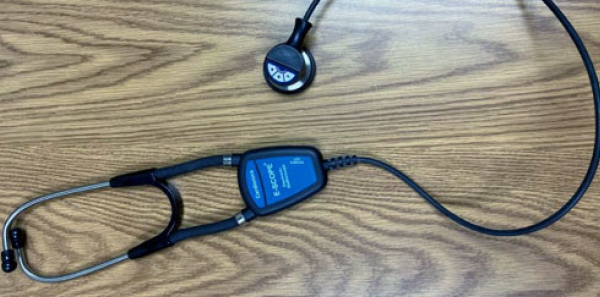
Figure 1: An amplified stethoscope.
Figure 6 (LEFT): Direct audio input from stethoscope to hearing aid. Figure 7 (ABOVE): A hearing aid telecoil receiving an induction signal. Figure 8 (RIGHT): A wireless stethoscope-to–hearing aid gateway device.

You Might Also Like
  • Published Clinical Decision Aids May Lack Validation
  • The Internet of Medical Things, Useful Devices for Emergency Physicians
  • Interpreting Pediatric Breathing Issues
Explore This Issue
ACEP Now: Vol 39 – No 08 – August 2020

Figure 6 (LEFT): Direct audio input from stethoscope to hearing aid.
Figure 7 (ABOVE): A hearing aid telecoil receiving an induction signal.
Figure 8 (RIGHT): A wireless stethoscope-to–hearing aid gateway device.
Credit: David Baehren

If your behind-the-ear hearing aid is equipped with a telecoil (ie, circuitry that picks up electromagnetic induction signals), you could plug a silhouette connection to the stethoscope (see Figure 7). The silhouettes are placed behind the hearing aids, and the signal is transmitted wirelessly. The listener must change the hearing aid program to the telecoil program setting. Again, the audiologist should verify the telecoil circuity can produce the needed low frequencies.

Wireless Connections: No stethoscopes transmit a Bluetooth signal directly to hearing aids. If a hearing aid user wants a wireless connection, a gateway device that can transit a signal to the hearing aid wirelessly from a digital stethoscope (see Figure 8) might do the trick. Again, the audiologist should verify the hearing aid can transmit the needed low frequencies. This solution can work for cochlear implant users as well.

Table 1: Stethoscope Solutions for Various Hearing Aid Styles

(click for larger image) Table 1: Stethoscope Solutions for Various Hearing Aid Styles

Medical Students

The student with hearing loss who must learn to use a stethoscope is different from an experienced health care worker who gradually experiences hearing loss after practicing for years. A student does not know what they are listening for and may not be able to judge if they are hearing adequately. Such students should be encouraged to obtain an amplified stethoscope with a second listener port that an instructor can plug into and listen with the student. This will allow the instructor to judge whether the student is hearing adequately through the amplified stethoscope by asking the student to describe the signals they hear.

Final Thoughts

If your health care setting typically provides stethoscopes, the workplace should purchase an amplified stethoscope for you, too. If not, you will need to supply your own device.

Finally, if you haven’t yet purchased hearing aids, let the audiologist know you are a stethoscope user so the hearing aid recommendation can be at least partly based on ease of access to sounds through a stethoscope.

Q&A with a Hearing Loss Expert

The author interviewed Catherine Palmer, PhD, to discuss hearing issues relevant to our challenges as emergency physicians. She is president of the American Academy of Audiology and an associate professor at the University of Pittsburgh.

Pages: 1 2 3 4 5 | Single Page

Topics: careerhearing aidshearing lossstethoscopes

Related

  • Choose Your Shift: The Freedom of a Locum Tenens Career in EM

    September 2, 2025 - 1 Comment
  • The 2025 Emergency Physician Compensation Report

    August 29, 2025 - 0 Comment
  • Aerospace Medicine Residency Program Pushes the Envelope

    June 25, 2025 - 1 Comment

Current Issue

ACEP Now: November 2025

Download PDF

Read More

One Response to “Stethoscopes & Hearing Aids: Choosing the Right Devices for You”

  1. June 28, 2021

    rahul kumar Reply

    Where I can buy a amplified stethoscope..

Leave a Reply Cancel Reply

Your email address will not be published. Required fields are marked *


*
*


Careers Center
  • Lee Health - Golisano Children’s Hospital of SWFL Seeks a Pediatric Emergency Medicine Physician!

    Position Information: Lee Health / Golisano Children’s Hospital – Pediatric Emergency Medicine is seeking a full-time physician BC/BE in Pediatric ...

    Fort Myers, Florida

    Competitive compensation package- sign on bonus and relocation!

    Lee Health physician group

    Read More
  • Director, Undergraduate Medical Education

    Penn State Health Milton S. Hershey Medical Center seeks a BC/BE Emergency Medicine Physician to serve as Director, Undergraduate Medical Education.

    Hershey, Pennsylvania

    Competitive salary & benefits at prestigious Pennsylvania health system

    Penn State Health

    Read More
  • Pediatric Emergency Medicine

    Akron Children's Hospital is seeking a Physician to join the Emergency Department out of the Boardman, Ohio location.

    Boardman, Ohio

    N/A

    Akron Children's Hospital

    Read More
More Jobs
Wiley
  • Home
  • About Us
  • Contact Us
  • Privacy
  • Terms of Use
  • Advertise
  • Cookie Preferences
Copyright © 2025 by John Wiley & Sons, Inc. All rights reserved, including rights for text and data mining and training of artificial technologies or similar technologies. ISSN 2333-2603

