
The third annual Stanford Emergency Medicine Innovation Symposium (STEMI X) was held on June 22nd, 2023. The Symposium featured a keynote presentation on digital transformation in emergency medicine from Jared Conley, MD, PHD, MPH, multiple expert panels and round table discussions, and innovation workshops. Topics covered included doctor-driven disruption, innovation through entrepreneurship, and the revolutionary power of (artificial intelligence) AI in the emergency department (ED). Rapidly becoming a yearly staple among health care innovators, STEMI X attracted several hundred physicians and other health care stakeholders and can be viewed here.
Explore This Issue
ACEP Now: Vol 42 – No 12 – December 2023STEMI X’s “Pitch ‘EM” competition featured six startups hoping to reshape and revolutionize patient care. Companies had ten minutes to pitch the next big idea in health care innovation to a live audience and judges representing academia, health care-focused venture firms, and Google Clinicians. These judges leveraged diverse backgrounds to determine which participating company would earn the opportunity to work with the Stanford Emergency Medicine Partnership Program, an academic-private partnership focused on piloting technology for acute care.
Six finalists and two alternates were selected to participate in this year’s pitch competition:
| Company | Problem | Solution | Technology |
| Tali AI | Increasing administrative burdens on clinicians. | AI-based scribe and medical resource tool | Artificial Intelligence |
| Rocket Doctor | Inconvenient, inefficient traditional healthcare delivery systems | Physician-led digital health platform and marketplace | Digital Health, Telehealth |
| Endiatix | Limited availability of accessible endoscopy options | Physician-guided pill-sized endoscopic devices | PillBotTM GI visual diagnostics |
| Thread Medical | Physician paperwork burden leading to burnout and errors | AI-based scribe | Artificial Intelligence |
| Florence | Optimizing Emergency Department workflow and patient experience | App-based patient-facing resource | Digital Health |
| Upside Health | Difficulty in delivering personalized chronic pain management | Evaluation tool and resource for chronic pain patients | Digital Health |
| Ivy Clinicians | Difficulty for clinicians to find jobs | Platform to connect clinicians and potential employers | Website |
| CranioSense | Difficulty recognizing intracranial hypertension | Non-invasive medical device to continuously monitor intracranial pressure | Medical Device |
The Finalists
Tali AI
Working to target the administrative burdens contributing to high rates of physician burnout, Tali AI offers a voice-enabled virtual assistant available to help 24/7. Co-Founder and CEO, Mahshid Yassaei, lead a team of serial healthtech entrepreneurs closely partnered with Canadian family medicine clinicians. Their multi-faceted product includes an AI Ambient Scribe that listens to conversations to write SOAP notes as well as search medical/pharmaceutical databases and retrieve EMR information among other features. Already embedded in OSCAR PRO with over 10,000 clinicians utilizing this product, they have seen a 12–15 hour per month reduction in time spent on admin-related tasks and are currently raising funds for expansion.
Rocket Doctor
Rocket Doctor is a technology-driven digital health platform and marketplace that revolutionizes health care accessibility by offering virtual care for a vast range of health conditions. Through video or audio visits, doctors conduct thorough assessments, supported by at-home medical devices and additional photographs, when necessary. Patients benefit from the convenience and safety of remote appointments, while serious conditions or emergencies warrant in-person visits or immediate attention. Rocket Doctor’s Patient Care Coordinators ensure suitable care options, striking a balance between virtual and physical consultations to provide high-quality, comprehensive, and convenient health care to patients, particularly those on Medicaid and in rural areas. Since its launch two and a half years ago, the platform has facilitated over 250,000 visits, serving as a vital link between over 400 MDs and patients in need. Rocket Doctor was founded by William Cherniak, MD, BSc, MPH, CCFD(EM)/DABFM, an emergency physician, with a mission to empower independent physicians and enhance the quality and accessibility of health care for all. Their digital health platform and marketplace revolutionize the doctor-patient connection, offering a unique way to bring advanced medical care directly to patients. The platform’s goal is to deliver faster, more convenient, and more compassionate care, bridging the gap between doctors and patients through innovative virtual health care solutions.
Endiatx
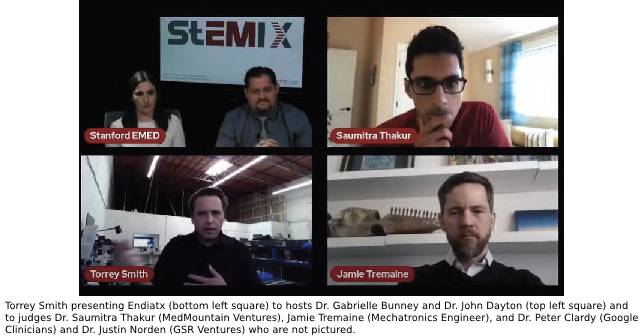
Led by CEO and Co-Founder, Torrey Smith, Endiatx is seeking to utilize micro-robotics to dramatically alter the upper endoscopy market. Utilizing their PillBotTM technology, physician-guided pill-sized endoscopic devices with mounted cameras would liberate patients to have this high-demanded procedure done in the comfort of their own home. Given the special designation of “game changer” at the 2023 Edison Awards, Endiatx brings together a rockstar team and has deep partnerships with leaders in the gastroenterology field at Mayo Clinic and King’s College London. Headquartered in Hayward, CA, they have raised over three million dollars.
Thread Medical
Thread Medical is a startup that offers an AI-powered platform for doctors to have natural conversations with patients. The AI autonomously generates medical notes from live or recorded audio, with quick and accurate turnaround times. It also automates billing code capture based on patient history. This streamlines clinical documentation and improves overall efficiency for healthcare professionals. Founded by CEO Brian Flaherty, Thread Medical aims to tackle the detrimental impact of paperwork burden on healthcare professionals. Inspired by his mother’s experience, Brian is committed to empowering doctors and enhancing patient safety. Thread Medical’s mission is to build tools that alleviate administrative work, allowing physicians to focus on providing top-notch care. This AI scribe will help save emergency physicians around two to three hours of charting time and lead to improved patient care. By streamlining documentation and thereby addressing one factor causing physician burnout, Thread Medical strives to make a positive impact on the health care system and patient outcomes.
Florence
Florence is a startup that offers a platform for streamlining the workflow and throughput in running day-to-day operations in an emergency department. The software has multiple layers of application—from an emergency room guide to PCP scheduling to discharge planning/insurance assistance. The second aspect of Florence’s technology is its triage and treatment tools. When a patient arrives in the ED, Florence can gather data from the patient to help decrease documentation time. A patient, throughout the ED visit can be guided to various parts of the platform as needed. The triage and treatment tools aspect of the platform provides fully protocols to let patients even complete asynchronous visits, with escalation to a video or in-person visit, which is unique for a medical encounter. To date, Florence has been utilized in four million patient encounters, increased revenue per new patient, and decreased savings cost per visit. The ability to increase efficiency with asynchronous consultations utilizing Florence is unique and innovative.
Upside Health
Upside Health is looking to transform the way chronic pain is evaluated and assessed. The team has developed a platform to improve chronic pain management through improved objective evaluations and personalized care. Upside Health cites the challenges of chronic pain care for emergency medicine doctors and patient struggles with chronic pain as a growing issue. The company has developed a software platform, known as Branch Health, to help address this challenge. To date, 1,054 patients have been enrolled with 19 clinicians, with a month-to-month revenue growth of 125 percent. Most recent data show a statistically significant decrease in morphine equivalency by 30 percent in three months for patients on the Branch Health platform. Furthermore, six percent of patients were able to avoid emergency department visits. Addressing chronic pain management is important, and Upside Health’s new platform delivers an innovative solution.
The Alternates
Ivy Clinicians
Ivy Clinicians is seeking to help physicians, physician assistants and nurse practitioners find jobs in a more efficient manner. The goal is to decrease cost-per-placement and time-to-hire metrics for physician groups and hospitals and increase the simplicity for clinicians. Founded by Leon Adelman, MD, MBA, FACEP, FAAEM, an emergency physician, and Matthew Simpson, the initial launch is in emergency medicine, helping clinicians match into jobs in the emergency department.
CranioSense
CranioSense is developing a non-invasive way to triage and continuously monitor intracranial pressure. Intracranial hypertension can be difficult to diagnose with non-invasive tools and can be present in emergent conditions including intracranial bleeds. CranioSense is developing a medical device that will non-invasively calculate intracranial pressure to increase early detection, early decision making and early intervention in patients with increased intracranial pressure.
The 2023 winner was…Rocket Doctor.
The judges were thoroughly impressed by Rocket Doctor’s pitch, which showcased their dedication to developing innovative health care solutions centered around strengthening the physician-patient connection. Rocket Doctor’s transformative approach not only promises to enhance patient care but also offers the potential to revolutionize existing care models, empower independent physicians, and establish a true marketplace. Their commitment to reforming the health care landscape garnered admiration from the judges who recognized the significant positive impact their ideas could have on the industry.
Reviewed by dark. We either publish in December or set aside a time when they are looking for NEW applicants for the 2024 competition.
Read more by following the QR code: 
Pages: 1 2 | Multi-Page


No Responses to “Stanford’s Innovation Exchange”