Logo

Log In Sign Up |  An official publication of: American College of Emergency Physicians
Navigation
  • Home
  • Multimedia
    • Podcasts
    • Videos
  • Clinical
    • Airway Managment
    • Case Reports
    • Critical Care
    • Guidelines
    • Imaging & Ultrasound
    • Pain & Palliative Care
    • Pediatrics
    • Resuscitation
    • Trauma & Injury
  • Resource Centers
    • mTBI Resource Center
  • Career
    • Practice Management
      • Benchmarking
      • Reimbursement & Coding
      • Care Team
      • Legal
      • Operations
      • Quality & Safety
    • Awards
    • Certification
    • Compensation
    • Early Career
    • Education
    • Leadership
    • Profiles
    • Retirement
    • Work-Life Balance
  • Columns
    • ACEP4U
    • Airway
    • Benchmarking
    • Brief19
    • By the Numbers
    • Coding Wizard
    • EM Cases
    • End of the Rainbow
    • Equity Equation
    • FACEPs in the Crowd
    • Forensic Facts
    • From the College
    • Images in EM
    • Kids Korner
    • Medicolegal Mind
    • Opinion
      • Break Room
      • New Spin
      • Pro-Con
    • Pearls From EM Literature
    • Policy Rx
    • Practice Changers
    • Problem Solvers
    • Residency Spotlight
    • Resident Voice
    • Skeptics’ Guide to Emergency Medicine
    • Sound Advice
    • Special OPs
    • Toxicology Q&A
    • WorldTravelERs
  • Resources
    • ACEP.org
    • ACEP Knowledge Quiz
    • Issue Archives
    • CME Now
    • Annual Scientific Assembly
      • ACEP14
      • ACEP15
      • ACEP16
      • ACEP17
      • ACEP18
      • ACEP19
    • Annals of Emergency Medicine
    • JACEP Open
    • Emergency Medicine Foundation
  • About
    • Our Mission
    • Medical Editor in Chief
    • Editorial Advisory Board
    • Awards
    • Authors
    • Article Submission
    • Contact Us
    • Advertise
    • Subscribe
    • Privacy Policy
    • Copyright Information

Should You Use Direct Oral Anticoagulants for Cancer-Associated VTE?

By Ken Milne, MD | on January 13, 2019 | 1 Comment
Skeptics' Guide to EM
  • Tweet
  • Click to email a link to a friend (Opens in new window) Email
Print-Friendly Version
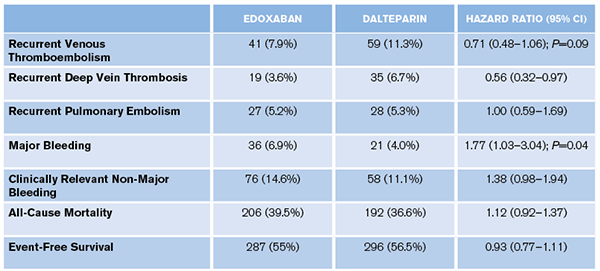
Table 1: Secondary Outcomes

Case Resolution

The patient is given LMWH and has outpatient injections arranged. He is referred back to his oncologist to further discuss the issue of using a DOAC to manage his cancer-associated DVT.

You Might Also Like
  • Restarting Antithrombotics After Gastrointestinal Bleeding Tied to Better Outcomes
  • Low Risk of Brain Hemorrhage in Ground-Level Fall with Antiplatelets, Anticoagulants
  • New Developments in Direct Oral Anticoagulant Safety and Indications
Explore This Issue
ACEP Now: Vol 38 – No 01 – January 2019

Thank you to Dr. Anand Swaminathan, assistant professor of emergency medicine at the St. Joseph’s Regional Medical Center in Paterson, New Jersey.

Remember to be skeptical of anything you learn, even if you heard it on the Skeptics’ Guide to Emergency Medicine.

References

  1. Lee AY, Levine MN, Baker RI, et al. Low-molecular-weight heparin versus a coumarin for the prevention of recurrent venous thromboembolism in patients with cancer. N Engl J Med. 2003;349(2):146-153.
  2. Beam DM, Kahler ZP, Kline JA. Immediate discharge and home treatment of low-risk venous thromboembolism diagnosed in two U.S. emergency departments with rivaroxaban: a one-year preplanned analysis. Acad Emerg Med. 2015;22(7):788-795.
  3. Young AM, Marshall A, Thirlwall J, et al. Comparison of an oral factor Xa inhibitor with low molecular weight heparin in patients with cancer with venous thromboembolism: results of a randomized trial (SELECT-D). J Clin Oncol. 2018;36(20):2017-2023.

Pages: 1 2 3 | Single Page

Topics: AnticoagulantsCancerCancer-Associated Venous ThromboembolismDeep Vein ThrombosisDirect Oral AnticoagulantsVenous Thromboembolism

Related

  • PCC versus Andexanet Alfa for Factor Xa Reversal

    October 9, 2025 - 0 Comment
  • Case Report: Rare Pulmonary Embolism After Routine PIVC Insertion

    September 22, 2025 - 1 Comment
  • Doctors: Sharing Our Personal Health Stories Can Save a Life

    July 3, 2025 - 0 Comment

Current Issue

ACEP Now: November 2025

Download PDF

Read More

About the Author

Ken Milne, MD

Ken Milne, MD, is chief of emergency medicine and chief of staff at South Huron Hospital, Ontario, Canada. He is on the Best Evidence in Emergency Medicine faculty and is creator of the knowledge translation project the Skeptics Guide to Emergency Medicine.

View this author's posts »

One Response to “Should You Use Direct Oral Anticoagulants for Cancer-Associated VTE?”

  1. January 20, 2019

    Gregg Chesney Reply

    Thanks for this review! I had this exact debate last week (but enoxaparin vs rivaroxaban) with our ED pharmacist, the patient’s oncologist and his general surgeon for a patient with an acute DVT 2 weeks post-op from a resection of a colonic adenocarcinoma. I hadn’t seen the new article in the NEJM yet, and the 2016 ACCP VTE guidelines are still recommending LMWH. I had originally ordered enoxaparin but the oncologist decided he wanted to manage him on rivaroxaban, citing new data that DOACs are noninferior in these patients, which I hadn’t had a chance to look for yet, so thanks for filling me in!

Leave a Reply Cancel Reply

Your email address will not be published. Required fields are marked *


*
*


Wiley
  • Home
  • About Us
  • Contact Us
  • Privacy
  • Terms of Use
  • Advertise
  • Cookie Preferences
Copyright © 2025 by John Wiley & Sons, Inc. All rights reserved, including rights for text and data mining and training of artificial technologies or similar technologies. ISSN 2333-2603
