
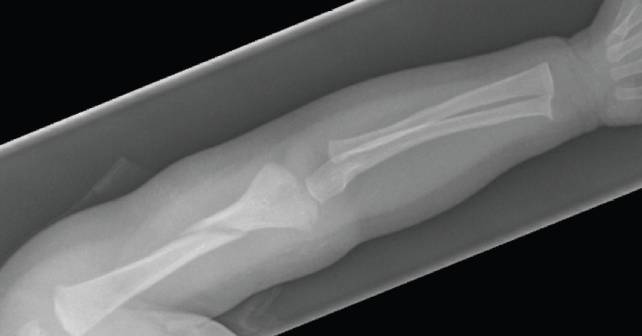
A 14-month-old male presents with fussiness. Per his mother, he seems to have some discomfort in his right arm. She does not recall any falls or other trauma. On examination, you note that he will not reach for a toy with his right arm. He has bruising to the upper arm. Otherwise, he is well appearing and interacts normally with his mother and twin brother.1
Explore This Issue
ACEP Now: Vol 43 – No 03 – March 2024Question
What, if any, imaging needs to be obtained? Should you consider obtaining imaging for the patient’s twin as well?
Discussion
Fractures are common injuries of childhood. Nearly 66 percent of boys and 40 percent of girls will sustain a fracture by their 15th birthday. Though these fractures are most commonly accidental, 25 percent of abused children sustain fractures as a result of child abuse.2 As most fractures due to abusive trauma occur in children younger than 18 months old, physicians need to maintain a high level of suspicion when there is a traumatic injury, particularly without a witnessed traumatic event. Radiologic imaging may be the only indicator of abusive trauma, and it may also point to alternative diagnoses such as an abnormality in bone mineralization.
The American Academy of Pediatrics recommends that a skeletal survey be done in children younger than two years old if nonaccidental trauma (NAT) is suspected, as abused children may have occult injuries. Indications for skeletal survey include witnessed NAT, injury during a domestic violence assault, or a delay in seeking care for injury. Skeletal survey should be considered at the physician’s discretion in children older than two years, especially those with developmental delays.
NAT should be suspected and a skeletal survey obtained in nonmobile children with any bruising. Skeletal survey is indicated in children younger than two years old who have patterned bruises and in children younger than four years old who have injury to the torso, neck, ear, or face (including the frenula).
A skeletal survey should be strongly considered in children younger than two years old with fractures that are not a toddler’s fracture of the tibia or linear skull fractures with the appropriate history of fall. All nonmobile children with fractures unrelated to birth injury should have a skeletal survey. Burn injuries and abusive head trauma are also indications for a skeletal survey.
Other Children in the Home
When a child is suspected to be the victim of NAT, other children in the home should also be evaluated. Skeletal survey should be performed on siblings under the age of two years who live in the same home, as well as on any multiple birth sibling, of the abused child.
For children older than two years, with developmental delays who are suspected victims of NAT, skeletal survey should be strongly considered. For children between the ages of two and five years, the decision whether to get a skeletal survey should be based upon clinician judgement.
Skeletal surveys require considerable experience to obtain properly and to interpret accurately. Recommended imaging protocols are detailed by the American College of Radiology.3 If a severely injured child presents to a hospital without experience performing skeletal surveys and is awaiting transfer to a tertiary care center, it may be preferable to defer the survey until arrival at the receiving hospital. This should be discussed with the accepting physician.
Case Resolution
The patient was found to have a humeral fracture on X-ray. Subsequent skeletal survey revealed a healing ulnar fracture as well. The patient’s twin sibling also had a skeletal survey, which showed a healing ulnar fracture. A report was filed with Child Protective Services and the hospital’s child protection service was consulted. The hospital’s social worker was also notified.
 Dr. Rozzi is medical director of the forensic examiner team at WellSpan Health, and the secretary of ACEP’s Forensic Section.
.
 Dr. Riviello is chair and professor of emergency medicine at the University of Texas Health Science Center at San Antonio.
References
- American Academy of Pediatrics, Section on Radiology. Diagnostic Imaging of Child Abuse. Pediatrics. 2009;123(5):1430–5.
- Botash AS, Ashraf I. CHAMP practice recommendation: Skeletal survey. CHAMP website. Published March 2021. Accessed February 28, 2024.
- ACR-SPR practice parameter for the performance and interpretation of skeletal surveys in children (ACR Res. 37). ACR website. Revised 2021. Accessed February 28, 2024.
Pages: 1 2 | Multi-Page



No Responses to “Scan for These Potential Signs of Non-Accidental Trauma”