Logo

Log In Sign Up |  An official publication of: American College of Emergency Physicians
Navigation
  • Home
  • Multimedia
    • Podcasts
    • Videos
  • Clinical
    • Airway Managment
    • Case Reports
    • Critical Care
    • Guidelines
    • Imaging & Ultrasound
    • Pain & Palliative Care
    • Pediatrics
    • Resuscitation
    • Trauma & Injury
  • Resource Centers
    • mTBI Resource Center
  • Career
    • Practice Management
      • Benchmarking
      • Reimbursement & Coding
      • Care Team
      • Legal
      • Operations
      • Quality & Safety
    • Awards
    • Certification
    • Compensation
    • Early Career
    • Education
    • Leadership
    • Profiles
    • Retirement
    • Work-Life Balance
  • Columns
    • ACEP4U
    • Airway
    • Benchmarking
    • Brief19
    • By the Numbers
    • Coding Wizard
    • EM Cases
    • End of the Rainbow
    • Equity Equation
    • FACEPs in the Crowd
    • Forensic Facts
    • From the College
    • Images in EM
    • Kids Korner
    • Medicolegal Mind
    • Opinion
      • Break Room
      • New Spin
      • Pro-Con
    • Pearls From EM Literature
    • Policy Rx
    • Practice Changers
    • Problem Solvers
    • Residency Spotlight
    • Resident Voice
    • Skeptics’ Guide to Emergency Medicine
    • Sound Advice
    • Special OPs
    • Toxicology Q&A
    • WorldTravelERs
  • Resources
    • ACEP.org
    • ACEP Knowledge Quiz
    • Issue Archives
    • CME Now
    • Annual Scientific Assembly
      • ACEP14
      • ACEP15
      • ACEP16
      • ACEP17
      • ACEP18
      • ACEP19
    • Annals of Emergency Medicine
    • JACEP Open
    • Emergency Medicine Foundation
  • About
    • Our Mission
    • Medical Editor in Chief
    • Editorial Advisory Board
    • Awards
    • Authors
    • Article Submission
    • Contact Us
    • Advertise
    • Subscribe
    • Privacy Policy
    • Copyright Information

Scan for These Potential Signs of Non-Accidental Trauma

By Ralph J. Riviello, MD, MS, FACEP, and Heather V. Rozzi, MD, FACEP | on March 6, 2024 | 0 Comment
Forensic Facts
  • Tweet
  • Click to email a link to a friend (Opens in new window) Email
Print-Friendly Version

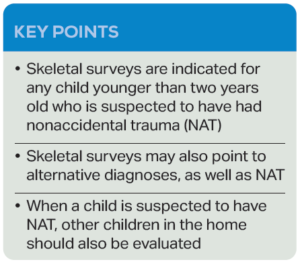
For children older than two years, with developmental delays who are suspected victims of NAT, skeletal survey should be strongly considered. For children between the ages of two and five years, the decision whether to get a skeletal survey should be based upon clinician judgement.

You Might Also Like
  • Tips for Diagnosing Abusive Head Trauma
  • How to Evaluate Your Youngest Victims in Child Abuse Cases
  • TEN-4 FACES P: A Mnemonic to Help You Spot Signs of Child Abuse
Explore This Issue
ACEP Now: Vol 43 – No 03 – March 2024
Skeletal surveys require considerable experience to obtain properly and to interpret accurately. Recommended imaging protocols are detailed by the American College of Radiology.3 If a severely injured child presents to a hospital without experience performing skeletal surveys and is awaiting transfer to a tertiary care center, it may be preferable to defer the survey until arrival at the receiving hospital. This should be discussed with the accepting physician.

Case Resolution

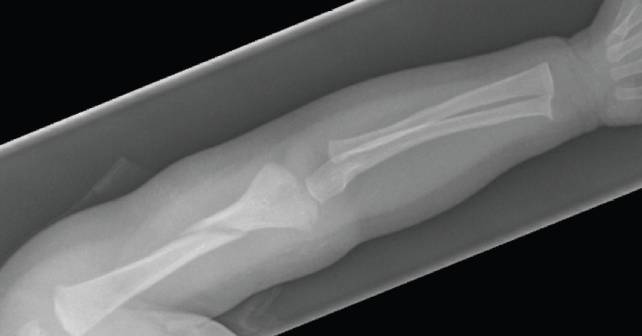
The patient was found to have a humeral fracture on X-ray. Subsequent skeletal survey revealed a healing ulnar fracture as well. The patient’s twin sibling also had a skeletal survey, which showed a healing ulnar fracture. A report was filed with Child Protective Services and the hospital’s child protection service was consulted. The hospital’s social worker was also notified.


Dr. RozziDr. Rozzi is medical director of the forensic examiner team at WellSpan Health, and the secretary of ACEP’s Forensic Section.

.

Dr. RivielloDr. Riviello is chair and professor of emergency medicine at the University of Texas Health Science Center at San Antonio.

References

  1. American Academy of Pediatrics, Section on Radiology. Diagnostic Imaging of Child Abuse. Pediatrics. 2009;123(5):1430–5.
  2. Botash AS, Ashraf I. CHAMP practice recommendation: Skeletal survey. CHAMP website. Published March 2021. Accessed February 28, 2024.
  3. ACR-SPR practice parameter for the performance and interpretation of skeletal surveys in children (ACR Res. 37). ACR website. Revised 2021. Accessed February 28, 2024.

Pages: 1 2 | Single Page

Topics: AbuseChild AbuseClinicalPediaricsTrauma & Injury

Related

  • Non-Invasive Positive Pressure Ventilation in the Emergency Department

    October 1, 2025 - 0 Comment
  • Emergency Department Management of Prehospital Tourniquets

    October 1, 2025 - 0 Comment
  • ACEP’s October 2025 Poll: How Often Do You Read Your Own X-Rays?

    September 30, 2025 - 0 Comment

Current Issue

ACEP Now: November 2025

Download PDF

Read More

No Responses to “Scan for These Potential Signs of Non-Accidental Trauma”

Leave a Reply Cancel Reply

Your email address will not be published. Required fields are marked *


*
*


Wiley
  • Home
  • About Us
  • Contact Us
  • Privacy
  • Terms of Use
  • Advertise
  • Cookie Preferences
Copyright © 2025 by John Wiley & Sons, Inc. All rights reserved, including rights for text and data mining and training of artificial technologies or similar technologies. ISSN 2333-2603
