Logo

Log In Sign Up |  An official publication of: American College of Emergency Physicians
Navigation
  • Home
  • Multimedia
    • Podcasts
    • Videos
  • Clinical
    • Airway Managment
    • Case Reports
    • Critical Care
    • Guidelines
    • Imaging & Ultrasound
    • Pain & Palliative Care
    • Pediatrics
    • Resuscitation
    • Trauma & Injury
  • Resource Centers
    • mTBI Resource Center
  • Career
    • Practice Management
      • Benchmarking
      • Reimbursement & Coding
      • Care Team
      • Legal
      • Operations
      • Quality & Safety
    • Awards
    • Certification
    • Compensation
    • Early Career
    • Education
    • Leadership
    • Profiles
    • Retirement
    • Work-Life Balance
  • Columns
    • ACEP4U
    • Airway
    • Benchmarking
    • Brief19
    • By the Numbers
    • Coding Wizard
    • EM Cases
    • End of the Rainbow
    • Equity Equation
    • FACEPs in the Crowd
    • Forensic Facts
    • From the College
    • Images in EM
    • Kids Korner
    • Medicolegal Mind
    • Opinion
      • Break Room
      • New Spin
      • Pro-Con
    • Pearls From EM Literature
    • Policy Rx
    • Practice Changers
    • Problem Solvers
    • Residency Spotlight
    • Resident Voice
    • Skeptics’ Guide to Emergency Medicine
    • Sound Advice
    • Special OPs
    • Toxicology Q&A
    • WorldTravelERs
  • Resources
    • ACEP.org
    • ACEP Knowledge Quiz
    • Issue Archives
    • CME Now
    • Annual Scientific Assembly
      • ACEP14
      • ACEP15
      • ACEP16
      • ACEP17
      • ACEP18
      • ACEP19
    • Annals of Emergency Medicine
    • JACEP Open
    • Emergency Medicine Foundation
  • About
    • Our Mission
    • Medical Editor in Chief
    • Editorial Advisory Board
    • Awards
    • Authors
    • Article Submission
    • Contact Us
    • Advertise
    • Subscribe
    • Privacy Policy
    • Copyright Information

Research on Therapeutic Hypothermia for Post-Arrest Patients Helps Refine Temperature-Management Strategies

By Scott D. Weingart, MD, FCCM | on October 10, 2014 | 1 Comment
ED Critical Care
  • Tweet
  • Click to email a link to a friend (Opens in new window) Email
Print-Friendly Version
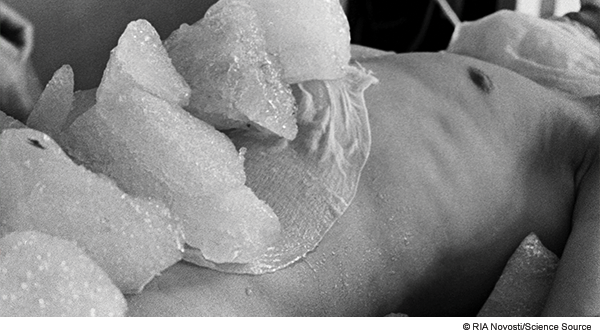
To Chill or Not To Chill

It also important to mention that for low-volume centers that do not see large numbers of post-arrest patients, 36°C may be an easier and equally effective option, without the difficulty of managing all the potential complications of hypothermia.

You Might Also Like
  • Critical Decisions: Therapeutic Hypothermia After Cardiac Arrest
  • Hypothermia After Cardiac Arrest
  • Hypothermia Therapy for Cardiac Arrest: Not Enough Proof
Explore This Issue
ACEP Now: Vol 33 – No 10 – October 2014

Dr. WeingartDr. Weingart is an ED intensivist. This column is a distillation of the best material from the EMCrit Blog and Podcast (http://emcrit.org).


Dr. CoxDr. Cox is a resident in emergency medicine at the Icahn School of Medicine at Mount Sinai in New York City.


References

  1. Nielsen N, Wetterslev J, Cronberg T, et al. Targeted temperature management at 33°C versus 36°C after cardiac arrest. N Engl J Med. 2013;369:2197-2206.
  2. Benson DW, Williams GR Jr, Spencer FC, Yates AJ. The use of hypothermia after cardiac arrest. Anesth Analg. 1959;38:423-428.
  3. Bernard SA, Gray TW, Buist MD, et al. Treatment of comatose survivors of out-of-hospital cardiac arrest with induced hypothermia. N Engl J Med. 2002;346:557-563.
  4. The Hypothermia After Cardiac Arrest Study Group. Mild therapeutic hypothermia to improve neurologic outcome after cardiac arrest. N Engl J Med. 2002;346:549-556.
  5. Kim YM, Yim HW, Jeong SH, Klem ML, Callaway CW. Does therapeutic hypothermia benefit adult cardiac arrest patients presenting with non-shockable rhythms? A systematic review and meta-analysis of randomized and non-randomized studies. Resusitation. 2012;83:188-196.
  6. Arrich J, Holzer M, Herkner H, Müllner M. Hypothermia for neuroprotection in adults after cardiopulmonary resuscitation. Cochrane Database Syst Rev. 2009;(4):CD004128.
  7. Bernard S. Post-cardiac arrest care in 2013 with Stephen Bernard. EMCRIT Podcast. 2013. Available at http://emcrit.org/podcasts/post-arrest-care-2013-i/.
  8. Polderman KH, Varon J. We should not abandon therapeutic cooling after cardiac arrest. Crit Care. 2014;18:130.

Pages: 1 2 3 4 | Single Page

Topics: Cardiac ArrestCardiovascularCritical CareEmergency MedicineEmergency PhysicianHypothermiaPatient SafetyResearch

Related

  • Why the Nonrebreather Should be Abandoned

    December 3, 2025 - 0 Comment
  • Q&A with ACEP President L. Anthony Cirillo

    November 5, 2025 - 0 Comment
  • Overcoming Language Barriers in the Emergency Department

    October 21, 2025 - 0 Comment

Current Issue

ACEP Now: November 2025

Download PDF

Read More

About the Author

Scott D. Weingart, MD, FCCM

Scott D. Weingart, MD, FCCM, is an ED intensivist. This column is a distillation of the best material from the EMCrit Blog and Podcast (http://emcrit.org).

View this author's posts »

One Response to “Research on Therapeutic Hypothermia for Post-Arrest Patients Helps Refine Temperature-Management Strategies”

  1. October 26, 2014

    ekulstad Reply

    Funny that despite the beautifully articulated analysis, even the headline in the ACEP eNow mailing sorta gets it wrong: “ADVANCES IN ED CRITICAL CARE – Chill on Therapeutic Hypothermia?”

Leave a Reply Cancel Reply

Your email address will not be published. Required fields are marked *


*
*


Wiley
  • Home
  • About Us
  • Contact Us
  • Privacy
  • Terms of Use
  • Advertise
  • Cookie Preferences
Copyright © 2025 by John Wiley & Sons, Inc. All rights reserved, including rights for text and data mining and training of artificial technologies or similar technologies. ISSN 2333-2603
