
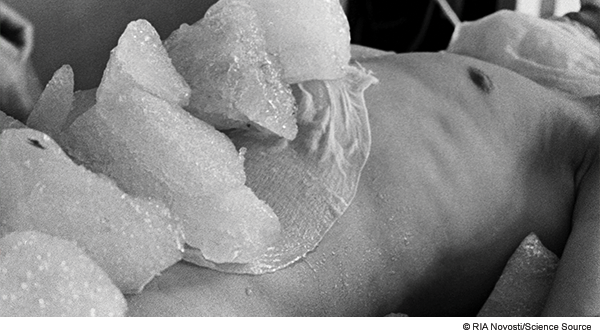
So please do not misinterpret this trial! Subjects in the 36°C arm were still actively cooled using ice packs, cooling blankets, and intravenous cooling catheters when necessary. It is unfortunate that the paper does not specifically describe interventions made in the 36°C arm at each site, but these patients were not simply given Tylenol and a hope for the best.
Explore This Issue
ACEP Now: Vol 33 – No 10 – October 2014What we find now is that 36°C may be as good a dose as 33°C with potentially fewer complications, and that makes a lot of sense—it’s still mild hypothermia, it’s still preventing fever, and it’s still accompanied by a profoundly aggressive and meticulous post-arrest care package, which was not seen in the control groups of previous trials.
Navigating the Nitty-Gritty
There are plenty of well-respected experts in post-arrest care who are not so quick to adopt 36°C based upon this single trial. Here is a list of their concerns, with brief summaries and analysis.
- Power of the Study: Dr. Carley was probably the first to point out that the TTM trial was a negative trial of difference, not a positive trial of equivalence. Dr. Cadogan echoed these concerns. The TTM trial was powered to find a 20 percent relative risk reduction, or 11 percent absolute risk reduction, between the two groups, and it failed to show a difference. This is not the same as proving the two therapies are equivalent in terms of mortality benefit. Statistically speaking, 33°C could confer a 10 percent absolute risk reduction versus 36°C that would have been detected had more subjects been enrolled.
Retort: That being said, there was no trend toward benefit in the data, and 939 subjects nearly triples the total used in the 2011 Cochrane review. To say that a randomized controlled trial with nearly 1,000 patients doesn’t offer much is raising the bar extremely high for future studies. - “Small but Cumulative” Differences: In a 2014 editorial, Dr. Polderman and Joseph Varon, MD, of the University of Texas Health Science Center in Houston, suggest that while no significant differences were found in favorable versus unfavorable clinical factors between the two groups, the trend was for less-favorable factors, such as absence of pupillary reflexes for the 33°C group and more-favorable factors such as bystander-witnessed arrest and shockable rhythm in the 36°C group.8 As a whole, these small, statistically insignificant differences would accumulate to create unequal study populations favoring the 36°C group.
Retort: In terms of Glasgow Coma Scale and Sequential Organ Failure Assessment–Cardiovascular (SOFA-C) scores, these two groups were nearly identical. Another interesting piece of data was that patients in the 36°C arm dramatically improved their SOFA-C over days two to three, as opposed to the 33°C arm. - Patient-Selection Bias? TH was already the standard of care, so patients not screened for the trial would by default receive TH. Thus, physicians may have had a subconscious incentive to not screen the patients they felt would most likely benefit from TH. On average, the 36 ICUs involved in the TTM trial screened 18 patients per year and only enrolled about 12 patients per year, or one per month, a number Dr. Polderman points out is suspiciously low and evidence of the potential effect of the subconscious incentive described above.
Retort: Lead TTM trial study author Niklas Nielsen, MD, PhD, writes, “The baseline characteristics, active care (60 percent early angiography and 40 percent coronary intervention), and survival rates strongly contradict a selection of patients with a presumed poor outcome.” - Rapid Rate of Rewarming? Dr. Polderman also expresses concern over a rapid rate of active rewarming in the TTM trial, from 33°C to 36°C in six hours, or 0.5°C per hour, which is greater than in previous trials, and potentially enough to negate the potential benefits of TH.
Retort: Dr. Nielsen states on EMCrit that the guideline for each institution was to actively re-warm at a rate no greater than 0.5°C per hour, and the actual average of rate was closer to previous trials at 0.36°C per hour, which closely correlates with the HACA trial rewarming rates. Also, there is no definitive evidence that the rate of rewarming leads to a change in outcome.
Final Take
At the virtual hospital Janus General, Dr. Weingart is targeting a temperature range between 35°C and 36°C for ventricular fibrillation, ventricular tachycardia, and pulseless electrical activity patients who qualify for an aggressive treatment path. Unwitnessed asystolic arrest patients were left out of the HACA, Bernard, and TTM trials. In this group, there is little guidance, and it may be reasonable to continue cooling to 33°C because these patients are most likely to have the most severe post-arrest neurologic injury. Certainly, more evidence may surface that identifies subpopulations that benefit at different temperatures or duration of temperature managements, but for now, the TTM appears to be the best evidence out there.
Pages: 1 2 3 4 | Single Page




One Response to “Research on Therapeutic Hypothermia for Post-Arrest Patients Helps Refine Temperature-Management Strategies”
October 26, 2014
ekulstadFunny that despite the beautifully articulated analysis, even the headline in the ACEP eNow mailing sorta gets it wrong: “ADVANCES IN ED CRITICAL CARE – Chill on Therapeutic Hypothermia?”