Logo

Log In Sign Up |  An official publication of: American College of Emergency Physicians
Navigation
  • Home
  • Multimedia
    • Podcasts
    • Videos
  • Clinical
    • Airway Managment
    • Case Reports
    • Critical Care
    • Guidelines
    • Imaging & Ultrasound
    • Pain & Palliative Care
    • Pediatrics
    • Resuscitation
    • Trauma & Injury
  • Resource Centers
    • mTBI Resource Center
  • Career
    • Practice Management
      • Benchmarking
      • Reimbursement & Coding
      • Care Team
      • Legal
      • Operations
      • Quality & Safety
    • Awards
    • Certification
    • Compensation
    • Early Career
    • Education
    • Leadership
    • Profiles
    • Retirement
    • Work-Life Balance
  • Columns
    • ACEP4U
    • Airway
    • Benchmarking
    • Brief19
    • By the Numbers
    • Coding Wizard
    • EM Cases
    • End of the Rainbow
    • Equity Equation
    • FACEPs in the Crowd
    • Forensic Facts
    • From the College
    • Images in EM
    • Kids Korner
    • Medicolegal Mind
    • Opinion
      • Break Room
      • New Spin
      • Pro-Con
    • Pearls From EM Literature
    • Policy Rx
    • Practice Changers
    • Problem Solvers
    • Residency Spotlight
    • Resident Voice
    • Skeptics’ Guide to Emergency Medicine
    • Sound Advice
    • Special OPs
    • Toxicology Q&A
    • WorldTravelERs
  • Resources
    • ACEP.org
    • ACEP Knowledge Quiz
    • Issue Archives
    • CME Now
    • Annual Scientific Assembly
      • ACEP14
      • ACEP15
      • ACEP16
      • ACEP17
      • ACEP18
      • ACEP19
    • Annals of Emergency Medicine
    • JACEP Open
    • Emergency Medicine Foundation
  • About
    • Our Mission
    • Medical Editor in Chief
    • Editorial Advisory Board
    • Awards
    • Authors
    • Article Submission
    • Contact Us
    • Advertise
    • Subscribe
    • Privacy Policy
    • Copyright Information

Research on Therapeutic Hypothermia for Post-Arrest Patients Helps Refine Temperature-Management Strategies

By Scott D. Weingart, MD, FCCM | on October 10, 2014 | 1 Comment
ED Critical Care
  • Tweet
  • Click to email a link to a friend (Opens in new window) Email
Print-Friendly Version
To Chill or Not To Chill

The Targeted Temperature Management (TTM) trial published in the New England Journal of Medicine in November 2013 was perhaps the most important article of the year in resuscitative and critical care medicine.1

You Might Also Like
  • Critical Decisions: Therapeutic Hypothermia After Cardiac Arrest
  • Hypothermia After Cardiac Arrest
  • Hypothermia Therapy for Cardiac Arrest: Not Enough Proof
Explore This Issue
ACEP Now: Vol 33 – No 10 – October 2014

In the setting of advanced post-arrest care and a protocolized neuroprognostication system, this large, multinational randomized controlled trial compared two targeted temperature management strategies (33°C versus 36°C) in out-of-hospital post-arrest patients and found no significant difference in mortality between the two groups.

If you haven’t heard about this study yet, this is not an introductory piece. But that’s okay. The website www.EMCrit.org offers an enormous set of resources about this trial and others dealing with therapeutic hypothermia (TH) that came before it. The purpose of this piece, rather, is to discuss some important details of the study and attempt to answer the question, “So, what do we do now?”

Basis for Mild Therapeutic Hypothermia and TTM Trial

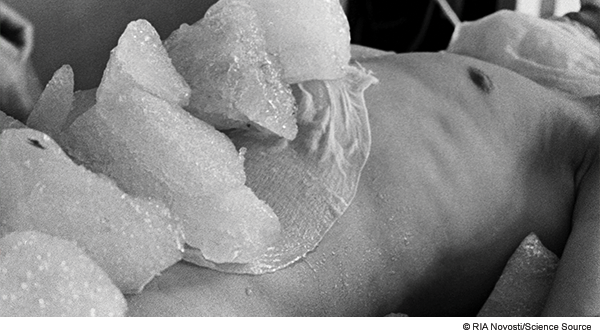
TH in post-arrest patients has been used for decades; it’s a practice largely based on theory, animal models, and retrospective analyses.2 In 2002, two groundbreaking randomized control trials, Bernard and Hypothermia After Cardiac Arrest (HACA), demonstrated a benefit in the number of patients discharged neurologically intact when cooling patients with initial shockable ventricular dysrhythmias. These patients were cooled to mild hypothermic temperatures of 32–35°C for 12 and 24 hours after arrest versus then-standard-of-care ad-lib temperatures. The control groups did not receive active temperature control.3,4

Further nonrandomized studies have shown similar survival benefit in terms of relative risk in other arrest rhythms and groups, making moderate hypothermia the standard of care for out-of-hospital post-arrest patients around the world.5

36°C may be as good as 33°C with potentially fewer complications…it’s still mild hypothermia, it’s still preventing fever.

A 2011 Cochrane review estimates that for every six patients treated with mild hypothermia after cardiac arrest, one receives survival benefit, making TH one of the most effective interventions in our modern post-arrest care arsenal.6

However, moderate TH does not come without potential adverse events such as sepsis, coagulopathy, electrolyte imbalance, and life-threatening dysrhythmia, to name a few.7

That’s why this trial is such a big deal. The TTM trial suggests that by actively preventing fever with mild hypothermia at 36°C, we can achieve the same mortality benefit without added adverse consequences.

Online Reaction & Reception

Almost immediately after its publication, the TTM trial gained widespread attention in the FOAMed and social media communities, igniting discussion and debate with both praise and caution for its future implication on clinical practice.

Pages: 1 2 3 4 | Single Page

Topics: Cardiac ArrestCardiovascularCritical CareEmergency MedicineEmergency PhysicianHypothermiaPatient SafetyResearch

Related

  • Why the Nonrebreather Should be Abandoned

    December 3, 2025 - 0 Comment
  • Q&A with ACEP President L. Anthony Cirillo

    November 5, 2025 - 0 Comment
  • Overcoming Language Barriers in the Emergency Department

    October 21, 2025 - 0 Comment

Current Issue

ACEP Now: November 2025

Download PDF

Read More

About the Author

Scott D. Weingart, MD, FCCM

Scott D. Weingart, MD, FCCM, is an ED intensivist. This column is a distillation of the best material from the EMCrit Blog and Podcast (http://emcrit.org).

View this author's posts »

One Response to “Research on Therapeutic Hypothermia for Post-Arrest Patients Helps Refine Temperature-Management Strategies”

  1. October 26, 2014

    ekulstad Reply

    Funny that despite the beautifully articulated analysis, even the headline in the ACEP eNow mailing sorta gets it wrong: “ADVANCES IN ED CRITICAL CARE – Chill on Therapeutic Hypothermia?”

Leave a Reply Cancel Reply

Your email address will not be published. Required fields are marked *


*
*


Wiley
  • Home
  • About Us
  • Contact Us
  • Privacy
  • Terms of Use
  • Advertise
  • Cookie Preferences
Copyright © 2025 by John Wiley & Sons, Inc. All rights reserved, including rights for text and data mining and training of artificial technologies or similar technologies. ISSN 2333-2603
