
Shortly after 1:20 a.m. on June 24, 2021, a large section of Champlain Towers South, a 12-story condominium in Surfside, Florida, collapsed. It was one of the largest non-hurricane emergencies in the state’s history, killing 98.
Explore This Issue
ACEP Now: Vol 40 – No 10 – October 2021Search and rescue teams spent weeks scouring 18 million pounds of concrete to rescue survivors and recover victims. As the coordinating medical team manager for Miami-Dade Fire Rescue’s Urban Search and Rescue team, I was one of the first (and last) physicians on the scene.
First Impressions
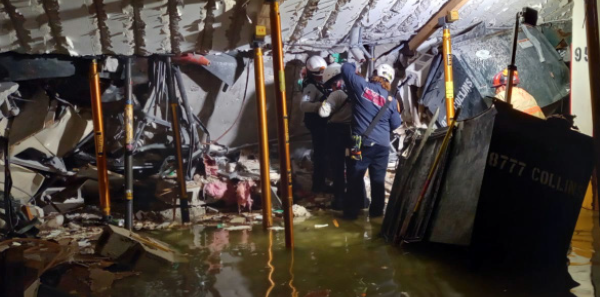
The front of the building looked fine, but then we walked around the building. It was just a giant rubble pile. You could hear screaming and crying. Everyone was just trying to figure out what was going on. We were going up through a collapsed part of the floor in the parking garage, trying to rescue anyone we could reach. We were sloshing through water past our knees. I remember looking over and seeing a Tesla parked nearby, hardly visible because it was under water. Thoughts were running through my mind as we assessed the scene: Are we going to get electrocuted? Is the rest of this building going to come down on us? How do we secure the scene? What hazardous materials are we dealing with?
We could hear a teenage girl crying out for help from within the rubble, trapped behind a mass of rebar, dumpster, and concrete slabs. We spent hours trying to locate her, but eventually we stopped hearing her calls. A fire broke out, forcing us to pull back until we could control the flames. After that, we knew she had passed.
Benjamin Abo
The Floating Photo
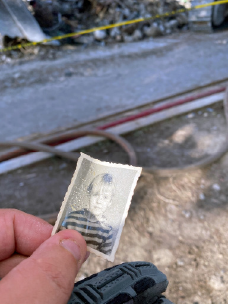
I walked out from the garage rubble and was standing on a pool deck that had collapsed down a little bit. Floating in the pool water was a black-and-white wedding photo, probably from the late ’70s, taken inside a synagogue. I thought about the people in the photo: Is this someone who survived, or is the only remaining person from the family now lost in the rubble? I set it aside, eventually taking a photo of it with my phone and sending it to a local Jewish community leader to see if he knew any of the people in the photo. As we found more items, we started collecting and cataloging them. I think we’re probably up to nearly 15 huge bins of items we’ve brought out from the rubble. We knew these people didn’t have time to get to their belongings when the building collapsed, but these are memories. We thought they might bring some comfort and closure to the families.
After being on-site for two and a half weeks, Dr. Abo glanced down and spotted this photo from 1968 right next to his boot.
Benjamin Abo
A Place to Recover
We noticed a small memorial had started on the chain-link fence next to our tents. Someone had hung a photo and some flowers upside down so they would dry. I added a stuffed alligator we found inside the collapse. Within days, the entire fence was covered in objects to memorialize the victims. Now it takes up the whole block. The problem was that our rescue team’s tents, each with 16 beds inside, were set up on the tennis courts right inside that fence. We were working all night and trying to sleep in those tents during the day, but all we could hear were people visiting the memorial, sobbing, grieving. There was no place for us to get away from it, no quiet place to recover both physically and emotionally between our shifts. After two weeks, we moved our tents to a park a few blocks away.
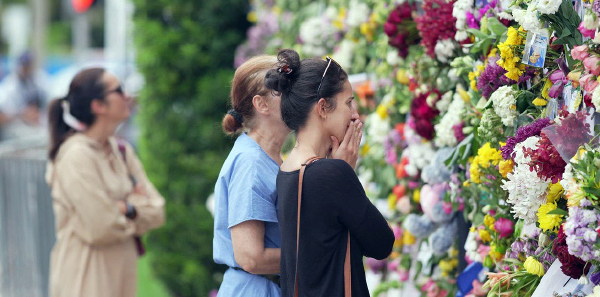
Visitors spend time at the memorial that grew on the fence next to the site.
Rick Stephens of Miami-Dade Fire Rescue
Preparation Versus Reality
I started volunteering with EMS when I was 16 years old in New Jersey and then in Pittsburgh during college. My Pittsburgh mentors taught me that we are not paid for what we do but for what we are prepared to do.
I’ve been working in disaster medicine a long time—Katrina, Haiti, Dorian, plus a lot of local responses to homicides, accidents, and various things. I’ve always identified with Miami-Dade Fire Rescue’s motto, “Always ready, proud to serve.” But this was different. This was my community. These were people I knew.
I will never forget where I was standing when we found the daughter of one of our firefighters. I will always remember seeing his face in that moment and the way we all lined up for a procession to gently take her out of the rubble. Our teams are as ready as we can be, but there is no way to prepare for moments like that.
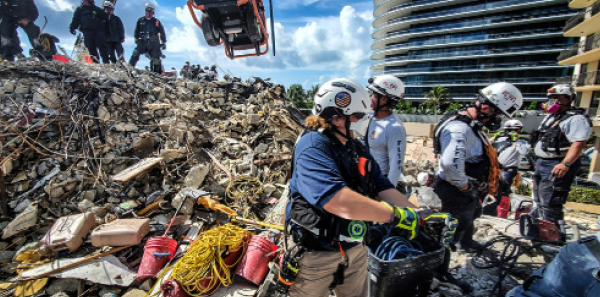
The Urban Search and Rescue team worked 24-7 in 12-hour shifts in and atop the debris, searching, geolocating information, and assuring safety.
Rick Stephens of Miami-Dade Fire Rescue
Peer Support
We are all dealing with so many emotions. I think it helps to talk about it, so I encourage that for our team members. I think it’s important that we don’t hold it in. I remember seeing a physician colleague of mine. As we hugged hello, we both cried. (And that’s OK—I felt better after and went back to work.) It’s not helpful when outside people ask for gritty details about what we are witnessing, but it can be cathartic when we get to talk about our feelings and what we are processing. For me, seeing and knowing that everyone is looking out for one another, that helps. But I also think this is going to hit harder once we aren’t so busy and we have more time to think about it.
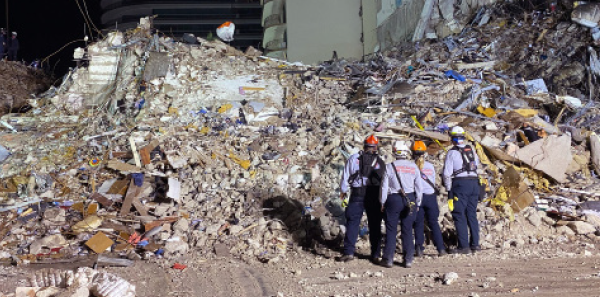
Members of the Urban Search and Rescue team assessed the site during a night shift.
Benjamin Abo
The Feelings Factor
In our line of work, we become adept at compartmentalizing our feelings and pushing through. For me, that fine line of staying strong and calm while also acknowledging I need to prioritize my own mental health—that is a consistent balancing act, an internal conflict we all face. I’ve worked in EMS for 25 years. I’m trained in critical incident stress management, and I’ve been on a number of “once-in-a-lifetime” calls. I’ve lost co-workers, partners, and mentors to suicide or substance abuse. When we feel the need to constantly be strong and we don’t have that outlet to talk through it with someone, that’s often when we see the mental health struggles. Even the strongest substances can break. But I know firsthand that the balancing act is hard; it’s a constant effort.
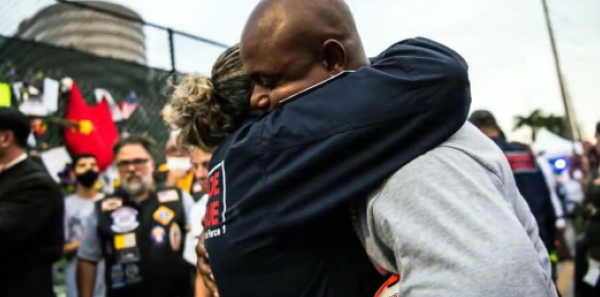
Members of the Urban Search and Rescue team comfort each other during a memorial service after spending several weeks working at the scene.
Rick Stephens of Miami-Dade Fire Rescue
Man’s Best Friend
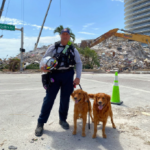
K9 specialist John Long with FEMA-certified search and rescue dogs Stone and Cable. One dog focuses on finding living people, while the other searches for human remains.
Rick Stephens of Miami-Dade Fire Rescue
Our search and rescue team includes a father and son dog duo, Stone and Cable. They’re not here as peer-support animals—they are well-trained working dogs, a big part of our search and rescue team. It’s my job to look out for their physical well-being, too, even though I’m not a vet. Keeping them active and checking on them is cathartic though. We can step away from the scene and let our teammates know, “Hey, I’m hanging with the dogs.” The dogs know we’re stressed; they know how to read our cues. They’ll come over and put their heads on our laps, looking up at us like, “What’s up—you good? You wanna give us a scratch?” They’re amazing.
Affirmation
I hope to never have to go through this again. However, I know that I’m ready if it happens. For me specifically, it reaffirms that I am absolutely in the right field. This is my passion. I know this experience isn’t going to have the same effect on everyone, but for me, it has further solidified that emergency medicine is what I’m supposed to be doing, and these paramedics, firefighters, and emergency physicians are my family.
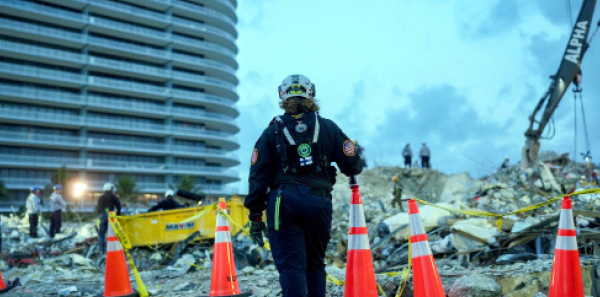
Dr. Benjamin Abo surveys the Surfside scene as part of his role to oversee recovery operations and assure the safety and welfare of the rescue teams.
Rick Stephens of Miami-Dade Fire Rescue
Acknowledgment: Dr. Abo wrote this in collaboration with ACEP Communications Manager Jordan Grantham.
Dr. Abo is an EMS and emergency physician and medical director for multiple fire departments in Florida. He is medical team manager for Miami-Dade Fire Rescue’s Urban Search and Rescue team (FLTF1) and is faculty for the upcoming EMS Fellowship with Florida State University.
Pages: 1 2 3 4 | Multi-Page



One Response to “Rescue Team Doctor at the Surfside Condo Collapse Shares Experience”
October 27, 2021
Laurie BryantI had the privilege to work alongside Dr. Ben Abo (Medical team Manager for FTF-1) at the Surfside Collapse while I served as Medical Team Manager for FTF-5. A truly representative article…in its most raw form. This is why i pursued emergency medicine, and working alongside leaders such as Ben make me a better physician.
Respectfully,
Laurie Bryant, DO
Jacksonville, FL