
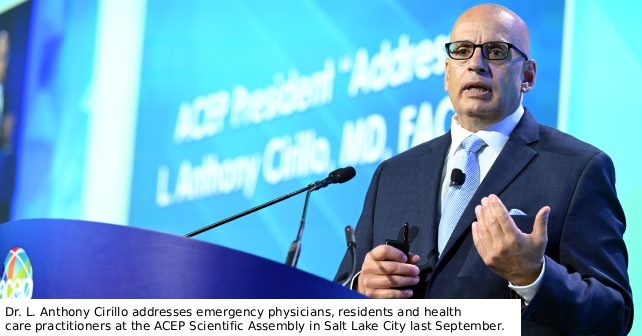
Twice a year, the Medical Editor-in-Chief of ACEP Now sits down with the ACEP President to discuss issues relevant to the College and important to emergency physicians. This article is an excerpt of the conversation I had with L. Anthony Cirillo, MD, FACEP; it has been edited for length and clarity.
Explore This Issue
ACEP Now: November 2025Dr. Cedric Dark: With me today is ACEP’s president, Dr. Anthony (Tony) Cirillo. Thank you very much for joining us. You’ve been president for maybe about a month now, and hopefully you’ve had a chance to get your feet wet. I wanted to start off with a really difficult question, though.
It’s about our current ACEP Now poll, sparked by a lecture at ACEP25 where one of the presenters was talking about who’s actually reading their own X-rays. Because of the liability that might be there if a radiologist missed something, or if there’s something subtle that we’re looking for that the radiologist doesn’t know to look for, I want to ask you. Do you read your own X-rays?
Dr. Cirillo: I read them all. I personally look at them, and again, to your point, I know where the boo-boo is, right? I know where they hurt. I know what the exam was like. When I look at the X-ray, if I see what I was expecting, I’m usually comfortable. Nothing against our radiology colleagues, but we’re finding that sometimes official readings take a while. And if somebody has rolled their ankle, and they’re tender over their lateral malleus, and they’ve got a non-displaced fibula fracture, and they’re neurovascularly intact, you’re like, I think I’m good. I always go back, though, to make sure that I look at the official reads at some point.
Dr. Dark: Let’s talk about what began as the One Big, Beautiful Bill, now officially called H.R. 1, which was the big tax law that was passed this summer. There are a lot of Medicaid provisions that impact emergency physicians because of EMTALA. An article in The Hill recently quoted Vice President J.D. Vance as saying:
“If you’re an American citizen and you’ve been to the hospital in the last few years, you’ve probably noticed that wait times are especially large, and very often, somebody who’s there in the ER is an illegal alien. Why do those people get health care benefits at hospitals paid for by American citizens?”
I wanted to get your take, as President of ACEP, on that statement, and how the new tax law impacts us in the emergency department.
Dr. Cirillo: On the most fundamental part of that question, we put out a statement on Sunday [October 5, 2025]. Building on what the Vice President had said, Speaker [Mike] Johnson on “Face the Nation” doubled down a little bit but then backed off on that.
We decided we needed to make a statement as a College, and the statement basically said we take care of people based upon how sick they are. We are committed to taking care of every patient, regardless of their immigration status, insurance status, or ability to pay. We took an oath to do that, and we will never waver from that oath. Our approach is, politics and reimbursement aside, for emergency physicians, our job is to take care of people, and that’s what we’re committed to.
From the perspective of H.R. 1, there’s really two major things that, honestly, will have an economic impact on the specialty. One is the increased requirements for maintaining Medicaid, including work requirements. People are going to lose coverage. Even the people who are entitled to have coverage are going to [lose it] because it will be administratively more difficult for them.
The Congressional Budget Office [has] estimated that about 10 million people are going to lose Medicaid coverage. The second part is the tax credits and the subsidies that allow people to maintain their coverage under the health exchanges that were created under the [Affordable Care Act] ACA. Similarly, it’s not just those with Medicaid coverage, but those people with access to full commercial insurance coverage, with their premiums getting subsidized through the ACA.
The estimate is that six million additional people are going to lose coverage.1 We have 350 million people in this country; having 16 million of them lose access to health insurance is not good. I know, and every emergency physician knows we can take care of people when they’re acutely ill and injured. But the follow-up for those is dependent upon them being in the system. Taking 16 million people out of the system doesn’t help.
When it comes to emergency department finances, when we treat people with Medicaid coverage, we get paid something. Now, in some states that something is pitiful. But in other states — and I’ll use Maryland as an example — we get 100 percent of Medicare. In that situation, it helps to sustain the practice model. People going from Medicaid to being uninsured means we will collect essentially almost nothing. In the balance of trying to run an EM group where you have basically commercially insured, Medicare insured, Medicaid insured, and the uninsured, the more we shift away from people who have any insurance, it just makes it harder to run a group — big, small, or everywhere in between.
Dr. Dark: Let’s jump a little bit to talking about the practice of medicine, and somewhat the corporate influence, too. There was a recent paper published in Annals of Emergency Medicine by Dr. Angela Cai that talked about how emergency physician groups are staffed and owned. It said that private equity is responsible for staffing about 25 percent of all ED visits, health system groups responsible for about a third, and physician-owned groups represent fewer than half (about 21 percent are regional clinical partnerships, 13 percent national partnerships, and eight percent are single-site clinician partnerships). Dr. Cai’s quoted as saying in MedPage Today that “there’s a larger conversation that we should have as a society about who should be owning medical practices” and in this case, emergency medicine staffing groups. What is your opinion on that?
Dr. Cirillo: I will tell you, the answer is, it’s complicated, because in this country, we have certain business models and certain kinds of economic models.
The right way to finance health care is a question that every country is struggling with. Regardless of the model they have today, the population of the world is getting larger, the population is getting older, and we have more complex medicine. All those things lead to more cost. As I hear with my health policy ears, people talking about how we spend too much on health care. We better take a step back and go, wait a minute, who and what are we really talking about? Because there’s lots of places [where] we spend money in the system, including towards end-of-life care. If you want to have a tough conversation, there are a lot of conversations to have there.
The nature of health care as a business continues to be more business. Insurance companies were the first part of the triangle. If you think about health care economics in this country, we have insurers, we have facilities, and then we have providers. And I know we don’t like to use that word, providers, but that is the term that officially gets used, so we’ll just say physicians. And of those three, it has always been a balance of negotiating leverage. Because if you’re a physician group, you’re trying to negotiate with an insurer to make sure that you get paid fairly. What we saw was, years ago, the insurers began consolidating. There are now about eight insurance companies. The insurance companies very quickly realized that size matters, and they could get negotiating leverage over hospitals. What did hospitals start to do? In response, they started to consolidate into health care systems. And we’ve watched many, many independent hospitals become part of health care systems.
Physicians are the last part of the triangle. How do we maintain some negotiating leverage in a system where the two other parties have gotten so big, so fast? It raises that question of how sustainable is single hospital group practice. And we’d love for that to continue, but in the setting of negotiating with Blue Cross, that’s not so easy. As you talk about consolidation, we look at market share and in Alabama — it’s the most egregious example — Blue Cross of Alabama insures 75 percent of the commercial patients.
So, if you want to say, I’m not going to take Blue Cross of Alabama as an independent group, you basically are not in business anymore.
What the role is of private equity or outside funding versus independent ownership is a fundamental one. If we’re going to shine that light on the physician community, we damn well better shine it on the health care system and the insurer community.
United Healthcare is the largest insurer in this country. They are a publicly traded, for-profit entity where people can day trade their stock to make money. If we think that’s bad, then we ought to be calling all that behavior out. If we’re going to say health care really shouldn’t be a business anymore, then we can say that. But then we’ve got to come up with an alternative model, whether that’s a public utility model, or a one-size-fits-all model like a Medicare-for-all model. But in the current structure, we’re all trying to fight for the same dollars as for-profit insurers and for-profit hospitals. We have to be able to sustain ourselves in that system.
Dr. Dark: I think it is a double-edged sword because as you say, unless we go for scale, then we are at the mercy of the insurance companies, or maybe even the hospitals, in terms of what we’re able to do in our physician practices. But then to get at scale sometimes, that requires more corporatization. I like your response that we shouldn’t purely focus on our physician side of that triangle without also focusing on the insurance side or the hospital side.
A lot of times, all we’re taught to do is move the meat. It’s a phrase that shows up in a New York Times article that just came out recently detailing a tragic case of a young college-age student who wound up dying following a few emergency department visits. The writer of that article had a couple of questions, and I want to read those for you and give you a chance to respond. She asks, “Can we expect emergency physicians, imperfect people treating idiosyncratic patients, to perform almost flawlessly in a system that is stretched to the limit? And when care is flawed, where is the line between adequate and failing, and who, beyond judges and juries, makes that call?”
Dr. Cirillo: I think we all saw the article on Sunday morning [October 5, 2025]. There have been internal discussions about it. Kudos to the author because she pulled off all of the bandages. In that specific case, we won’t comment on that as a College because we don’t know all the details. But as she’s described them, I think she laid out that ultimate question, which is, “Are we expected to be perfect in an imperfect system?”
First of all, medicine itself, you and I know, is not perfect. That there are times when people present, and you could be wicked smaht,* you could know everything there is to know about medicine, but you can’t put that person in a cubbyhole. Somehow their condition, their presentation, is just baffling. Second, even the things like laboratory testing — they reference some of that in the article — are designed with a 95 percent confidence limit. There are 2.5 percent of people on both sides of that curve who will defy the test results. Then you add to it the fact that we don’t feel like the system is making it easy for us to do our best.
The third part is, we’re not perfect, and sometimes, physicians do make mistakes. As we were discussing this internally for the College, we’re threading that needle about how to say those things without seeming to be uncaring, callous, or defensive.
What we’re trying to find is that balance. The medicine’s never perfect; the systems certainly don’t help us to be better at it, and then there are times when individual physicians make mistakes.
Part of what I hope we can share with the author is the RAND report. I’m sharing that with every writer I can in the health policy space because I think the RAND report tells the story we’ve been trying to tell for 25 years: We know we’re not perfect, but the system is deeply broken.
I will give kudos to the author. She wrote the story with enough objectivity that it didn’t feel like she was passing judgment, but she hit all the highlights of the places where the Swiss cheese can have a hole.
Dr. Dark: I wanted to give you a chance to share one of those feel-good stories that emergency physicians need to hear. What should we feel good about right now?
Dr. Cirillo: My answer is: every patient you go to see. You just laid out many of the challenges we face: the realities of medicine, being overwhelmed in the ED, and the economics of health care in this country. When I give talks to residents or ACEP Chapters, I put up a slide with 15 of these problems, and I’ll say, “We all feel like Sisyphus, about to get crushed by the rock again today.” But then I remember, that’s not why we’re here. Ultimately, we’re here every day in the emergency department to be healers. People come to us because they trust us, not only to care about them, but to care for them. They also trust that we’ll know the science. I tell residents and students: if you’ve made it this far, you’re smart. Learning the science won’t set you apart. That’s what everyone expects when you introduce yourself as “doctor.”
What makes the difference is who you are when you walk into that room, and whether you truly understand what that patient needs [to have] healed that day. Sometimes it’s the medical issue. But often it’s not their body that needs healing. It’s their mind or their soul.
We have more power to change the world, one human interaction at a time, than we’re told. When you heal another human being, you create ripples in the world. You won’t always see those ripples, because those people leave and often don’t come back. But you have no idea how much you’ve changed them. Don’t ever underestimate that. If you want to feel good about something, that’s the restorative moment, when you physically touch another human being and help heal them.
*EDITOR’S NOTE: Although Dr. Cirillo is originally from Brooklyn, he said this in a very Boston accent after living in New England for 28 years.
Reference
- Center on Budget and Policy Priorities. By the Numbers: Harmful Republican Megabill Will Take Health Coverage Away From Millions of People and Raise Families’ Costs. Published August 27, 2025. Accessed October 16, 2025. https://www.cbpp.org/research/health/by-the-numbers-harmful-republican-megabill-will-take-health-coverage-away-from#:~:text=Roughly%2015%20million%20people%20will,not%20available%20at%20this%20time.


No Responses to “Q&A with ACEP President L. Anthony Cirillo”