
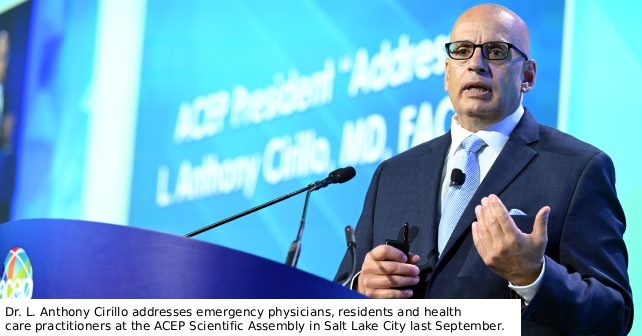
Dr. Cirillo: I think we all saw the article on Sunday morning [October 5, 2025]. There have been internal discussions about it. Kudos to the author because she pulled off all of the bandages. In that specific case, we won’t comment on that as a College because we don’t know all the details. But as she’s described them, I think she laid out that ultimate question, which is, “Are we expected to be perfect in an imperfect system?”
Explore This Issue
ACEP Now: November 2025First of all, medicine itself, you and I know, is not perfect. That there are times when people present, and you could be wicked smaht,* you could know everything there is to know about medicine, but you can’t put that person in a cubbyhole. Somehow their condition, their presentation, is just baffling. Second, even the things like laboratory testing — they reference some of that in the article — are designed with a 95 percent confidence limit. There are 2.5 percent of people on both sides of that curve who will defy the test results. Then you add to it the fact that we don’t feel like the system is making it easy for us to do our best.
The third part is, we’re not perfect, and sometimes, physicians do make mistakes. As we were discussing this internally for the College, we’re threading that needle about how to say those things without seeming to be uncaring, callous, or defensive.
What we’re trying to find is that balance. The medicine’s never perfect; the systems certainly don’t help us to be better at it, and then there are times when individual physicians make mistakes.
Part of what I hope we can share with the author is the RAND report. I’m sharing that with every writer I can in the health policy space because I think the RAND report tells the story we’ve been trying to tell for 25 years: We know we’re not perfect, but the system is deeply broken.
I will give kudos to the author. She wrote the story with enough objectivity that it didn’t feel like she was passing judgment, but she hit all the highlights of the places where the Swiss cheese can have a hole.
Dr. Dark: I wanted to give you a chance to share one of those feel-good stories that emergency physicians need to hear. What should we feel good about right now?



No Responses to “Q&A with ACEP President L. Anthony Cirillo”