
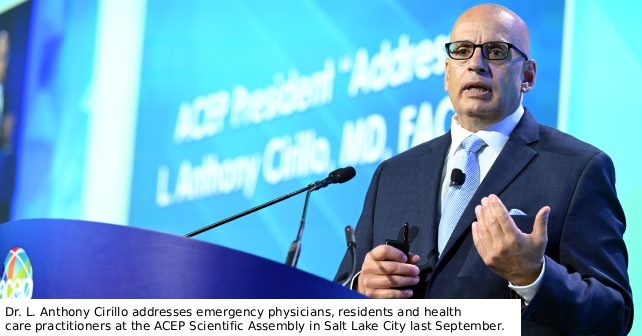
Physicians are the last part of the triangle. How do we maintain some negotiating leverage in a system where the two other parties have gotten so big, so fast? It raises that question of how sustainable is single hospital group practice. And we’d love for that to continue, but in the setting of negotiating with Blue Cross, that’s not so easy. As you talk about consolidation, we look at market share and in Alabama — it’s the most egregious example — Blue Cross of Alabama insures 75 percent of the commercial patients.
Explore This Issue
ACEP Now: November 2025So, if you want to say, I’m not going to take Blue Cross of Alabama as an independent group, you basically are not in business anymore.
What the role is of private equity or outside funding versus independent ownership is a fundamental one. If we’re going to shine that light on the physician community, we damn well better shine it on the health care system and the insurer community.
United Healthcare is the largest insurer in this country. They are a publicly traded, for-profit entity where people can day trade their stock to make money. If we think that’s bad, then we ought to be calling all that behavior out. If we’re going to say health care really shouldn’t be a business anymore, then we can say that. But then we’ve got to come up with an alternative model, whether that’s a public utility model, or a one-size-fits-all model like a Medicare-for-all model. But in the current structure, we’re all trying to fight for the same dollars as for-profit insurers and for-profit hospitals. We have to be able to sustain ourselves in that system.
Dr. Dark: I think it is a double-edged sword because as you say, unless we go for scale, then we are at the mercy of the insurance companies, or maybe even the hospitals, in terms of what we’re able to do in our physician practices. But then to get at scale sometimes, that requires more corporatization. I like your response that we shouldn’t purely focus on our physician side of that triangle without also focusing on the insurance side or the hospital side.
A lot of times, all we’re taught to do is move the meat. It’s a phrase that shows up in a New York Times article that just came out recently detailing a tragic case of a young college-age student who wound up dying following a few emergency department visits. The writer of that article had a couple of questions, and I want to read those for you and give you a chance to respond. She asks, “Can we expect emergency physicians, imperfect people treating idiosyncratic patients, to perform almost flawlessly in a system that is stretched to the limit? And when care is flawed, where is the line between adequate and failing, and who, beyond judges and juries, makes that call?”



No Responses to “Q&A with ACEP President L. Anthony Cirillo”