Logo

Log In Sign Up |  An official publication of: American College of Emergency Physicians
Navigation
  • Home
  • Multimedia
    • Podcasts
    • Videos
  • Clinical
    • Airway Managment
    • Case Reports
    • Critical Care
    • Guidelines
    • Imaging & Ultrasound
    • Pain & Palliative Care
    • Pediatrics
    • Resuscitation
    • Trauma & Injury
  • Resource Centers
    • mTBI Resource Center
  • Career
    • Practice Management
      • Benchmarking
      • Reimbursement & Coding
      • Care Team
      • Legal
      • Operations
      • Quality & Safety
    • Awards
    • Certification
    • Compensation
    • Early Career
    • Education
    • Leadership
    • Profiles
    • Retirement
    • Work-Life Balance
  • Columns
    • ACEP4U
    • Airway
    • Benchmarking
    • Brief19
    • By the Numbers
    • Coding Wizard
    • EM Cases
    • End of the Rainbow
    • Equity Equation
    • FACEPs in the Crowd
    • Forensic Facts
    • From the College
    • Images in EM
    • Kids Korner
    • Medicolegal Mind
    • Opinion
      • Break Room
      • New Spin
      • Pro-Con
    • Pearls From EM Literature
    • Policy Rx
    • Practice Changers
    • Problem Solvers
    • Residency Spotlight
    • Resident Voice
    • Skeptics’ Guide to Emergency Medicine
    • Sound Advice
    • Special OPs
    • Toxicology Q&A
    • WorldTravelERs
  • Resources
    • ACEP.org
    • ACEP Knowledge Quiz
    • Issue Archives
    • CME Now
    • Annual Scientific Assembly
      • ACEP14
      • ACEP15
      • ACEP16
      • ACEP17
      • ACEP18
      • ACEP19
    • Annals of Emergency Medicine
    • JACEP Open
    • Emergency Medicine Foundation
  • About
    • Our Mission
    • Medical Editor in Chief
    • Editorial Advisory Board
    • Awards
    • Authors
    • Article Submission
    • Contact Us
    • Advertise
    • Subscribe
    • Privacy Policy
    • Copyright Information

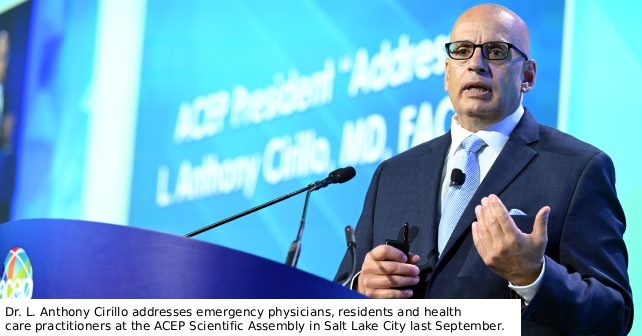
Q&A with ACEP President L. Anthony Cirillo

By ACEP Now | on November 5, 2025 | 0 Comment
Features
  • Tweet
  • Click to email a link to a friend (Opens in new window) Email
Print-Friendly Version

Dr. Dark: Let’s jump a little bit to talking about the practice of medicine, and somewhat the corporate influence, too. There was a recent paper published in Annals of Emergency Medicine by Dr. Angela Cai that talked about how emergency physician groups are staffed and owned. It said that private equity is responsible for staffing about 25 percent of all ED visits, health system groups responsible for about a third, and physician-owned groups represent fewer than half (about 21 percent are regional clinical partnerships, 13 percent national partnerships, and eight percent are single-site clinician partnerships). Dr. Cai’s quoted as saying in MedPage Today that “there’s a larger conversation that we should have as a society about who should be owning medical practices” and in this case, emergency medicine staffing groups. What is your opinion on that?

You Might Also Like
  • What Will Obamacare Mean for Emergency Physicians?
  • Opinion: Single Payer Health Care Would Be Detrimental to Emergency Physicians
  • ACEP Acts to Avert National Medicaid Crisis
Explore This Issue
ACEP Now: November 2025

Dr. Cirillo: I will tell you, the answer is, it’s complicated, because in this country, we have certain business models and certain kinds of economic models.

The right way to finance health care is a question that every country is struggling with. Regardless of the model they have today, the population of the world is getting larger, the population is getting older, and we have more complex medicine. All those things lead to more cost. As I hear with my health policy ears, people talking about how we spend too much on health care. We better take a step back and go, wait a minute, who and what are we really talking about? Because there’s lots of places [where] we spend money in the system, including towards end-of-life care. If you want to have a tough conversation, there are a lot of conversations to have there.

The nature of health care as a business continues to be more business. Insurance companies were the first part of the triangle. If you think about health care economics in this country, we have insurers, we have facilities, and then we have providers. And I know we don’t like to use that word, providers, but that is the term that officially gets used, so we’ll just say physicians. And of those three, it has always been a balance of negotiating leverage. Because if you’re a physician group, you’re trying to negotiate with an insurer to make sure that you get paid fairly. What we saw was, years ago, the insurers began consolidating. There are now about eight insurance companies. The insurance companies very quickly realized that size matters, and they could get negotiating leverage over hospitals. What did hospitals start to do? In response, they started to consolidate into health care systems. And we’ve watched many, many independent hospitals become part of health care systems.

Pages: 1 2 3 4 5 6 | Single Page

Topics: ACEP PresidentAdvocacycorporate medicineDr. L. Anthony CirilloEMTALAFrom the PresidentHealth PolicyMedicaidMedical ErrorPatient SafetyPractice ManagementPrivate EquityReimbursement

Related

  • Florida Emergency Department Adds Medication-Dispensing Kiosk

    November 7, 2025 - 1 Comment
  • How Does Emergency Medicine Navigate Consolidation Trends in Health Care?

    October 29, 2025 - 0 Comment
  • Overcoming Language Barriers in the Emergency Department

    October 21, 2025 - 0 Comment

Current Issue

ACEP Now: December 2025 (Digital)

Read More

No Responses to “Q&A with ACEP President L. Anthony Cirillo”

Leave a Reply Cancel Reply

Your email address will not be published. Required fields are marked *


*
*


Wiley
  • Home
  • About Us
  • Contact Us
  • Privacy
  • Terms of Use
  • Advertise
  • Cookie Preferences
Copyright © 2025 by John Wiley & Sons, Inc. All rights reserved, including rights for text and data mining and training of artificial technologies or similar technologies. ISSN 2333-2603
