
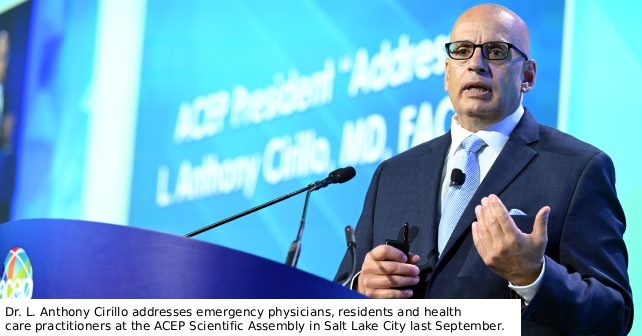
Dr. Cirillo: On the most fundamental part of that question, we put out a statement on Sunday [October 5, 2025]. Building on what the Vice President had said, Speaker [Mike] Johnson on “Face the Nation” doubled down a little bit but then backed off on that.
Explore This Issue
ACEP Now: November 2025We decided we needed to make a statement as a College, and the statement basically said we take care of people based upon how sick they are. We are committed to taking care of every patient, regardless of their immigration status, insurance status, or ability to pay. We took an oath to do that, and we will never waver from that oath. Our approach is, politics and reimbursement aside, for emergency physicians, our job is to take care of people, and that’s what we’re committed to.
From the perspective of H.R. 1, there’s really two major things that, honestly, will have an economic impact on the specialty. One is the increased requirements for maintaining Medicaid, including work requirements. People are going to lose coverage. Even the people who are entitled to have coverage are going to [lose it] because it will be administratively more difficult for them.
The Congressional Budget Office [has] estimated that about 10 million people are going to lose Medicaid coverage. The second part is the tax credits and the subsidies that allow people to maintain their coverage under the health exchanges that were created under the [Affordable Care Act] ACA. Similarly, it’s not just those with Medicaid coverage, but those people with access to full commercial insurance coverage, with their premiums getting subsidized through the ACA.
The estimate is that six million additional people are going to lose coverage.1 We have 350 million people in this country; having 16 million of them lose access to health insurance is not good. I know, and every emergency physician knows we can take care of people when they’re acutely ill and injured. But the follow-up for those is dependent upon them being in the system. Taking 16 million people out of the system doesn’t help.
When it comes to emergency department finances, when we treat people with Medicaid coverage, we get paid something. Now, in some states that something is pitiful. But in other states — and I’ll use Maryland as an example — we get 100 percent of Medicare. In that situation, it helps to sustain the practice model. People going from Medicaid to being uninsured means we will collect essentially almost nothing. In the balance of trying to run an EM group where you have basically commercially insured, Medicare insured, Medicaid insured, and the uninsured, the more we shift away from people who have any insurance, it just makes it harder to run a group — big, small, or everywhere in between.



No Responses to “Q&A with ACEP President L. Anthony Cirillo”