
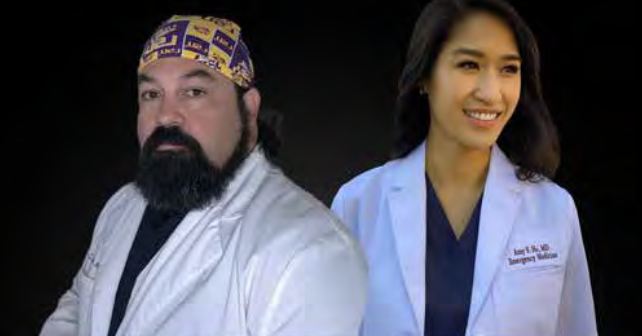
Dr. Amy Ho: In my current role in administration, it’s almost purely in data and analytics. We look at things like, what is the arrival-to-triage time? What is the arrival-to-room time? What is the disposition-to-departure time for discharge patients and also for admitted patients? So that has, in a lot of ways, allowed us go to our counterparts and say, “Hey guys, we’ve looked at the ICU patients admitted in the ED, what’s going on? Because your admit hold rates are four times what hospitalist medicine is!”
Explore This Issue
ACEP Now: Vol 42 – No 04 – April 2023Dr. Luke LeBas: The emergency department is more likely to not be stuck in a silo. We can speak surgeon, we can speak ICU, we can speak medicine. I do understand some of the difficulties these other specialties have, and I hope that they would also understand some of the difficulties that I have. Again, if everybody’s on the same page and everybody is equal within the conversation, I think that would be a great way to work toward improving the situation. But again, boarding is a hospital-wide, very complex issue, and expanding the ED, expanding the capabilities of the ED providers, I don’t think is a good answer to a problem that’s upstairs.
Dr. Amy Ho: Boarding is a problem that trickles down to us, right?
Dr. Luke LeBas: Yeah. I’m willing to work hard and I’m willing to bend over backwards, but I also want to see that other folks are doing the same. Prove to me that the hospital is trying to help out. One problem that we occasionally run into is there’s going to be one housekeeper for the entire facility on an overnight shift. Well, you expect me to turn over beds. I can’t do it unless I’m mopping floors and changing sheets myself.
Dr. Amy Ho: Sometimes the multiple internal waiting rooms feels a little bit like Disneyland. You wait in the line and you’re like, “Oh boy, I’m about there.” Then you turn the corner and you’re like, “Nope. Another internal waiting room, another turn.” From the perspective of the pit doc, not every hospital tries to address this solution administratively. What is there to do if you are at a facility where there isn’t an answer?
Dr. Luke LeBas: We’re constantly being told to do more, do it faster, do it quicker, do it with less. See 20 people in the waiting room with one nurse. And even if there is an emergency, your best nurse already has four ICU patients, two of which are intubated. I mean, we are revving the engine so fast, and at some point we’re going to break the engine. There needs to be help to unload the system.
Pages: 1 2 3 4 5 | Single Page


5 Responses to “Pros and Cons: Waiting Room Medicine”
April 16, 2023
John Patrick MD FACEPI was disappointed that there was very little said in the discussion about what is best for our patients
April 16, 2023
Mark Melrose, DO, FACEPDear Dr. Ho-
I come from a similar background as you- EM trained, spent most of my 35 year career in ED Director roles- academic, urban community, suburban community, public hospital, and founder/owner/operator of urgent care practices. I am now back in a purely clinical practice in an urban academic, tertiary care, well resourced specialty hospital. The issues you describe are indeed real world EM concerns, however there is one thing you stated as the basis for your value proposition on WR medicine that is so off base that I had to write this reply. “…But we also know that holding patients as collateral as a way to ransom the hospital into trying to come up with solutions isn’t part of the narrative we want to put out there.” FALSE!!! Patients are indeed held ransom daily by our ED’s, because they have nowhere else to go. In my urgent care practice, people would walk in, and turn right around and go somewhere else if the wait time was too long. It was money out of my pocket, so we made sure people didn’t wait. Our ED’s and ED patients will always be hostages as long as inpatient capacity is a slave to surgical revenue stream, and boarding is an ED problem, not a hospital-wide problem. If WR medicine was “best practice”, inpatient hallway medicine would be a thing, and private rooms would be doubled up, everywhere, everyday.
Yours truly,
Mark Melrose, DO, FACEP
April 16, 2023
GW MDLet’s be honest. This conversation is like the choice of only eating fast food and people arguing whether McDonalds or Burger King is better. Sure, you don’t want to starve. But how about not eating fast food at all.
What are the current interests and motivations of hospital leadership?
Let’s take an auto factory. Imagine one part of the factory has workers and processes with set hours.
In another part of the factory, you can run the workers into the ground, force them to build extra cars at all hours of the night, and they can’t say no.
Would you overwork that other part of the factory? Of course you would.
Want to fix this problem overnight?
1. Claw back the past 5 years of bonuses for the CEO, CNO, CFO, COO if there are more than 5 boarders 30 days of the year.
2. Not allow the CEO, CNO, CFO, COO to leave the hospital if there are any boarders in the ED.
3. Forced firing of all 4 of the above if there are more than 5 boarders 60 days of the year.
I guarantee you, the boarding problem would get fixed very very quickly.
But currently, the financial incentives are to maximize boarding. It’s a win-win for admin whatever they may say.
Elon Musk and Spacex are building self landing rockets. Boarding is just not that difficult. It hasn’t been fixed because the motivations are not to fix it.
And then it’s left to us to have these discussions of whether we should be taking care of patients with +trop’s, appendicitis, and sub arachnoids in the waiting room (yes, we had a SAH we were managing in the waiting room in the recent past).
April 23, 2023
Kevin C Meyer, MD, FACEPYou’re both saying the same thing, one glass half full and the other half empty.
I’ve done both clinical and admin over the years within different systems. Some systems are definitely more metric focused and do a better job than others.
Bottom line is that waiting room medicine (hallways too) is terrible for us and the patients. Fundamentally, hospital CEOs are convinced that a shift from inpatient to outpatient care is the future. I would argue that patients don’t know that. We are the center of the medical universe. Physicians in the outpatient setting cannot keep increasingly complicated patients from the ED, but actually encourage them to go if they are concerned.
We need to focus more staff and money on EDs, observation/respite units, and social workers. Make specialty ED in person consultations normal. Let telehealth and AI be the main stays of outpatient care.
We’re doing it wrong and those in charge are thinking about the future of medicine wrong.
January 12, 2024
N. Newman, MD“I think waiting room medicine, if you do it efficiently, shows our partners that we’re here doing our best.”
The fact that “waiting room medicine” is necessary demonstrates that the ED is not efficient and they system as a whole is functions poorly.