
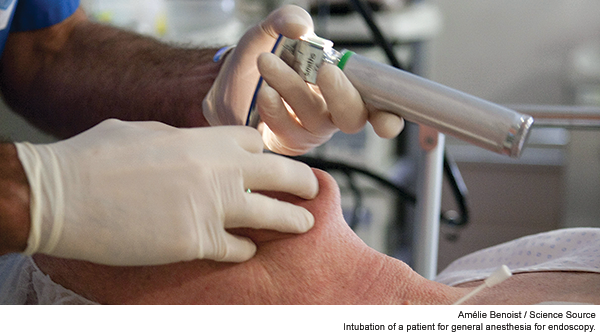
You are considering your next steps in management when you hear the BP cuff cycle…64/34…repeat…61/30…Heart rate now 40…now 0! You start CPR and resuscitation. Did you cause this? Was this inevitable? What happened?
Explore This Issue
ACEP Now: Vol 33 – No 05 – May 2014
The Case
A 65-year-old female presents to the emergency department in respiratory distress. As EMS wheels her into the resuscitation area, it is quite obvious that this patient is unlikely to maintain this effort for an extended period. Pulse ox shows an oxygen saturation of 85 percent on a non-rebreather. She is gasping for air as you place her on a trial of noninvasive ventilation. She is febrile, and a portable chest X-ray shows a large pneumonia as the likely source of infection. The patient’s O2 sat now reads 100 percent, but she is clearly tiring. As you are preparing to intubate, the blood pressure recycles, and a reading appears on the monitor: 89/50. Not wanting to wait for the nurse to hang fluids, you ask the nurse to push the standard doses of etomidate and succinylcholine and begin the intubation; the patient is intubated successfully. You are considering your next steps in management when you hear the BP cuff cycle…64/34…repeat…61/30…Heart rate now 40…now 0! You start CPR and resuscitation. Did you cause this? Was this inevitable? What happened?
Inevitable or Preventable?
Peri-intubation deaths are preventable with proper foresight and preparation. Three major sources of mortality during intubation and the peri-intubation period are related to oxygenation, pH status, and hemodynamic instability. With careful consideration of these factors, mortality can be reduced. In this case, failure to address the patient’s hemodynamic insufficiency likely led to her arrest. Hypotension during and after intubation has a multitude of causes, but studies have shown that the presence of hypotension is an independent predictor of in-hospital mortality and increased length of stay in the ICU. Patients who experienced hypotension after intubation had an in-hospital mortality rate of 33 percent versus 21 percent for patients who did not. In addition, hypotensive patients had an average stay in the ICU of 9.7 days versus 5.9 days for normotensive patients.
Set up to Fail
The very act of intubation causes a change in breathing dynamics that is deleterious to patients’ hemodynamic status. Switching from the negative-pressure ventilation of spontaneous-breathing patients to the positive-pressure ventilation (PPV) of paralyzed, intubated patients causes an instant decrease of venous return by increasing right atrial pressures. Decreased venous return leads to decreased preload, which is integral to maintaining hemodynamic stability in critically ill patients.
GO! GO! GO! STOP!!!!
That is the signal critically ill or distressed patients’ bodies are receiving during the intubation period. Most patients intubated in the emergency department are under physiologic stress. Whether for sepsis, fluid overload, respiratory failure, or a variety of other indications, most patients are stressed and working extremely hard to breathe prior to the intubation attempt. Catecholamines are surging throughout the cardiovascular system, augmenting arterial and venous vascular tone, stroke volume, heart rate, and ultimately cardiac output. When any induction agent is given, that sympathetic state is reversed, resulting in a decrease of endogenous catecholamines. This, in turn, removes the cardiovascular support they provide, reducing blood pressure. When combined with the increased right atrial pressure caused by PPV, patients are set up for hypotension—and possibly worse.
Too Hot, Too Cold…Just Right
While there is no perfect induction agent, some certainly have distinct advantages. Others have effects that clearly make them less desirable in patients who have the possibility of developing peri-intubation hypotension.
Propofol
Most providers would not consider propofol for inducing hypotensive or potentially hypotensive patients because of its justified reputation for causing hypotension. However, in some intensive care units, this may be the only agent immediately available. While not ideal, propofol can be used if dosed correctly in hemodynamically compromised patients. In hypovolemic hemodynamically unstable patients, the amount of propofol available to act on the brain is markedly increased. By reducing the propofol dose to 10 percent of its usual value, propofol can be used to induce hemodynamically unstable patients relatively safely while still maintaining the desired lack of awareness.
Etomidate
This is classically known as a cardiac stable medication. However, studies have shown that it can both drop blood pressure and heart rate, most likely due to the effects on endogenous catecholamines mentioned above. Conversely, a study of etomidate in hemodynamically unstable animals due to hemorrhage actually required the dose of etomidate to be increased to achieve adequate brain levels for lack of awareness.
Fentanyl and Midazolam
In shocked patients, these medications won’t take effect for three to five minutes. Even if hemodynamically stable doses of these medications are chosen, it is likely that, at the time of intubation, patients will have no induction effect from this combination.
Ketamine
This is my preferred agent. The much-bandied effect of ketamine to reduce cardiac output in patients who have been catecholamine dependent for long periods of time seems to be spurious and predicated on animal data with dose orders of a magnitude higher than those used in humans. I still recommend reducing the induction dose of ketamine in shocked patients. My preferred dose is 0.5 mg/kg in critically ill hypotensive patients. Ketamine can be used in traumatic brain injuries and patients with normo- or hypotension, but it should not be used in hypertensive brain or vascularly injured patients.
Pages: 1 2 3 | Single Page



One Response to “How To Prevent Peri-intubation Deaths with Careful Medication Choice”
May 24, 2014
jschaff112@gmail.comWhere is the mention of Rocuronium and Versed combo. I have used this or Vecuronium exclusively for many years without any incident. I have seen PLENTY of hypotension from Etomidate, the latest and greatest coming out of residency programs. And I routinely see the adrenergic state dissipate once the patient is paralyzed. A double whammy with Etomidate. I bet it is very useful for procedural sedation, just not for me.
And Sux is an old standard, but it has caveats in trauma and intracranial conditions where increased ICP occurs. Not my best choice again when the others are lacking in these adverse events and are just as useful or easy to use.