
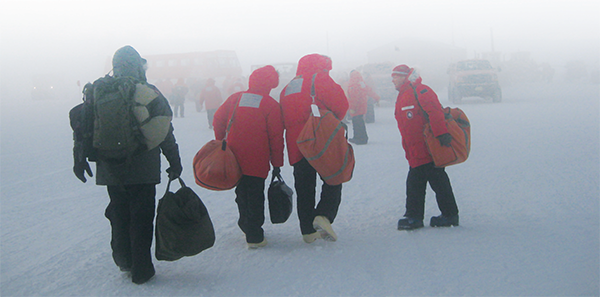
Antarctica is the Earth’s coldest, highest, and driest continent. You don’t believe that’s true? Antarctica’s average elevation is 8,200 feet (2500 m); its precipitation is as low as 0.8 inches (20 mm) per year; and the lowest temperature ever recorded on Earth, -128.6°F (-89.2°C), was at Russia’s Vostok Station in 1983.
Explore This Issue
ACEP Now: Vol 35 – No 02 – February 2016
Dr. Iserson and his luggage, ready to travel.
So how should I prepare to spend the next seven months on “The Ice,” as it is known? For simplicity, I divided it into clothing, personal necessities, work, and entertainment and electronics.
- Clothing: The program I’m traveling with provides the extreme cold weather (ECW) gear you need, including the massive hooded coat, “Big Red,” that you may have seen in any movie depicting the continent. It also issues a heavy black pair of wind-protective coveralls, gloves, heavy boots, and a neck gaiter. The last is possibly the most important piece of clothing since it protects the area between your balaclava (ski mask) and chest from any stray wind and blowing ice. Aside from normal indoor wear, I bring several pairs of medium- and heavyweight long underwear, my own heavy socks and gloves, jackets, sweatshirts, and various shirts for layering. For the cold, I also bring a ColdAvenger balaclava and face mask that I found to be lifesaving on my last sojourn on The Ice.
- Personal Necessities: Personal hygiene products and indoor shoes are a must. Also, so I found out, is a humidifier. Experience proves that, while I may not need a lot of cash, I’ll need a debit card that functions in the southernmost ATM machine in the world, located in McMurdo Station’s main building. Finally, since I’m in the Medicare age range, I have daily prescription medications, and that leads to the problem of New Zealand’s unusual customs regulations. They only permit travelers to carry three months’ worth of medications, so I had to get prescriptions for four additional months’ worth of medications and send them to myself at McMurdo. I also sent the humidifier and some other personal items ahead via US Mail (the only acceptable method) so that my luggage would meet the stringent weight restrictions for U.S. Air Force C-17 travel from Christchurch, New Zealand, to McMurdo. I hope they arrive!
- Work: Since the medical clinic is well-equipped, I only need my stethoscope, some penlights, and some electronic medical resources, including my book, Improvised Medicine: Providing Care in Extreme Environments, which proved to be very useful last time I was there.
- Entertainment and Electronics: Months of long nights mean that, in addition to community activities and other social gatherings, personal entertainment will be necessary, so I have gathered sufficient audiovisual media and electronic books to keep me happy. The one hitch is that, being a U.S. government facility run by the National Science Foundation and extremely concerned about both bandwidth limitations and security, there is no streaming, no Skype, and no WiFi using Android or Apple operating systems. My cellphone will be only for medical apps, and my Internet will be through my Windows 7 laptop. I will communicate to the world the “old-fashioned way,” via email and hardwired telephone.
Now that I’ve prepared to go, I will spend a couple of weeks at the University of Texas Medical Branch in Galveston, getting oriented to various aspects of the medical operation. Then it’s off to Christchurch to get on the C-17.

A selection of extreme cold weather gear issued to U.S. Antarctic Program participants.
Why New Zealand? While the tip of Antarctica’s peninsula (which we call “the Tropics” for its relatively balmy weather) is closest to South America’s tip at Cape Horn, the United States has only the small Palmer Station there. Those working there travel by ship through the Southern Ocean’s often brutal Drake Passage. Those of us working at the McMurdo (77°50’ S, 166°36’ E) and Amundsen-Scott South Pole (90° S, 0° W) stations don’t take that route. McMurdo Station, by far the largest of the three stations, is located directly south of New Zealand.
Christchurch is where the US Antarctic Program has its base of operations and, most important, distributes the ECW gear. A lesson learned last time: make very certain that every piece fits properly; you won’t have an opportunity to swap it out when you get there.
A lesson learned last time: make very certain that every piece fits properly; you won’t have an opportunity to swap it out when you get there.
Once in Christchurch, you arise every morning at about 4 a.m. to see if the weather has cleared sufficiently for the C-17 to attempt the five-hour trip. Often, you get up, get dressed, go into the lobby, and eventually discover that you should just go back to bed and wait another day. That, however, is far better than the experience that many folks have of almost getting to McMurdo or actually flying overhead and then having the plane return to Christchurch because the weather is too bad to land. This time we made it, and the winter adventure in Antarctica begins.
Dr. Iserson is professor emeritus of emergency medicine at The University of Arizona in Tucson.
Pages: 1 2 | Multi-Page


No Responses to “Prepping, Packing Among Challenges of Providing Medical Care in Antarctica”