Logo

Log In Sign Up |  An official publication of: American College of Emergency Physicians
Navigation
  • Home
  • Multimedia
    • Podcasts
    • Videos
  • Clinical
    • Airway Managment
    • Case Reports
    • Critical Care
    • Guidelines
    • Imaging & Ultrasound
    • Pain & Palliative Care
    • Pediatrics
    • Resuscitation
    • Trauma & Injury
  • Resource Centers
    • mTBI Resource Center
  • Career
    • Practice Management
      • Benchmarking
      • Reimbursement & Coding
      • Care Team
      • Legal
      • Operations
      • Quality & Safety
    • Awards
    • Certification
    • Compensation
    • Early Career
    • Education
    • Leadership
    • Profiles
    • Retirement
    • Work-Life Balance
  • Columns
    • ACEP4U
    • Airway
    • Benchmarking
    • Brief19
    • By the Numbers
    • Coding Wizard
    • EM Cases
    • End of the Rainbow
    • Equity Equation
    • FACEPs in the Crowd
    • Forensic Facts
    • From the College
    • Images in EM
    • Kids Korner
    • Medicolegal Mind
    • Opinion
      • Break Room
      • New Spin
      • Pro-Con
    • Pearls From EM Literature
    • Policy Rx
    • Practice Changers
    • Problem Solvers
    • Residency Spotlight
    • Resident Voice
    • Skeptics’ Guide to Emergency Medicine
    • Sound Advice
    • Special OPs
    • Toxicology Q&A
    • WorldTravelERs
  • Resources
    • ACEP.org
    • ACEP Knowledge Quiz
    • Issue Archives
    • CME Now
    • Annual Scientific Assembly
      • ACEP14
      • ACEP15
      • ACEP16
      • ACEP17
      • ACEP18
      • ACEP19
    • Annals of Emergency Medicine
    • JACEP Open
    • Emergency Medicine Foundation
  • About
    • Our Mission
    • Medical Editor in Chief
    • Editorial Advisory Board
    • Awards
    • Authors
    • Article Submission
    • Contact Us
    • Advertise
    • Subscribe
    • Privacy Policy
    • Copyright Information

Pre-COVID ED Trends Suggest More Challenges Lie Ahead

By James J. Augustine, MD, FACEP | on November 18, 2020 | 0 Comment
Benchmarking
  • Tweet
  • Click to email a link to a friend (Opens in new window) Email
Print-Friendly Version
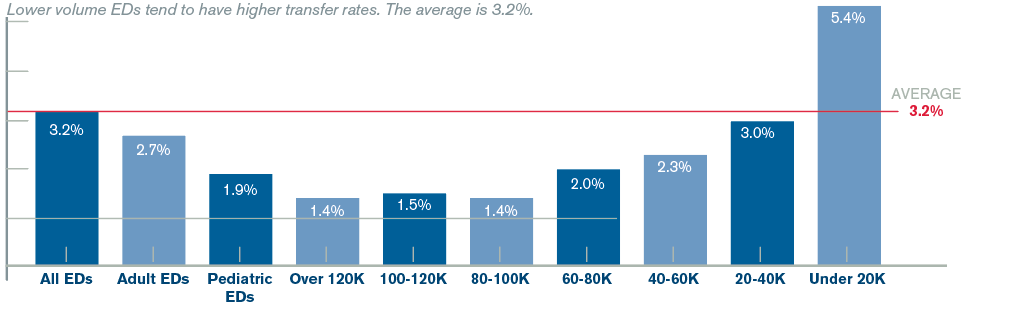
Figure 2. ED transfer % by cohort

You Might Also Like
  • Emergency Department Usage Trends Before COVID-19
  • Latest Data Reveal the ED’s Role as Hospital Admission Gatekeeper
  • 2015 Emergency Department Survey Shows Spike in Volume, Structural Changes, Patient Boarding Concerns
Explore This Issue
ACEP Now: Vol 39 – No 11 – November 2020

(click for larger image) Figure 2. ED transfer % by cohort

These numbers are primarily driven by smaller hospitals, but all types of emergency departments are trending toward more patient transfers. Of note, these data do not include freestanding emergency departments, which can place additional burdens on the transfer resources of hospitals and hospital systems.

3) The percentage of patients admitted from the emergency department to the hospital has rapidly increased.

About 67 percent of hospital admissions are processed through the emergency department. These admissions include patients seen in the emergency department and then placed in any inpatient area of the hospital, either as “full admission” or “observation status.” High-volume and adult-serving emergency departments tend to have high admission rates.

The average has increased from prior years to 22 percent (see Figure 3).

Figure 3. Percent of ED patients admitted

(click for larger image) Figure 3. Percent of ED patients admitted

4) Patients who require ED boarding challenge ED operations.

Boarding time is an important contributor to overall patient processing, and it has remained stubbornly high, an annual average of about 115 minutes between 2012 and 2019.

ED boarding, time from decision-to-admit until the patient physically leaves the emergency department, remains a burden on ED performance. It accounts for about 38 percent of the time admitted patients spend in the emergency department. This time interval has been part of each hospital’s required data submission to the Centers for Medicare & Medicaid Services since 2013, and results are posted on the Hospital Compare website (www.medicare.gov/hospitalcompare). It was hoped that public posting of boarding would motivate hospital administrators to improve this metric. Unfortunately, despite the work of many ED and hospital leaders to reduce boarding time, the data for 2019 list the average interval at 118 minutes.

The EDBA Performance Measures Summits have been used to unify the definitions used across the industry, and that process has been used to accurately define boarding time and the burden on the emergency department of admitted patients. There is ongoing work to identify hospitals that have reduced boarding time by making ED patient flow more efficient.

Prioritizing ED Management Challenges

The need for emergency physicians has dramatically increased due to patient needs and medical system challenges fueled by the COVID-19 pandemic. However, the advent of telemedicine programs has provided another ready source of care for patients with low-acuity, unscheduled care needs; those patients will largely disappear from the ED population for the foreseeable future.

Emergency physician leaders must appreciate trends present through 2019 and work collaboratively with hospital leaders to serve a changing emergency population in 2021 and beyond. The need to move admitted patients up to the inpatient units is a particularly important management priority.

The EDBA Summits have provided a dedicated group of federal, regional, and emergency leaders the opportunity to develop reasonable standards and performance measures for the industry. The definitions published after the 2018 summit have recently been published, and they provide guidance to ED leaders who are developing data management processes that improve performance.1

Pages: 1 2 3 | Single Page

Topics: COVID-19DataEDBAPerformance

Related

  • ACEP Member Uses ED, Military Training To Set Standards at FEMA

    August 11, 2025 - 0 Comment
  • Dr. Joe Sachs and “The Pitt” Redefine Public Health Education Through Storytelling

    July 3, 2025 - 0 Comment
  • Dr. Joe Sachs and “The Pitt” Are Redefining Public Health Education Through Storytelling

    June 11, 2025 - 0 Comment

Current Issue

ACEP Now: November 2025

Download PDF

Read More

About the Author

James J. Augustine, MD, FACEP

James J. Augustine, MD, FACEP, is national director of prehospital strategy for US Acute Care Solutions in Canton, Ohio; clinical professor of emergency medicine at Wright State University in Dayton, Ohio; and vice president of the Emergency Department Benchmarking Alliance.

View this author's posts »

No Responses to “Pre-COVID ED Trends Suggest More Challenges Lie Ahead”

Leave a Reply Cancel Reply

Your email address will not be published. Required fields are marked *


*
*


Wiley
  • Home
  • About Us
  • Contact Us
  • Privacy
  • Terms of Use
  • Advertise
  • Cookie Preferences
Copyright © 2025 by John Wiley & Sons, Inc. All rights reserved, including rights for text and data mining and training of artificial technologies or similar technologies. ISSN 2333-2603
