
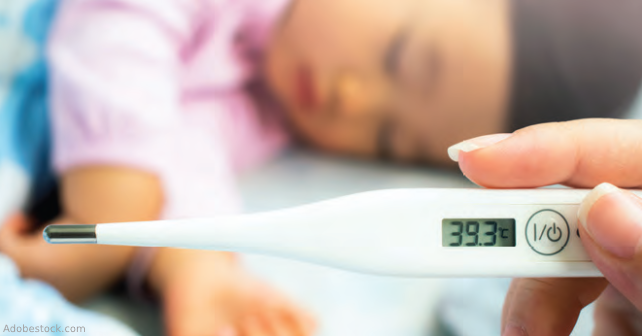
The best questions often stem from the inquisitive learner. As educators, we love—and are always humbled by—those moments when we get to say, “I don’t know.” For some of these questions, you may already know the answers. For others, you may never have thought to ask the question. For all, questions, comments, concerns, and critiques are encouraged. Welcome to the Kids Korner.
Explore This Issue
ACEP Now: Vol 42 – No 05 – May 2023Question: Does the height of the fever in children predict the likelihood of serious or invasive bacterial illness?
The first Haemophilus Influenza B (Hib) conjugated vaccine was licensed for use in the U.S. in the late 1980s and the first conjugated vaccine for Streptococcus pneumonia (Pneumococcus) was licensed in 2000. Prior to the incorporation of these routine immunizations, the height of fever in infants appeared to be proportionate to the likelihood of bacterial illness.1,2 But, is this still true now that we routinely immunize against these common invasive pathogens? Does it matter if a child has a fever greater than 39 degrees Celsius (102.2 degrees Fahrenheit) or greater than 40 degrees Celsius (104 degrees Fahrenheit)? The American Academy of Pediatrics recently published a clinical practice guideline for well-appearing febrile infants less than 60 days of age and risk-stratified these infants for bacterial illness using serum and urine labs.3 This discussion focuses on children who are over 60 days of age.
A 2006 prospective observational study in the post-pneumococcal vaccine era—meaning after both the Hib and Pneumococcus vaccines—evaluated 429 infants ages 57–180 days old (two to six months of age).4 Overall, 44 infants (10.3 percent) were positive for serious bacterial illness (SBI), which included 41 with positive bacterial urine cultures and four with positive blood cultures. One child had both urine and blood cultures positive. Cerebrospinal fluid was obtained from 58 infants and there were zero cases of bacterial meningitis. Respiratory screening tests were performed on 413 of the 429 infants and were positive in 163 cases (39.5 percent). There were five cases of viral meningitis. Height of fever comparing SBI and non-SBI groups was not significantly different (P=0.18).
A 2006 cross-sectional observational study evaluated 103 children less than 18 years of age over a two-year period who presented with “hyperpyrexia.”5 Hyperpyrexia was defined as greater than or equal to 106 degrees Fahrenheit (41.1 degrees Celsius). Complete blood count, blood culture, and viral respiratory culture were obtained on each patient. Additional lab work and imaging was at the discretion of the attending physician. Of these 103 children, 20 (18.4 percent) had a culture-proven SBI, including urine, blood, and CSF. Twenty-two (21.4 percent) had a positive viral culture. Temperature itself was not predictive of either a bacterial or viral illness. Of note, though, this study did not evaluate and compare children with temperatures less than 41.1 degrees Celsius versus greater than or equal to 41.1 degrees Celsius, therefore it cannot address whether hyperpyrexia was associated with a higher prevalence of bacterial illness.
The study that currently best answers this clinical question is a 2015 prospective observational study that evaluated 15,781 children less than five years old and identified 1,120 (7.1 percent) SBIs.6 The authors noted the maximum axillary temperature at presentation and the maximum temperature (any location) reported by family within the previous 24 hours. SBI included bacteremia, urinary tract infection, pneumonia, osteomyelitis, meningitis, and septic arthritis. 42 percent of children had a fever greater than or equal to 39 degrees Celsius (102.2 degrees Fahrenheit) at presentation or reported by family. Overall, SBIs were present in 3.6 percent of children with a fever greater than or equal to 39 degrees Celsius and duration of illness less than or equal to 24 hours, while the prevalence of SBI in children with fever greater than or equal to 39 degrees Celsius and illness duration greater than 96 hours was 20 percent. Duration of fever, rather than height of fever, appeared to play a role. The authors do mention that 45 of 137 (32.8 percent) children less than six months of age with a fever greater than or equal to 39 degrees Celsius had an SBI, but using a cut-off of 39 degrees Celsius missed 82 percent of cases of SBI in this same age group. The authors conclude that “temperature is an inaccurate marker of serious bacterial infection in children presenting to the emergency department with fever and reliance on magnitude of fever to guide further evaluation will result in misclassification of both serious bacterial infections and self-limiting illnesses.”
A 2018 systematic review and meta-analysis attempted to evaluate specifically this clinical question, but included studies that were both pre- and post-pneumococcal-vaccine time periods.7 The results were heterogenous and don’t apply to our current pediatric population in the post-pneumococcal-vaccine era.
Summary
In the post-pneumococcal vaccine era, the height of a child’s fever does not definitively predict a serious bacterial infection. While higher fevers do appear to have a higher association with bacterial illness, the actual temperature does not seem to predict whether a child has a bacterial versus a viral infection.
 Dr. Jones is assistant professor of pediatric emergency medicine at the University of Kentucky in Lexington.
 Dr. Cantor is professor of emergency medicine and pediatrics, director of the pediatric emergency department, and medical director of the Central New York Regional Poison Control Center at Upstate Medical University in Syracuse, New York.
References
- Bonadio WA, McElroy K, Jacoby PL, et al. Relationship of fever magnitude to rate of serious bacterial infections in infants aged 4-8 weeks. Clin Pediatr (Phila). 1991;30(8):478-80.
- Bonadio WA, Smith DS, Sabnis S. The clinical characteristics and infectious outcomes of febrile infants aged 8 to 12 weeks. Clin Pediatr (Phila). 1994;33(2):95-9.
- Pantell RH, Roberts KB, Adams WG, et al. Evaluation and management of well-appearing febrile infants 8 to 60 days old. Pediatrics. 2021;148(2):e2021052228.
- Hsiao AL, Chen L, Baker MD. Incidence and predictors of serious bacterial infections among 57- to 180-day-old infants. Pediatrics. 2006;117(5):1695-701.
- Trautner BW, Caviness AC, Gerlacher GR, et al. Prospective evaluation of the risk of serious bacterial infection in children who present to the emergency department with hyperpyrexia (temperature of 106 degrees F or higher). Pediatrics. 2006;118(1):34-40.
- De S, Williams GJ, Teixeira-Pinto A, et al. Lack of accuracy of body temperature for detecting serious bacterial infection in febrile episodes. Pediatr Infect Dis J. 2015;34(9):940-4.
- Rosenfelt-Yehoshua N, Barkan S, Abu-Kishk I, Booch M, Suhami R, Kozer E. Hyperpyrexia and high fever as a predictor for serious bacterial infection (SBI) in children—a systematic review. Eur J Pediatr. 2018;177(3):337-344.
Pages: 1 2 3 | Multi-Page



No Responses to “Pediatric Fever and Illness Correlations”