
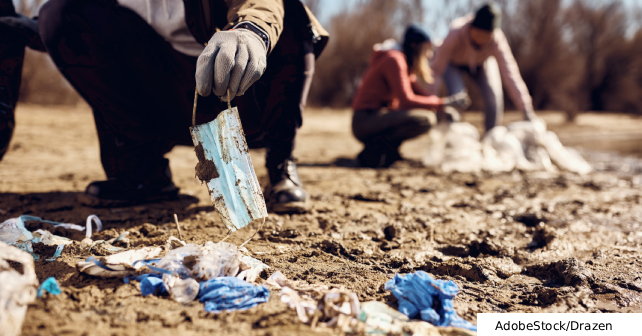
Health care has grown dependent on plastic. Plastic is involved in virtually every patient interaction, yet we don’t give it a second thought. Now science is starting to reveal the massive downstream health effects of plastic. It’s time that we considered our use of this ubiquitous material and whether we are causing harm to our communities by using it.
Explore This Issue
ACEP Now: December 2025 (Digital)The Healthcare Plastic Recycling Council has reported that the U.S. health care system disposes of approximately 14,000 tons of waste per day, 25 percent of which is plastic, which means that we toss out some seven million pounds of plastic each day.1 Waste audits in the emergency departments (EDs) of Kent Hospital in Warwick, Rhode Island, and Mass General Hospital in Boston found that four pounds of waste is generated per patient, per encounter, and about 60 percent of the waste is plastic.2
Health care waste contributes to approximately nine percent of our nation’s greenhouse gas emissions (GHGs).3 Our nation’s GHG emissions account for 27 percent of the global health care emissions despite our nation’s EDs serving just four percent of the world’s population.4 Seventy percent of health care GHGs calculation comes from things that we purchase, use, and get rid of (versus energy for infrastructure and transportation).4 Medical plastic is largely to blame. To reduce our carbon footprint, we have to look at reducing our plastic footprint.
Scientists are increasingly alarmed that we have reached a crisis point with plastic — a crisis that overlaps with the climate crisis because plastic is derived from fossil fuels and petrochemicals. The plastics industry is on track to triple plastic production, surpassing coal GHG emissions, as they sell us a world of convenience where everything is wrapped in plastic.5 In health care, gloves are our most common single-use piece of plastic. Studies have shown that we use them unnecessarily about 60 percent of the time.6
We have all thought that recycling is the answer, but in the US, only about 5 percent of plastic is recycled.7 The rest goes into landfill, becomes litter, or is incinerated like our red-bag waste, which spews toxins into the air. Plastic doesn’t break down; it just breaks up. Your single-use plastic laceration tray will still be around in some form in hundreds or even thousands of years. Plastics have been found everywhere on Earth, and scientists have found microplastics and nanoplastics in every organ of the human body. It’s in the brain, liver, gut, reproductive organs, blood vessels, lungs, kidneys, prostate, and joints. It’s in breastmilk, the placenta, and in meconium.8 Human beings are now partially plastic.
Many of these microplastics and nanoplastics are known to be carcinogens, neurotoxins, and endocrine disruptors. They are likely to increase cancer and cardiac disease. A steady stream of research finds correlations between plastic pollution in our bodies and increased cancer risks, asthma, diabetes, obesity, autism and other neurodevelopmental disorders, infertility, heart disease, and increased pregnancy risks.8-9 All of this is multifactorial, with highly processed foods on the rise at the same time, but we have more than enough information to act. In public health, we use the precautionary principle all the time, avoiding therapies that have potential harm. How can we do that in medicine without changing our quality of care?
Clearly there are plastic items that we need for patient care like an endotracheal tube or an IV. But are there areas in which we can reduce our use of plastic, switch back to reusables, or adapt to a more sustainable material? What is unnecessary? The low-hanging fruit: plastic pill and water cups, disposable blood pressure cuffs, plastic utensils, and Styrofoam food trays. Use PO medications when as effective as IV. Chewable tabs for kids over age two instead of a syringe with liquid?
What about just better plastic? A large quantity of IV fluids is made with the chemical DEHP, or phthalate.10,11 This chemical has been linked with all sorts of problems, including an increase in testicular cancer, hypertension in the neonate, premature birth, obesity, and more.12, 13,14 Yet we are dripping this into our patients. There are IV bags without phthalates. Find out what you were using and demand it be switched.
Take a look around on your next shift. Where can you reduce the use of plastic? If we consider our plastic footprint with everything we are doing, we can adjust our habits to give our patients and our world healthier care. Please consider it.
Dr. Bridget Lee has been an emergency physician in community hospitals for her career. She is now increasing her focus on sustainability in medicine, and lectures on plastic in health care, the toxicity of plastic, and why health care practitioners need to be leaders in reducing the use of plastic.
References
- Healthcare Plastics Recycling Council. Hospital Waste Characterization. https://www.hprc.org/resources/hospital-waste-characterization/.
- Hsu S, Thiel CL, Mello MJ, et al. Dumpster Diving in the Emergency Department. West J Emerg Med. 2020; 21(5): 1211-1217.
- Seervai S, Gustafsson L, Abrams MK. How the U.S. Health Care System Contributes to Climate Change. The Commonwealth Fund. April 19, 2022. https://www.commonwealthfund.org/publications/explainer/2022/apr/how-us-health-care-system-contributes-climate-change.
- Health Care Without Harm and Arup. Health Care’s Climate Footprint: How the Health Sector Contributes to the Global Climate Crisis and Opportunities for Action. https://global.noharm.org/resources/health-care-climate-footprint-report. September 2019.
- The Environmental and Energy Study Institute. The Climate Consequences of Plastics. Briefing Series: Reduce and Reuse: How to Cut Greenhouse Gas Emissions of Building Materials, Plastics, and Food. https://www.eesi.org/briefings/view/120921waste. December 9, 2021.
- Lalakea ML, Noel JE, Meiklejohn DA. Reducing Glove Overuse in Outpatient Specialty Clinics: Cost Reduction and Environmental Benefit. OTO Open. Published March 27, 2025.
- The Last Beach Cleanup and Beyond Plastics. The Real Truth About the U.S. Plastics Recylcling Rate. Published May 2022.
- Landrigan PJ, Dunlop S, Treskova M, et al. Countdown on Health and Plastics. The Lancet. 2025; 406(10507):1044-1062.
- Landrigan PJ, Raps H, Cropper M, et al. The Minderoo–Monaco Commission on Plastics and Human Health. Ann Glob Health. https://annalsofglobalhealth.org/articles/10.5334/aogh.4056. First published March 21, 2023.
- Tickner JA, Schettler T, Guidotti T, McCally M, Rossi M. Health risks posed by use of Di-2-ethylhexyl phthalate (DEHP) in PVC medical devices: a critical review. Am J Ind Med. 2001;39(1):100-111.
- Getting Harmful Chemicals Out of IV Bags and Tubing: New Report Released by Breast Cancer Prevention Partners. Breast Cancer Prevention Partners. Published August 15, 2024.
- Jenkins R, Farnbach K, Iragorri S. Elimination of Intravenous Di-2-Ethylhexyl Phthalate Exposure Abrogates Most Neonatal Hypertension in Premature Infants with Bronchopulmonary Dysplasia. Toxics. 2021;9(4):75.
- Lucaccioni L, Trevisani V, Passini E, et al. Perinatal Exposure to Phthalates: From Endocrine to Neurodevelopment Effects. Int J Mol Sci. 2021;22(8):4063.
- Bräuner EV, Lim YH, Koch T, et al. Endocrine Disrupting Chemicals and Risk of Testicular Cancer: A Systematic Review and Meta-analysis. J Clin Endocrinol Metab. 2021; 106(12):e4834-e4860.
Pages: 1 2 3 | Multi-Page


2 Responses to “Opinion: Physicians Must Reduce Plastic Waste”
December 10, 2025
Michaela NielsenThank you for this article – it is so very relevant. There are countless opportunities to reduce plastic packaging and waste in the healthcare system, and it is time for everybody working there to consciously address the issue.
December 10, 2025
Usha PillaiI did some work on healthcare sustainability some time back. There are a couple of resources I would recommend that go about it systematically. They are both from UK since they are far ahead in terms of reducing carbon footprint than sadly we in the US are:
Center for Sustainable Healthcare (https://sustainablehealthcare.org.uk/)
UK Health Alliance on Climate Change (https://ukhealthalliance.org/sustainable-healthcare/green-surgery-report/)